Some lessons feel like walking through thick mud.
You read the paragraph. You nod. You tell yourself, “Yes, I understand.” Then five minutes later, your brain acts like the information packed its bags and left.
That is where quiz questions can help.
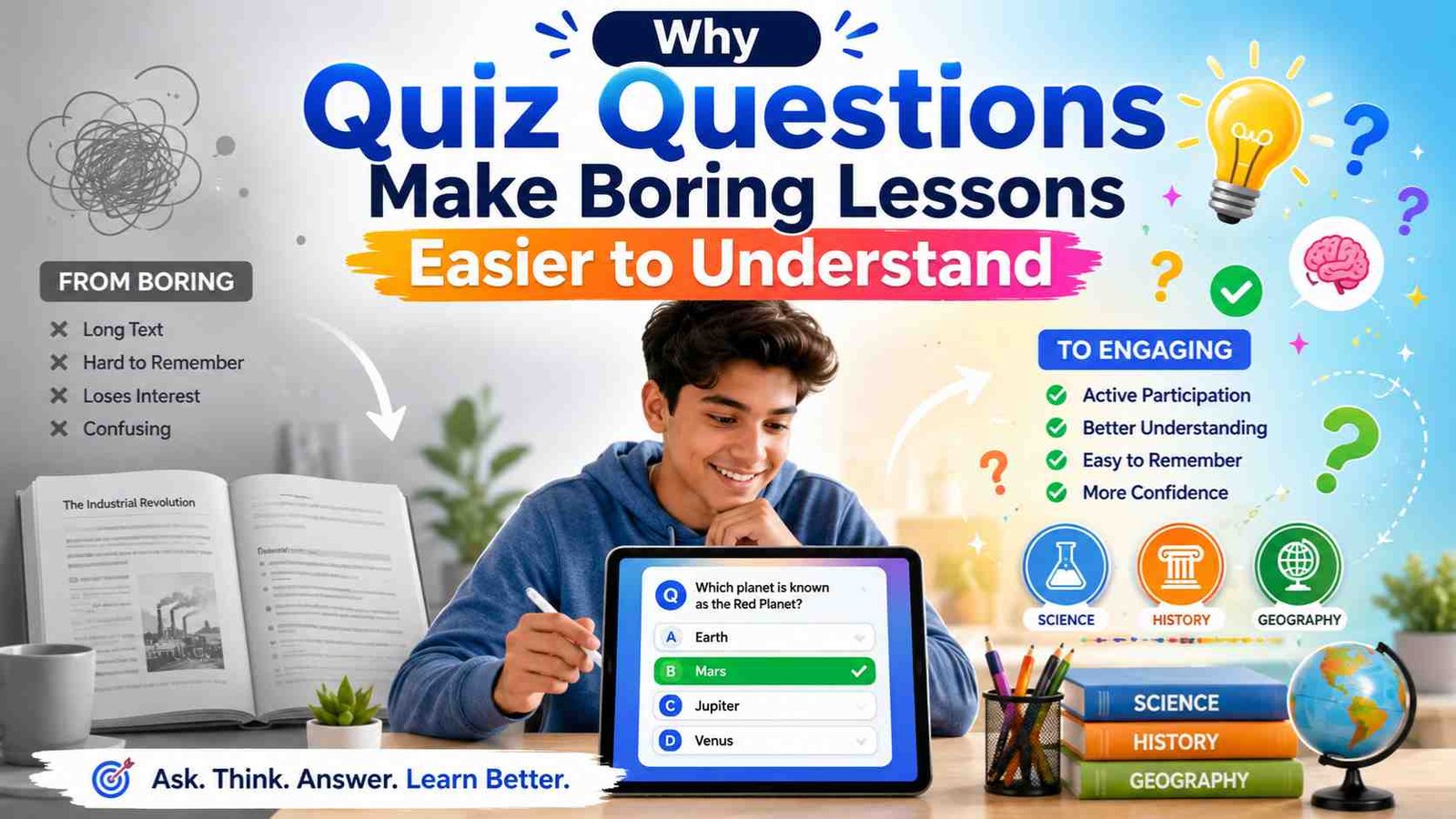
Quiz questions are not only for testing what you know. They can also make boring lessons clearer, lighter, and easier to remember. A good question gives your brain something specific to look for. Instead of staring at a long explanation, you begin hunting for an answer.
And once your brain starts hunting, the lesson becomes less boring.
Why Boring Lessons Feel Hard to Understand
Not all boring lessons are difficult. Sometimes they only feel difficult because they are presented in a flat way.
A long block of text can make even a simple topic feel heavy. Your brain has to decide what matters, what to ignore, and what to remember. That is a lot of work.
For example, imagine reading a lesson about photosynthesis. If the lesson begins with many terms like chlorophyll, carbon dioxide, glucose, and light energy, your brain may quickly lose interest.
But ask this instead:
What do plants use sunlight for?
Now the topic has a target.
That one question turns a dull explanation into something your brain can follow.
Quiz Questions Give the Brain a Clear Job
The brain likes tasks.
When you see a quiz question, your brain immediately starts searching. It scans memory. It looks for clues. It compares choices. It tries to solve the small problem in front of it.
That is why quiz learning works so well. It changes the learner from a passive reader into an active thinker.
Instead of simply reading:
“Evaporation happens when liquid water changes into water vapor.”
A quiz question asks:
What is it called when liquid water changes into vapor?
Now you are not just reading the fact. You are using it.
That tiny difference matters.
Quiz Questions Break Big Lessons Into Small Pieces
One reason boring lessons feel overwhelming is that they often contain too much information at once.
Quiz questions break the lesson into smaller bites.
Instead of learning an entire chapter in one sitting, you answer one question at a time:
- What is the main idea?
- What term matches this definition?
- What happened first?
- Why did this event matter?
- Which example shows the concept best?
Each question gives your brain a small checkpoint.
This is especially helpful for subjects like history, science, geography, grammar, and general knowledge. These topics can feel dry when they are only explained, but they become easier when turned into small challenges.
Questions Make You Notice What Matters
A boring lesson often becomes confusing because everything looks equally important.
Quiz questions help separate the main idea from the extra details.
For example, a lesson about volcanoes may mention magma, lava, pressure, tectonic plates, ash clouds, and eruptions. That is a lot.
But a quiz question like this helps:
What is magma called after it reaches Earth’s surface?
Answer: Lava
Now one important detail becomes clear.
Good educational quizzes do not just ask random facts. They guide your attention. They show you what you should remember.
Quiz Questions Wake Up Curiosity
Curiosity is a powerful learning tool.
A boring lesson says, “Here is the information.”
A quiz question says, “Can you figure this out?”
That small challenge can make learning feel more personal.
For example:
Which country has more time zones than any other country?
Even if you do not know the answer, you may feel curious. You may guess. You may want to check. That little spark makes the fact easier to remember later.
This is why online quizzes and daily quizzes can be useful for building general knowledge. They turn learning into a small discovery process instead of a long lecture.
Answer Choices Make Hard Topics Less Scary
Multiple-choice questions can help learners feel less overwhelmed.
A blank page can be scary. But answer choices give clues. They help you compare ideas and remove wrong options.
For example:
Which organ pumps blood around the body?
A. Lungs
B. Heart
C. Stomach
Even if a student is unsure, the choices guide their thinking.
This does not mean guessing is the goal. The real value comes from thinking through the options.
Why is it not the lungs?
Why is it not the stomach?
Why is the heart correct?
That process builds understanding.
Quiz Questions Help Memory Improvement
Memory improves when the brain practices pulling information back out.
Reading a fact once is not enough for most people. The brain needs retrieval. That means trying to remember the answer without immediately looking at it.
Quiz questions naturally create this moment.
When you answer a question, your brain does a small workout. It reaches for the information. The more often you retrieve a fact, the stronger that memory becomes.
This is why a five-question review after a lesson can be more useful than rereading the same paragraph three times.
Rereading feels comfortable. Quizzing feels active.
Active usually wins.
Boring Lessons Become Easier When You Turn Them Into Questions
Here is a simple trick:
When a lesson feels boring, turn each section into a question.
For example, if the lesson says:
“The water cycle includes evaporation, condensation, precipitation, and collection.”
Turn it into:
- What are the main steps of the water cycle?
- What happens during evaporation?
- What is condensation?
- What causes precipitation?
- Where does water collect after rain falls?
Now the lesson has structure.
You are no longer staring at a paragraph. You are solving small learning tasks.
Quiz Questions Make Mistakes Useful
Nobody loves getting an answer wrong. But wrong answers can be very helpful when the explanation is clear.
A mistake shows you exactly where your understanding is weak.
For example, if you answer that the sun is a planet, the correction is simple:
The sun is a star because it produces its own light and heat.
That short explanation fixes the misunderstanding.
This is why answer explanations matter in quiz learning. The score tells you what happened. The explanation tells you what to learn next.
How Quiz Websites Can Make Lessons More Useful
A quiz website can do more than entertain visitors.
It can help people learn without making them feel like they are studying for a difficult exam.
The best quiz pages often include:
✅ Short questions
✅ Clear answer choices
✅ Simple explanations
✅ Mixed topics
✅ Daily practice
✅ A balance of easy and challenging questions
This makes learning feel light, but still valuable.
A visitor may arrive just to answer a few fun questions. But along the way, they can pick up new facts about science, history, animals, geography, language, and everyday life.
That is the sweet spot.
Learning without the heavy backpack.
Practical Tips for Learning With Quiz Questions
1. Read the question before the lesson
Before studying a topic, look at a few quiz questions first. This gives your brain a reason to pay attention.
2. Guess before checking the answer
Even if you are unsure, make a guess. The effort helps your brain engage with the topic.
3. Always read the explanation
Do not stop at “correct” or “wrong.” The explanation is where the real learning happens.
4. Repeat missed questions later
Questions you got wrong are not failures. They are your best review list.
5. Use daily quizzes for small learning habits
A short daily quiz can help build general knowledge over time. You do not need one long study session. A few good questions a day can add up.
Why This Works for General Knowledge
General knowledge grows best through small, repeated exposure.
You may not remember a long article about world capitals, famous scientists, or historical events in one sitting. But if you meet those facts again and again through quiz questions, they become familiar.
That familiarity matters.
One question teaches a fact.
A second question strengthens it.
A third question makes it easier to recall.
This is how boring facts slowly become useful knowledge.
Quiz Questions Are Not a Replacement for Full Lessons
Quiz questions are powerful, but they work best when paired with good explanations.
A quiz can introduce a fact, test understanding, or review a lesson. But deeper topics still need examples, context, and discussion.
Think of quiz questions as doorways.
They help you enter the lesson. They make the first step easier. After that, the explanation helps you understand the bigger picture.
FAQs
1. Why do quiz questions make boring lessons easier?
Quiz questions give your brain a clear target. Instead of reading passively, you actively search for an answer, which makes the lesson easier to follow and remember.
2. Are educational quizzes good for memory improvement?
Yes. Educational quizzes help memory by making you recall information. This retrieval practice strengthens your ability to remember facts later.
3. Can online quizzes help with general knowledge?
Yes. Online quizzes can help build general knowledge by exposing you to different topics in a simple and engaging way. Daily quizzes are especially useful because they create a small learning habit.
4. What makes a quiz question useful for learning?
A useful quiz question is clear, focused, and followed by a simple explanation. It should help you understand the topic, not just test whether you memorized a random fact.
Final Thoughts
Boring lessons become easier when the brain has something to do.
That is the real power of quiz questions. They turn flat information into small challenges. They help you notice what matters, remember key facts, and stay curious long enough to learn.
A lesson may feel dull at first. But one good question can open it up.
And sometimes, that is all your brain needs: a simple question, a clear answer, and a reason to care.
Author

Sandy turns complex topics into concise, readable pieces. She built strong research and source-checking habits while helping archive community history projects. She’s exploring future study in the humanities (the University of Oxford is on her shortlist; no current affiliation). Her work is original, clearly cited, and updated when corrections are needed. Offline, she organizes neighborhood book swaps and sketches city scenes.