Rushing to answer feels productive. It gives the mind a little spark of speed, confidence, and momentum. In quizzes, classroom discussions, online lessons, or everyday conversations, a fast reply can make us feel sharp.
But fast is not always thoughtful.
Sometimes the first answer is only the loudest one, not the clearest one. It comes from habit, guessing, memory fragments, or the pressure to respond before someone else does. That kind of answer may be correct now and then, but it often leaves learning shallow. The brain reacts before it fully understands.
The slow answer works differently. It gives learning a small space to breathe.
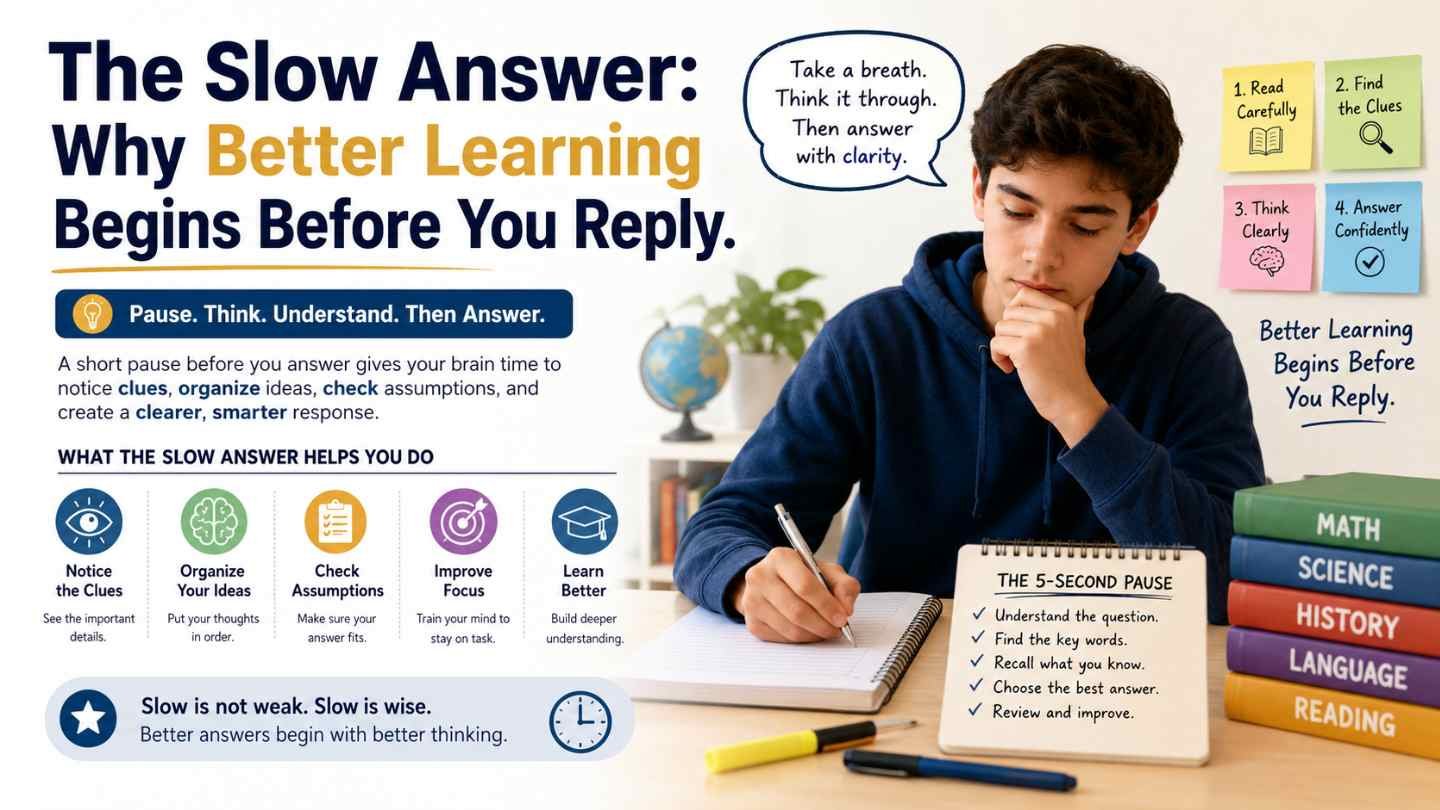
A pause before replying can help you notice the wording of a question, connect clues, organize your thoughts, and check whether your first idea actually makes sense. It is not about being slow because you do not know the answer. It is about thinking well before you give one.
What Is “The Slow Answer”?
The Slow Answer is the practice of pausing briefly before responding so your mind can process the question more deeply.
It does not mean waiting forever. It does not mean overthinking every tiny detail. It simply means giving yourself a short moment to ask, “What is really being asked here?”
That moment matters.
A slow answer might take three seconds during a conversation, ten seconds during a quiz, or one quiet minute during self-study. The goal is not delay. The goal is clarity.
Instead of jumping straight to a reply, you give your brain time to do four useful things:
Notice the Question
Many wrong answers begin with misreading. A learner sees one familiar word and assumes the rest.
For example, a history question might ask, “What caused tension before the war?” but the learner answers with something that happened after the war. The information may be related, but it misses the direction of the question.
A slow answer starts by reading or listening carefully.
Gather the Clues
Most questions contain hints. Dates, keywords, verbs, examples, and comparisons can point you toward the answer.
In a quiz, words like “main reason,” “best example,” “first,” “not,” or “most likely” can completely change what the question is asking. In reading, a repeated phrase can reveal the author’s main idea. In math, the unit of measurement can tell you what operation may be needed.
The slow answer gives you time to see those clues before reacting.
Organize the Idea
A rushed answer often comes out messy because the idea has not formed yet.
A slow answer gives you a moment to arrange your response. You can move from scattered thoughts to a simple structure: point, reason, example.
That small structure makes your answer easier to remember, easier to explain, and easier for others to follow.
Check the Assumption
The first thought is not always wrong, but it deserves a quick inspection.
Ask yourself: “Am I answering the question, or am I answering what I expected the question to be?”
This is especially useful in multiple-choice quizzes, reading comprehension, science problems, and everyday discussions where one small assumption can lead you in the wrong direction.
Why Pausing Before Answering Improves Learning
A pause may look quiet from the outside, but inside the mind, useful work is happening.
It Strengthens Focus
When you pause, you interrupt the habit of reacting automatically. That gives your attention a chance to settle on the actual task.
This is helpful for learners who often say, “I knew the answer, but I rushed.” In many cases, the problem is not a lack of knowledge. It is a lack of attention at the exact moment the answer is needed.
A slow answer trains the mind to stay with the question a little longer.
It Improves Memory
Memory becomes stronger when you retrieve information carefully instead of grabbing the first familiar idea.
For example, if someone asks for the capital of a country, you might know the answer quickly. But if the question asks why that city became important, you need more than recall. You need connection.
Pausing helps the brain search beyond surface memory. It looks for relationships, examples, and context. That deeper retrieval can make the lesson stick better.
It Builds Understanding
Understanding grows when learners notice why an answer is true, not just what the answer is.
A student might memorize that plants need sunlight for photosynthesis. But a slow answer invites a fuller thought: sunlight helps plants make food using carbon dioxide and water.
That extra layer turns a memorized fact into usable knowledge.
It Reduces Careless Mistakes
Many mistakes are not caused by not knowing. They are caused by answering too soon.
In math, rushing can lead to using the wrong formula. In language learning, it can lead to choosing a word that sounds right but does not fit the sentence. In online quizzes, it can lead to clicking before reading all choices.
The slow answer helps learners catch these mistakes before they happen.
How to Use Silence, Reflection, and Mental Checks Before Answering
The slow answer is simple, but it works best when you use it intentionally.
Use a Short Silence
Silence can feel awkward, especially in conversations or classroom settings. But a brief pause is not a weakness. It shows that you are thinking.
Before answering, take one breath. Let the question settle. This tiny pause can prevent a careless reply.
In everyday conversations, this can make your response more respectful and accurate. Instead of interrupting or reacting emotionally, you give yourself time to understand what the other person actually said.
Repeat the Question in Your Own Words
This is one of the fastest ways to improve comprehension.
If the question is, “Why did the character refuse the offer?” you might silently restate it as, “What reason made the character say no?”
That small rewrite forces your brain to focus on meaning rather than just words.
Look for the Key Word
Every question has a center. Find it.
In a science question, the key word might be “evidence.” In history, it might be “cause.” In math, it might be “total,” “difference,” or “rate.” In language learning, it might be tense, gender, tone, or context.
Once you find the key word, the answer becomes easier to aim.
Ask, “What Do I Know Already?”
Before guessing, gather what you already know.
This works especially well in self-study. If you are learning about a new topic, do not panic when the question feels unfamiliar. Start with one known piece of information, then build from there.
A slow answer often begins with a small known fact.
Check One Possible Trap
Before replying, ask: “Is there a trick, exception, or detail I might be missing?”
This is useful in quizzes, especially when answers look similar. It is also useful in reading, where a question may ask for the author’s view rather than your personal opinion.
For extra practice, learners can try a timed quiz like an extraordinary women quiz and intentionally pause before choosing each answer. The point is not only to score higher, but to notice how clues guide your thinking.
Practical Examples of Slow-Answer Learning
The slow answer can be used almost anywhere learning happens.
Quizzes
In quizzes, the slow answer helps you avoid clicking too quickly.
Suppose a question asks, “Which woman is best known for pioneering research in radioactivity?” A rushed learner might choose the most familiar scientist name. A slow learner pauses, notices “radioactivity,” and connects it to Marie Curie.
The pause helps the clue do its job.
This same habit is useful in current-events quizzes like a Bing News Quiz, where names, dates, places, and wording can change the meaning of a question.
School Subjects
In school, students often feel pressure to answer fast, especially when a teacher asks a question aloud.
But a better answer may come after a short pause.
In English class, pausing helps students support an answer with a detail from the text. In science, it helps them explain a process instead of naming a term. In history, it helps them separate cause, event, and result.
A slow answer turns “I think it is this” into “I think it is this because…”
Reading
Reading comprehension improves when learners stop before answering.
After a paragraph, ask: “What was the main point?” Do not rush. Look back at repeated words, examples, and the final sentence.
A slow answer helps readers avoid confusing a detail with the main idea. It also helps them notice tone, purpose, and hidden meaning.
Online Learning
Online lessons move quickly. Videos, slides, quizzes, and comments can create the feeling that learning is just clicking through.
The slow answer changes that.
Before answering a question in an online course, pause the video or stop scrolling. Say the answer in your own words before looking at the solution. This turns passive watching into active learning.
Math
Math rewards careful thinking.
A rushed student may see two numbers and immediately add them. But the problem might ask for the difference, average, percentage, area, or rate.
A slow-answer habit in math looks like this:
First, identify what is being asked. Next, list the known values. Then choose the operation. Finally, estimate whether the answer makes sense.
That process prevents many avoidable errors.
Science
Science questions often require relationships, not just definitions.
For example, if asked why ice melts faster on metal than on wood, a rushed answer might say, “Because metal is colder.” A slower answer checks the concept and realizes the issue is heat transfer.
The pause allows the learner to compare ideas before choosing one.
History
History becomes clearer when learners slow down long enough to place events in order.
If a question asks why a revolution happened, the answer may involve economic pressure, leadership, public anger, and political weakness. A rushed answer may name one famous event but miss the larger cause.
A slow answer asks: “What happened before this? Who was affected? What changed afterward?”
Language Learning
In language learning, quick answers can be useful for fluency, but slow answers are helpful for accuracy.
Before speaking or writing, pause to check tense, word order, pronunciation, or context. Ask whether the sentence sounds natural for the situation.
For example, translating word-for-word may produce an awkward sentence. A slow answer gives you time to choose meaning over literal matching.
Everyday Conversations
The slow answer is not only for school.
In daily conversations, pausing before replying can prevent misunderstandings. It helps you hear the full message instead of reacting to one phrase.
If someone asks a difficult question, a slow answer might begin with, “Let me think about that for a moment.” That small sentence gives your mind room and shows respect for the question.
Self-Study
Self-study requires honesty. There is no teacher watching, so it is easy to rush through answers and pretend you understand.
The slow answer helps you test yourself properly.
Before checking the answer key, write or say your response. Explain why you think it is correct. Then compare your reasoning with the solution.
This makes mistakes more useful because you can see where your thinking changed direction.
A Five-Minute Slow Answer Exercise
Use this exercise when studying, reviewing, or practicing quizzes.
Minute 1: Choose One Question
Pick one question from a lesson, book, quiz, video, or worksheet. Do not answer yet.
Read it slowly. Notice the exact wording.
Minute 2: Rewrite the Question
Put the question into your own words.
For example, “What caused the character to leave?” becomes “What reason made the character decide to go?”
This step checks whether you understand the task.
Minute 3: List Three Clues
Write three clues from the question, lesson, or surrounding text.
The clues might be keywords, dates, formulas, examples, names, or phrases.
Minute 4: Answer With a Reason
Give your answer, but include one reason.
Use this simple structure: “My answer is ___ because ___.”
This keeps the answer from being a random guess.
Minute 5: Check and Improve
Compare your answer with the correct answer or lesson material.
If you were right, ask why your reasoning worked. If you were wrong, ask where your thinking went off track.
The goal is not perfection. The goal is clearer thinking.
Common Mistakes to Avoid
The slow answer is powerful, but only when used well.
Mistake 1: Turning a Pause Into Overthinking
A pause should help you think, not trap you.
If you spend too long questioning every possible angle, you may lose confidence and focus. Keep the pause short and purposeful.
Ask one or two useful questions, then answer.
Mistake 2: Waiting Without Thinking
Silence alone is not the method.
The slow answer requires active reflection. During the pause, look for clues, restate the question, check assumptions, or organize your response.
Quiet time should be thinking time.
Mistake 3: Ignoring the Exact Wording
Many learners pause but still answer based on what they expected.
Pay attention to words like “except,” “most likely,” “main,” “first,” “best,” and “according to the passage.” These words guide the answer.
A careful answer begins with careful reading.
Mistake 4: Thinking Slow Means Lacking Skill
Some learners believe smart people always answer instantly.
That is not true. Skilled thinkers often pause because they care about accuracy. They know that a thoughtful answer is usually more useful than a fast guess.
Speed can show familiarity. A pause can show judgment.
Mistake 5: Never Practicing Under Time
Slow-answer learning does not mean ignoring time limits.
If you are preparing for a timed test or quiz, practice using short pauses. Learn how to think clearly within the time you have.
The goal is not to become slow. The goal is to become deliberate.
How to Build the Slow-Answer Habit
Start small.
Use the slow answer on just three questions a day. Before responding, take one breath, find the key word, and give your answer with a reason.
Over time, this becomes natural. You begin to notice clues faster. You catch mistakes earlier. You explain ideas more clearly.
The slow answer is not a dramatic technique. It is a quiet habit. But quiet habits often change learning the most.
When you pause before replying, you give your understanding a chance to arrive before your answer does.
FAQ
What does “The Slow Answer” mean?
The Slow Answer means pausing briefly before responding so you can understand the question, notice clues, organize your thoughts, and answer more clearly.
Is answering slowly always better?
Not always. Some situations require quick recall. But when learning, reviewing, solving problems, or explaining ideas, a short pause often improves accuracy and understanding.
How long should I pause before answering?
A few seconds may be enough for simple questions. For deeper questions, take longer. The pause should be long enough to understand the task, but not so long that you lose focus.
Can the slow answer help with quizzes?
Yes. It helps you read carefully, avoid traps, compare choices, and choose based on clues instead of impulse.
Does pausing improve memory?
It can support memory because it encourages active recall and deeper thinking. When you pause to retrieve and explain an answer, the information becomes more meaningful.
How can I use this in conversations?
Before replying, take a breath and make sure you understand what the other person asked. This helps you respond with more care, especially during serious or emotional conversations.
What is the easiest way to start?
Use one sentence: “My answer is ___ because ___.” This forces you to slow down just enough to connect your answer with a reason.
Author

John turns financial data into clear, factual stories. He holds a degree in Accountancy and spent several audit seasons reconciling ledgers and verifying documentation. He studies business cases and is exploring future graduate study in management (MIT is one of the schools he’s considering; no current affiliation). Every piece is concise, well-sourced, and fact-checked, with prompt corrections when needed. Off the clock, he teaches budgeting to local teens and restores vintage bikes.