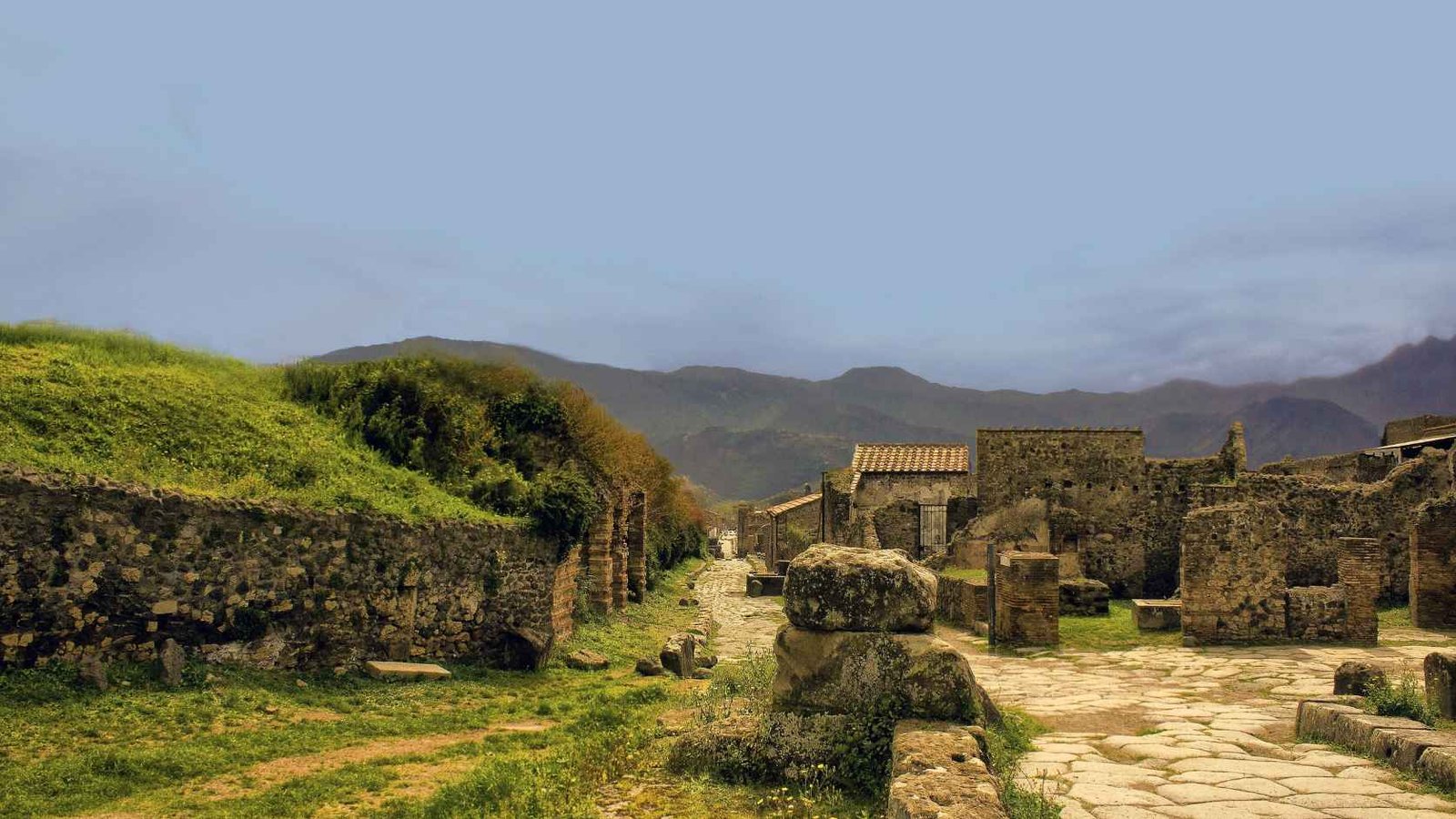
Few places on Earth tell a story as vividly as Pompeii. Within a single day in AD 79, Mount Vesuvius buried a busy Roman town on the Bay of Naples under ash and pumice, sealing its streets, shops, paintings and people where they stood. Nearly two thousand years later, that frozen moment is still teaching archaeologists something new, and this Bing Pompeii quiz walks you through it in 21 questions.
Every question has been checked against the Pompeii Archaeological Park, UNESCO, the surviving eyewitness letters of Pliny the Younger and reporting on recent excavations. You will see the correct answer and a short explanation the moment you choose, so even a wrong guess leaves you knowing more than you did before.
Why Pompeii Makes a Perfect Quiz Topic
Pompeii is unusual because it preserves ordinary life rather than just emperors and battles. Bakery ovens, street-food counters, election slogans painted on walls and graffiti scratched by bored neighbors all survived the eruption. That blend of natural disaster, science and everyday detail is why the city keeps turning up in classrooms, documentaries and trivia games around the world.
It is also exactly the kind of famous landmark that Bing likes to spotlight on its homepage, where one striking photograph can spark a quick round of questions. If you enjoy that morning habit, our daily bing quiz questions and answers page brings a fresh topic every day, so you can keep your learning streak alive long after you leave Pompeii.
How to Play and Score
The quiz is split into three "strata," like the layers an archaeologist digs through: the eruption itself, daily life in the Roman town, and the story of its rediscovery. Each correct answer earns 10 points, and once you get three or more right in a row, a Hot Streak bonus adds 5 extra points per question. Your total of correct answers decides your final archaeology rank.
Pompeii is not only ancient history; it is still current news. Archaeologists announced several new finds during 2026, including a victim identified as a doctor carrying his medical tools. If you like connecting the past to the present, challenge yourself next with today's bing world news quiz with answers and see how closely you follow the headlines.
Pompeii at a Glance
Use this quick reference before you start, or come back to it afterward to check what you learned.
Fact
Details
Location
Near modern Naples, in the Campania region of southern Italy
Destroyed by
The eruption of Mount Vesuvius in AD 79
Traditional date
24 August, based on manuscript copies of Pliny the Younger's letter
Date backed by a 2018 find
After 17 October, most likely around 24 October
Buried under
Roughly 4–6 metres of volcanic ash and pumice
Population
About 11,000 people (scholarly estimates vary)
Systematic excavation began
1748, under the Bourbon rulers of Naples
UNESCO status
World Heritage Site since 1997, together with Herculaneum and Torre Annunziata
The 21-Question Pompeii Quiz
Tap an answer to lock it in. Your excavation log at the bottom of the screen tracks your progress, points and streak.
Stratum I · The Day the Mountain Woke
Questions 1–7
I
Which volcano buried Pompeii in AD 79?
Mount Vesuvius rises above the Bay of Naples in Campania. Etna, Stromboli and Vulcano are all real Italian volcanoes, but they lie in or near Sicily, far to the south.
II
The only surviving eyewitness account of the eruption comes from letters written to the historian Tacitus. Who wrote them?
Pliny the Younger was 17 and watched from Misenum, across the bay. Decades later he described the disaster in two letters to Tacitus (Letters 6.16 and 6.20).
III
Which Roman naturalist and fleet commander died after sailing toward the eruption to help people?
Pliny the Elder, author of the encyclopedic Natural History and uncle of Pliny the Younger, commanded the fleet at Misenum. He died on the shore at Stabiae.
IV
A charcoal inscription found in 2018 suggests the eruption happened in which month, rather than the traditional August?
The scribble, found in a house under renovation in Regio V, reads "XVI K Nov," which equals 17 October. Because charcoal fades quickly, archaeologists think the eruption came about a week later, around 24 October. Earlier finds of autumn fruit and heating braziers pointed the same way.
V
Volcanologists use which term for violent eruptions with towering columns of gas and ash, named after the Roman eyewitness?
"Plinian" honors Pliny the Younger, who compared the eruption cloud to an umbrella pine tree. Hawaiian eruptions are gentle lava outpourings, while Strombolian ones throw out short bursts of lava.
VI
What killed most of the people who were still in Pompeii when the eruption peaked?
Lava never reached the town. After hours of falling pumice, fast-moving pyroclastic currents of superheated gas and ash swept through Pompeii and killed those who had stayed behind.
VII
Pompeii was still repairing damage from a strong earthquake when Vesuvius erupted. When did that earlier quake strike?
The earthquake is traditionally dated to AD 62 (the philosopher Seneca's account may point to 63). Many buildings were still under repair 17 years later, which is why scaffolding and half-finished work turn up in excavations.
Stratum II · Life on the Streets
Questions 8–14
VIII
The famous "Cave Canem" mosaic at the House of the Tragic Poet warns visitors about what?
"Cave canem" is Latin for "beware of the dog." The entrance mosaic shows a chained black dog, an ancient version of the signs people still hang on their gates today.
IX
What was a thermopolium in Pompeii?
Thermopolia were Roman "fast food" counters with clay jars set into the countertop. A brightly painted example fully excavated in Regio V in 2020 still held traces of food residues.
X
Pompeii was known for producing garum. What was it?
Garum was a salty sauce made from fermented fish, used across the Roman world much as people use fish sauce or soy sauce today. A Pompeian merchant named Aulus Umbricius Scaurus grew wealthy trading it.
XI
Pompeii's amphitheatre, built around 70 BC, holds which distinction?
It predates Rome's Colosseum by about 150 years and is the oldest surviving Roman amphitheatre built of stone. The Colosseum, not Pompeii's arena, was the largest.
XII
In AD 59, a deadly riot in Pompeii's amphitheatre broke out between locals and visitors from which neighboring town?
The historian Tacitus (Annals 14.17) records that taunts between Pompeians and Nucerians turned violent. The Roman Senate banned gladiator games in Pompeii for ten years as punishment.
XIII
The celebrated Alexander Mosaic, showing Alexander the Great in battle, was found in which Pompeian home?
The House of the Faun, one of the largest homes in Pompeii, held the mosaic of Alexander facing the Persian king Darius III. The original is now displayed at the National Archaeological Museum of Naples.
XIV
Pompeii became a Roman colony in 80 BC under which Roman leader?
After the town sided against Rome in the Social War, the dictator Sulla settled veterans there and renamed it Colonia Cornelia Veneria Pompeianorum. Despite the similar name, Pompeii was not named after Pompey; the town is older and its name likely has Oscan roots.
Stratum III · Rediscovery and Science
Questions 15–21
XV
Systematic excavations at Pompeii began in 1748 under rulers from which royal dynasty?
Digging began under Charles of Bourbon, King of Naples, who later became Charles III of Spain. Excavators did not confirm the site was Pompeii until an inscription naming the town turned up in 1763.
XVI
Who developed the technique of pouring plaster into hollows in the ash to create casts of victims, in 1863?
Giuseppe Fiorelli realized that bodies had decayed inside the hardened ash and left empty spaces. Filling them with plaster captured poses, clothing folds and even facial expressions. Schliemann is linked to Troy and Carter to Tutankhamun's tomb.
XVII
In what year did UNESCO add Pompeii, Herculaneum and Torre Annunziata to the World Heritage List?
The "Archaeological Areas of Pompei, Herculaneum and Torre Annunziata" were inscribed in 1997. Torre Annunziata is home to the lavish Villa of Oplontis, often linked to Emperor Nero's wife Poppaea.
XVIII
Which nearby town, buried under much deeper volcanic deposits, preserved carbonized wooden furniture and papyrus scrolls?
Herculaneum was sealed by thick pyroclastic deposits that carbonized wood, food and the scrolls of the Villa of the Papyri. Researchers are now using AI and X-ray scanning to read some of those scrolls without unrolling them.
XIX
What did a 2024 ancient-DNA study of several Pompeii plaster casts reveal?
The study, published in Current Biology, found that an adult long described as a mother holding a child was actually an unrelated man. It also showed Pompeii's residents had diverse ancestry, largely linked to the eastern Mediterranean.
XX
In May 2026, archaeologists announced that a victim in the Garden of the Fugitives had most likely worked as what?
The Garden of the Fugitives was the last refuge of 13 people. Decades after their casts were made, researchers found that one man had been carrying medical instruments as he tried to flee, pointing to a doctor.
XXI
Vesuvius is still an active volcano. When did it last erupt?
Vesuvius last erupted in March 1944, during World War II, destroying several villages and dozens of Allied aircraft parked nearby. The 1631 eruption was far deadlier, and the volcano is monitored around the clock today.
Excavated 0/21Correct 0Points 0Streak 0
Your archaeology rank
—
0/21
Points: 0Best streak: 0
Scoring Ranks Explained
Points reward speed of thought and consistency, but your rank depends only on how many questions you answered correctly.
Correct answers
Your rank
21
Fiorelli-Level Excavator: a flawless dig worthy of the plaster-cast pioneer
18–20
Pliny's Apprentice: sharp observation, a true eyewitness of history
14–17
Fresco Restorer: you see the detail most visitors miss
10–13
Thermopolium Regular: well fed on facts, hungry for more
5–9
Forum Wanderer: you know your way around the main square
0–4
Day-Tripper in Sandals: every great archaeologist started here
What Pompeii Still Teaches Us
Evidence can rewrite the textbook. A faint charcoal note moved the likely eruption date by two months, and DNA testing overturned stories told about the casts for generations.
Ordinary life is history too. Food counters, shop signs and graffiti tell us how regular Romans worked, ate, joked and voted.
Volcanic risk has not gone away. Vesuvius remains active above a densely populated region, which is why Italian scientists monitor it constantly.
Disaster was not the final chapter. Recent excavations suggest some people returned after the eruption and lived among the ruins, possibly until the fifth century AD.
Frequently Asked Questions
What is the Bing Pompeii quiz?
It is a trivia challenge about Pompeii in the style of Bing's homepage quizzes. This version has 21 fact-checked questions with instant answers and explanations. It is an independent educational resource and is not affiliated with or endorsed by Microsoft or Bing.
When was Pompeii destroyed?
Pompeii was destroyed by the eruption of Mount Vesuvius in AD 79. The traditional date is 24 August, but a charcoal inscription found in 2018 supports a date in late October, most likely around 24 October.
Did lava destroy Pompeii?
No. The town was first buried by falling pumice and ash, then struck by pyroclastic currents, which are fast, scorching avalanches of gas and volcanic debris. Lava played no part in burying the city.
Are the Pompeii plaster casts real bodies?
The casts were made by pouring plaster into hollows left in the ash after bodies decomposed. Many of them still contain the victims' bones and teeth, which is why scientists have been able to study their DNA.
Can you visit Pompeii today?
Yes. The ruins are managed by the Pompeii Archaeological Park near Naples and are open to visitors. Check the park's official website for current opening hours, tickets and areas under excavation before you go.
Sources and Fact-Check Notes
Facts in this quiz were cross-checked against the following sources. Where experts disagree, such as the exact eruption date, both views are noted.
Denise Bruno is a writer and quiz creator who contributes to The Times of Israel Blogs. She researches history, science and world events, checks every claim against reliable sources, and turns what she finds into clear, engaging quizzes for curious readers.