
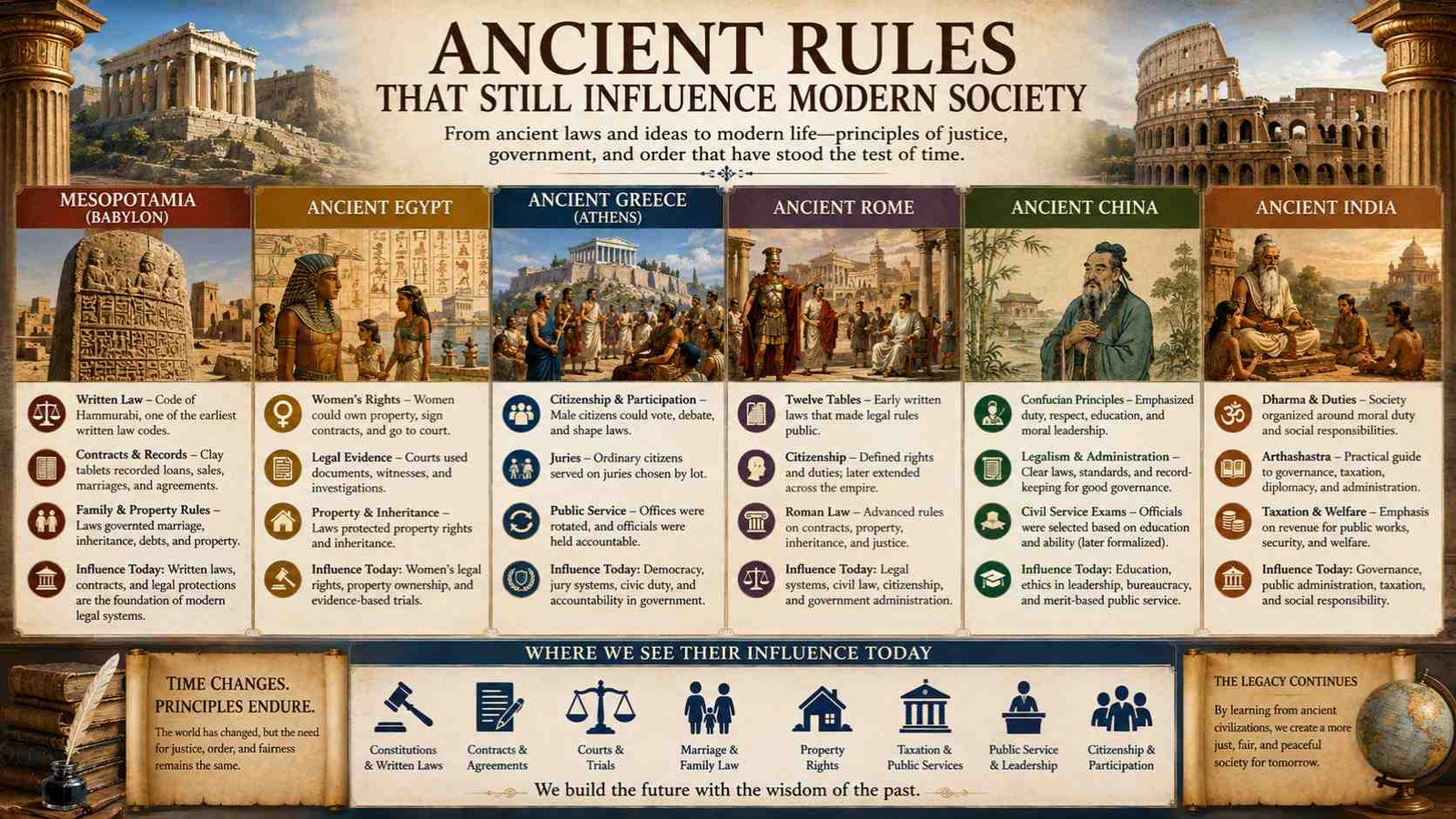
Many rules that govern modern life appear thoroughly modern. Citizens vote, courts examine evidence, governments collect taxes, couples sign marriage agreements, businesses rely on contracts, and public officials are expected to meet legal and ethical standards.
Yet the basic problems behind these institutions are ancient.
Long before modern constitutions and national governments existed, societies had to decide who could own land, how debts should be paid, what made an agreement binding, who counted as a citizen, how rulers should behave, and how conflicts could be settled without endless retaliation. Civilizations including Mesopotamia, Egypt, Greece, Rome, China, and India developed different answers to these questions.
Modern society did not simply copy their systems. Ancient institutions were repeatedly altered by conquest, religion, trade, colonialism, political reform, and social movements. Some ancient principles survived through a recognizable chain of influence. Others reappeared because later societies faced similar practical challenges.
Understanding these connections reveals something important: civilization advances not by abandoning the past completely, but by inheriting its ideas, testing them, correcting them, and sometimes rejecting them.
1. Mesopotamia Made Law Visible and Written
The ancient practice
One of the best-known surviving legal collections from Mesopotamia is the Code of Hammurabi, produced during the reign of the Babylonian king Hammurabi in the 18th century BCE. Its provisions addressed commercial disputes, property, family relationships, agricultural responsibilities, wages, injuries, debt, and criminal behavior.
The laws were inscribed on a monumental stone stele. This did not mean that every Babylonian could read them, nor did it create equality before the law in the modern sense. Penalties often varied according to a person’s social status, sex, or rank.
Nevertheless, the collection presented royal justice as something that could be stated, preserved, and consulted rather than treated entirely as an unwritten privilege of rulers and judges.
Why it was created
Hammurabi governed a kingdom containing different cities, occupations, traditions, and social groups. A recorded body of rulings helped communicate the king’s authority and establish expectations for recurring disputes.
Written law also served a political purpose. By portraying himself as a protector of justice, Hammurabi could present royal power as a defense against disorder and exploitation rather than as mere force.
Its continuing influence
The Code of Hammurabi is not the direct source of modern constitutions or criminal codes. Its deeper significance lies in the principle that legal expectations should be expressed publicly and preserved in a stable form.
Modern societies continue to depend on that expectation. Laws are published, regulations are recorded, court decisions are archived, and citizens may challenge government actions by referring to an official legal text. The content has changed enormously, but the belief that law should be knowable remains fundamental.
2. Mesopotamian Contracts Turned Promises Into Evidence
The ancient practice
Mesopotamian scribes recorded loans, land transfers, business partnerships, sales, adoptions, marriages, deliveries, and employment arrangements on clay tablets. Legal records could identify the parties involved, describe the property or obligation, list witnesses, and preserve the terms of an agreement.
Surviving records include deeds, receipts, bonds, accounts, conveyances, and decisions arising from disputes.
Why it was created
As cities expanded, economic relationships became too complicated to rely entirely on memory or personal trust. A farmer might borrow seed, a merchant might finance a distant trading expedition, or a family might transfer land to the next generation.
Written records reduced uncertainty. They helped establish what had been promised, what had already been paid, and who could confirm the transaction.
Its continuing influence
Modern contract law is far more developed, but it rests on familiar concerns: agreement, proof, identifiable obligations, witnesses, signatures, records, and remedies when one party fails to perform.
A lease, employment agreement, loan document, digital receipt, or property deed serves the same broad social purpose as an ancient tablet. It transforms a private promise into something that can be verified by others.
This does not mean that Mesopotamian merchants invented every rule in present-day contract law. It means they confronted a lasting reality: complex economies cannot function efficiently when agreements disappear with a person’s memory.
3. Mesopotamian Family Rules Treated the Household as an Economic Institution
The ancient practice
Babylonian law regulated marriage payments, dowries, inheritance, divorce, adoption, legitimacy, widowhood, debt, and household property. Marriage was not treated only as a personal or emotional relationship. It also affected wealth, labor, lineage, inheritance, and alliances between families.
The surviving rules frequently reinforced male authority and social hierarchy. Women’s protections and obligations varied according to circumstance, while enslaved people and lower-status individuals received very different treatment from elite men.
Why it was created
The household was a central unit of production and social organization. Land, tools, animals, labor, and inheritance often passed through families. Governments therefore had a practical interest in defining who belonged to a household and who could claim its property.
Clear family rules could reduce disputes over children, estates, debts, and marital assets.
Its continuing influence
Modern family law still recognizes that marriage has legal and financial consequences. Governments regulate marital property, inheritance, parental responsibility, divorce, maintenance, adoption, and the legal status of children.
The values have changed. Many societies now emphasize individual consent, gender equality, and children’s rights. Nevertheless, the ancient recognition that family relationships create public legal consequences remains visible in every marriage license, inheritance case, custody order, and prenuptial agreement.
4. Ancient Egyptian Women Could Possess a Separate Legal Identity
The ancient practice
Women in ancient Egypt, particularly free women, could own, inherit, purchase, transfer, and bequeath property. They could enter contracts in their own names and pursue legal claims. Documentary evidence also shows women participating in economic transactions and controlling property independently.
These rights did not make ancient Egypt a modern gender-equal society. Political authority, literacy, and elite office remained heavily male-dominated. Social position also influenced a woman’s ability to exercise formal rights.
Still, Egyptian women possessed a degree of legal and economic independence that was unusual in many other ancient societies.
Why it was created
Egyptian property arrangements recognized women as members of families who could receive and transmit wealth. Maintaining a woman’s legal identity also helped families manage inheritance, marriage assets, household property, and support after separation or widowhood.
Its continuing influence
Modern legal systems generally recognize married women as independent legal persons who may own assets, sign contracts, operate businesses, sue, and make wills.
That principle was not transmitted directly and continuously from pharaonic Egypt to every modern country. In fact, some much later societies restricted married women’s property rights more severely than ancient Egypt did.
The Egyptian example is influential today partly because it challenges the assumption that women’s independent property ownership is an entirely recent invention. History shows that legal restrictions on women were neither universal nor inevitable.
5. Egyptian Courts Relied on Documents, Witnesses, and Recorded Decisions
The ancient practice
Ancient Egypt did not leave behind a single famous law code comparable to Hammurabi’s stele. Much of what historians know comes from contracts, petitions, court records, wills, administrative texts, and accounts of disputes.
Egyptian legal proceedings could use witnesses, written documents, investigations, searches, and inspections of relevant locations. Courts also preserved records that could help produce consistency when similar disputes arose.
Why it was created
A large territorial state needed methods for resolving disagreements involving land, labor, theft, inheritance, taxation, and official misconduct. Decisions based entirely on personal influence would have made administration unstable.
Documents allowed officials to reconstruct transactions and compare competing claims. Witnesses connected legal decisions to community knowledge.
Its continuing influence
Modern trials place enormous importance on evidence. Courts assess documents, testimony, physical objects, expert analysis, and records of earlier proceedings.
Ancient Egyptian courts were not identical to modern independent judiciaries, and their procedures did not provide all the protections now associated with due process. Even so, they demonstrate an early recognition that legal judgment should be connected to evidence rather than determined solely by power, rumor, or revenge.
6. Athenian Citizenship Connected Political Rights With Participation
The ancient practice
In classical Athens, eligible male citizens could attend the assembly, debate public questions, and vote directly on decisions involving laws, finances, diplomacy, and war.
Citizenship was highly exclusive. Women, enslaved people, and resident foreigners were excluded from formal political participation. Athens was therefore democratic for a restricted citizen body, not for its entire population.
Why it was created
Athenian democracy developed through political struggles over aristocratic power, debt, military service, wealth, and representation. Giving citizens a direct role helped distribute authority more widely among eligible men and strengthened their identification with the city-state.
Political participation was not viewed merely as a private privilege. It was considered part of belonging to the community.
Its continuing influence
Modern citizenship still combines rights and responsibilities. Citizens may vote, hold public office, petition government, serve on juries, pay taxes, or perform civic duties.
Most modern democracies differ sharply from Athens. They are representative rather than purely direct, operate across enormous territories, and generally recognize political rights regardless of sex, ancestry, property, or social class.
Even so, the Athenian idea that legitimate government requires citizen participation remains one of the most recognizable inheritances of the ancient world.
7. Athenian Juries Made Ordinary Citizens Part of Justice
The ancient practice
Athenian courts drew jurors from large groups of eligible citizens. Selection by lot reduced the ability of powerful individuals to predict and bribe the people who would decide a particular case. Jurors could also receive compensation, allowing citizens without great wealth to participate.
The juries were often much larger than modern ones, and cases were argued without the professional court structure familiar today.
Why it was created
The jury system reflected a broader distrust of permanent concentrations of power. If the same small group controlled courts year after year, wealthy families could dominate justice.
Random selection distributed judicial authority across the citizen body and made participation part of public service.
Its continuing influence
Modern jury systems preserve the principle that legal judgment should not belong exclusively to government officials. Defendants in many jurisdictions may be judged by ordinary members of the community.
Today’s juries are smaller, legal procedures are more formal, and judges supervise questions of law. Yet the underlying principle remains familiar: community participation can provide legitimacy, reduce official monopoly, and bring multiple perspectives into the courtroom.
Random selection is also still used because it is viewed as fairer than allowing authorities to handpick decision-makers.
8. Greek Public Service Emphasized Rotation and Accountability
The ancient practice
Many Athenian offices were filled by lot, held for short periods, or subject to limits on repeated service. Officials could face public scrutiny, legal challenges, and investigations into their conduct.
Athens also used ostracism, a procedure through which citizens could vote to exile an individual considered dangerously powerful. Ostracism was political rather than a normal criminal conviction and did not require proof of a specific offense.
Why it was created
Athenians feared that ambitious individuals might transform temporary authority into permanent domination. Rotation made it harder for one person to control an institution indefinitely.
Public review reminded officeholders that authority belonged to the community and could be withdrawn.
Its continuing influence
Modern democracies use term limits, elections, impeachment, ethics investigations, financial disclosures, audits, legislative oversight, and conflict-of-interest rules to restrain public officials.
Ostracism itself would conflict with modern expectations of due process because it could punish a person without proving wrongdoing. The broader concern behind it, however, remains current: how can a political system stop popularity, wealth, or office from becoming unchecked personal power?
9. Rome’s Twelve Tables Made Legal Procedure a Public Concern
The ancient practice
The Twelve Tables, traditionally dated to 451–450 BCE, were the earliest written legislation of the Roman Republic. They addressed court procedure, debt, family authority, inheritance, property, injury, and funerary rules.
The laws reflected the inequalities of early Roman society. They recognized slavery, harsh debt enforcement, and extensive patriarchal power. Nevertheless, writing the rules helped reduce the exclusive control of legal knowledge by patrician and priestly elites.
Why it was created
Plebeians feared that unwritten customs could be interpreted selectively by elite magistrates. Recording the rules made it more difficult for officials to claim that the law was whatever they said it was at a particular moment.
Its continuing influence
The Twelve Tables helped establish a Roman tradition of treating law as a distinct field that could be studied, interpreted, revised, and organized.
Modern legal systems still insist that procedures matter. Courts must have jurisdiction, parties must receive notice, claims must be filed in an accepted form, and judgments must be enforced according to established rules.
The particular procedures have changed, but Rome strengthened the idea that justice depends not only on the final decision but also on the process used to reach it.
10. Roman Citizenship Became a Portable Legal Status
The ancient practice
Roman citizenship provided a defined set of legal rights, privileges, protections, and obligations. Its meaning changed over time, but it could affect marriage, property, contracts, access to courts, political participation, taxation, and protection from certain punishments.
Rome gradually extended citizenship beyond the city itself. In 212 CE, Emperor Caracalla granted Roman citizenship to nearly all free inhabitants of the empire.
Why it was created
Citizenship distinguished full members of the Roman political community from allies, foreigners, enslaved people, and other categories. As Rome expanded, granting citizenship could reward military service, integrate conquered populations, create loyalty, and place more people under Roman legal institutions.
Its continuing influence
Modern citizenship similarly functions as a legal relationship between an individual and a state. It can determine voting rights, passports, diplomatic protection, residence, public employment, legal duties, and eligibility for government services.
Modern citizenship is grounded in national constitutions and international law rather than Roman imperial policy. Even so, Rome helped demonstrate how a political identity could operate across a vast, culturally diverse territory.
Citizenship was no longer simply residence in one city. It became a legal status that could travel with a person.
11. Roman Private Law Shaped Contracts, Property, and Inheritance
The ancient practice
Roman jurists developed detailed ways of analyzing ownership, possession, obligations, sales, leases, loans, inheritance, guardianship, and compensation for harm.
They distinguished different kinds of property and agreements and considered the legal remedies available when rights were violated. These concepts were later preserved and reorganized, most famously in the compilation associated with Emperor Justinian.
Roman law was subsequently studied in European universities and received into numerous civil-law traditions. Its influence is especially strong in legal systems that organize private law through comprehensive civil codes.
Why it was created
Rome’s growing economy required rules that could handle trade, landholding, inheritance, urban development, and relationships among citizens and noncitizens.
Jurists responded by developing categories that allowed different cases to be compared and analyzed systematically.
Its continuing influence
Modern civil codes still organize law into recognizable fields such as persons, property, obligations, contracts, succession, and family relations.
The rules are no longer Roman. Modern systems recognize corporations, electronic transactions, consumer protection, intellectual property, gender equality, and many other concepts unknown to antiquity.
The Roman inheritance lies mainly in legal structure and reasoning: define the parties, classify the relationship, identify the right or obligation, and determine an appropriate remedy.
12. Roman Censuses Linked Population Records to Taxation and Public Duties
The ancient practice
Roman censors registered citizens, assessed property, placed people into civic categories, and helped determine obligations to the state. Census information could affect taxation, military service, voting arrangements, and social rank.
Censors also became involved in public finances, including contracts connected to revenue collection and the maintenance of public buildings.
Why it was created
A government cannot collect taxes, recruit soldiers, distribute political rights, or plan public works effectively unless it knows something about the people and resources under its authority.
The census turned population and property information into tools of administration.
Its continuing influence
Modern censuses are used to allocate legislative representation, plan schools and hospitals, understand migration, measure employment, and distribute public funds. Tax authorities maintain separate but related records of income, property, businesses, and transactions.
Modern privacy rights and statistical methods are far removed from Roman practice. Still, Rome illustrates an enduring feature of organized government: public administration depends on information.
The same records that make services possible can also increase state control. That tension between administrative usefulness and personal privacy remains unresolved today.
13. Confucian Thought Treated Social Roles as Reciprocal Duties
The ancient practice
Confucian teaching placed great importance on family relationships, education, ritual, moral character, respect for elders, and the responsibilities attached to social roles.
A child owed duties to parents, but parents also had obligations toward children. Ministers owed loyalty, while rulers were expected to govern responsibly and cultivate virtue. Proper conduct within families was treated as a foundation for order in the wider state.
Why it was created
Confucius lived during a period of political fragmentation and conflict. His teachings sought stability not primarily through severe punishment but through moral education, proper conduct, responsible leadership, and carefully maintained relationships.
Its continuing influence
Confucian ideas have shaped family life, education, public ethics, respect for scholarship, and attitudes toward authority across China and other parts of East Asia.
Their effects can still be seen in the high value placed on education, family responsibility, care for parents, disciplined public service, and leadership by moral example.
These values are not fixed or universally accepted. Critics have challenged the ways hierarchical interpretations supported patriarchy, age-based authority, conformity, and restrictions on individual choice.
The lasting question is not whether every person must remain in a traditional role. It is whether rights can be balanced with responsibilities and whether authority carries obligations toward those who obey it.
14. Chinese Legalism and Civil-Service Recruitment Strengthened the Administrative State
The ancient practice
Thinkers now grouped under the label “Legalism” emphasized clear standards, administrative methods, rewards, punishments, and institutions that did not depend entirely on a ruler’s personal goodness. The Chinese term fa could refer not only to law but also to standards, models, and impersonal methods of government.
Later Chinese dynasties blended administrative traditions with Confucian political ethics. Systems for educating, recommending, testing, and selecting officials gradually developed, while the imperial examination system became more systematic under later dynasties. Examinations focused heavily on classical learning and were never a perfect meritocracy, since wealthy families had much better access to education.
Why it was created
Large states required officials who could keep records, apply regulations, collect revenue, manage local government, and communicate orders across long distances.
Recruitment based at least partly on learning or demonstrated ability offered an alternative to filling every office solely through hereditary privilege.
Its continuing influence
Modern civil services use examinations, educational qualifications, standardized applications, performance rules, professional training, and promotion systems.
Today’s public-service exams usually test administrative knowledge, reasoning, law, mathematics, or specialized skills rather than mastery of Confucian classics. The modern principle, however, is recognizable: government positions should require demonstrated competence.
China’s experience also provides a warning. Examinations can appear objective while favoring people who can afford the best preparation. A test-based system is only genuinely merit-based when access to education is reasonably fair.
15. Ancient Indian Thought Joined Moral Duty With Practical Government
The ancient practice
Ancient Indian political and legal thought developed through several traditions rather than one unified national code. Texts associated with dharma discussed duties, proper conduct, family relations, inheritance, social roles, dispute settlement, and the responsibilities of rulers.
The Arthashastra, associated with Kautilya, took a more practical approach to statecraft. It addressed administration, taxation, trade, revenue, law, diplomacy, intelligence, war, and the selection and supervision of officials.
Together, these traditions reflected an enduring tension between government as a moral institution and government as the practical management of power, security, and resources.
Why it was created
Rulers needed revenue to support armies, irrigation, officials, infrastructure, security, and royal institutions. At the same time, political authority required moral justification.
Ideas of dharma helped define expected conduct, while statecraft literature considered how rulers could maintain order, protect territory, supervise officials, and prevent corruption.
Its continuing influence
The belief that taxation must support public responsibilities remains central to modern government. So does the idea that officials should be supervised because public power can be abused.
Indian legal history also demonstrates how multiple legal traditions can coexist. Custom, religious norms, royal orders, community practices, and formal adjudication could overlap rather than fit into a single uniform code.
Modern India is governed by a democratic constitution and statutory law, not by ancient political treatises. Yet debates about duty, welfare, religious tradition, family law, social justice, taxation, and state authority continue to engage with concepts shaped by the subcontinent’s long intellectual history.
Which Ancient Ideas Have Changed or Become Outdated?
Ancient societies produced influential institutions, but they also accepted practices that modern legal and moral standards reject.
Citizenship was too narrow
Athenian political participation excluded women, enslaved people, and foreigners. Roman citizenship expanded more widely, but Rome still maintained sharp legal differences based on freedom, status, sex, and rank.
Modern democratic citizenship is founded on a broader principle: political rights should not depend on ancestry, wealth, property ownership, or gender.
Punishment often depended on social class
The Code of Hammurabi did not treat every injured person or accused individual equally. A person’s rank could determine the penalty.
Modern legal systems formally embrace equality before the law, although wealth and social position may still influence access to representation and outcomes in practice.
Patriarchal authority restricted personal freedom
Many ancient laws placed women, children, and younger relatives under extensive male household authority. Marriage could be arranged for economic or political reasons, while individual consent was limited or unevenly recognized.
Contemporary legal reform has increasingly emphasized consent, equal property rights, protection from domestic abuse, and the independent legal identity of each spouse.
Slavery was accepted as part of social order
Mesopotamian, Egyptian, Greek, Roman, Chinese, and Indian societies all experienced forms of slavery, bondage, forced labor, hereditary subordination, or severe status inequality.
Modern human-rights principles reject the ownership of human beings, even though forced labor, trafficking, and debt bondage continue illegally.
Collective order often outweighed individual rights
Ancient governments commonly prioritized stability, family authority, religious duty, or imperial security over personal freedom.
Modern constitutions attempt to protect speech, privacy, equality, religion, and due process. The tension has not disappeared, however. Governments still argue that public safety, national unity, or social order may justify limits on individual liberty.
Public office was not always accountable to everyone
Athens developed notable systems of citizen oversight, but only a restricted group counted as citizens. Roman, Egyptian, Chinese, Mesopotamian, and Indian rulers often connected authority to divine approval, hereditary status, conquest, or royal tradition.
Modern democratic theory instead holds that public authority ultimately comes from the people and remains subject to constitutional limits.
Key Takeaways
Ancient influence is rarely a simple story of one civilization inventing an institution and modern society copying it unchanged.
Written Mesopotamian laws helped establish the value of recorded legal expectations. Egyptian documents show the importance of evidence and demonstrate that women’s property rights existed in some ancient settings. Greek practices connected citizenship with political and judicial participation. Roman jurists created legal categories that deeply influenced later civil-law systems. Chinese traditions shaped ideas of moral leadership, administrative standards, education, and official recruitment. Indian thought explored the continuing tension between ethical duty and practical statecraft.
At the same time, modern society has rejected slavery, hereditary legal inequality, class-based punishment, restricted citizenship, and many forms of patriarchal control.
For readers who enjoy testing connections across history, culture, science, and public life, a knowledge quiz today can provide a lighter way to continue exploring how ideas travel across time.
Conclusion: The Past Is Present, but It Is Not in Control
Ancient civilizations did not leave modern society a finished instruction manual. They left arguments, institutions, records, successes, injustices, and warnings.
They asked how law could restrain violence, how property could be transferred, how rulers could collect revenue, how officials should be chosen, and what citizens owed to their communities. Modern governments continue to ask the same questions, although the answers now operate within very different ideas about equality, freedom, representation, and human rights.
The most valuable ancient principles have survived because later societies adapted them. Written law became constitutional government. Restricted citizenship became a struggle for universal political rights. Royal administration evolved into professional public service. Family obligations were reexamined through individual liberty and gender equality. Ancient contracts became part of complex commercial systems operating across the world.
Other ideas survived longer than they deserved. Social hierarchy, forced labor, exclusion, patriarchy, and unequal justice were also ancient inheritances. Progress required people to challenge tradition rather than respect it automatically.
Modern society therefore has two relationships with the ancient world. It is an heir to old institutions, but it is also their critic.
The rules of the past still influence daily life, yet they do not have the final word. Each generation decides which principles deserve preservation, which require reform, and which should be left behind.
Author

Sandy turns complex topics into concise, readable pieces. She built strong research and source-checking habits while helping archive community history projects. She’s exploring future study in the humanities (the University of Oxford is on her shortlist; no current affiliation). Her work is original, clearly cited, and updated when corrections are needed. Offline, she organizes neighborhood book swaps and sketches city scenes.