Most people treat a quiz like a tiny exam.
They read the question, pick an answer, check the score, and move on.
Smart learners do something different.
They treat every quiz like a conversation.
Not a loud conversation, of course. Nobody needs to sit in a room arguing with a multiple-choice question like it owes them money. But mentally, smart learners “talk back” to the quiz. They ask questions. They notice clues. They wonder why one answer is right and another one is wrong.
That small change can turn a simple quiz into a real learning tool.
A quiz is not only there to test what you know. It can also help you think, remember, connect ideas, and become more curious about the world.
The Fresh Angle: A Quiz Is Not Just Asking You Questions
A good quiz does not only ask, “Do you know this?”
It also quietly asks:
“What made you choose that answer?”
“Did you notice the clue?”
“Why is the other answer wrong?”
“Where have you seen this fact before?”
“What can you connect this to?”
That is why treating a quiz like a conversation makes learning more active. You are no longer just clicking answers. You are thinking with the question.
And that is where real quiz learning begins.
What It Means to Treat a Quiz Like a Conversation
Treating a quiz like a conversation means you do not rush through the question.
You pause for a moment.
You let the question speak.
Then you respond mentally.
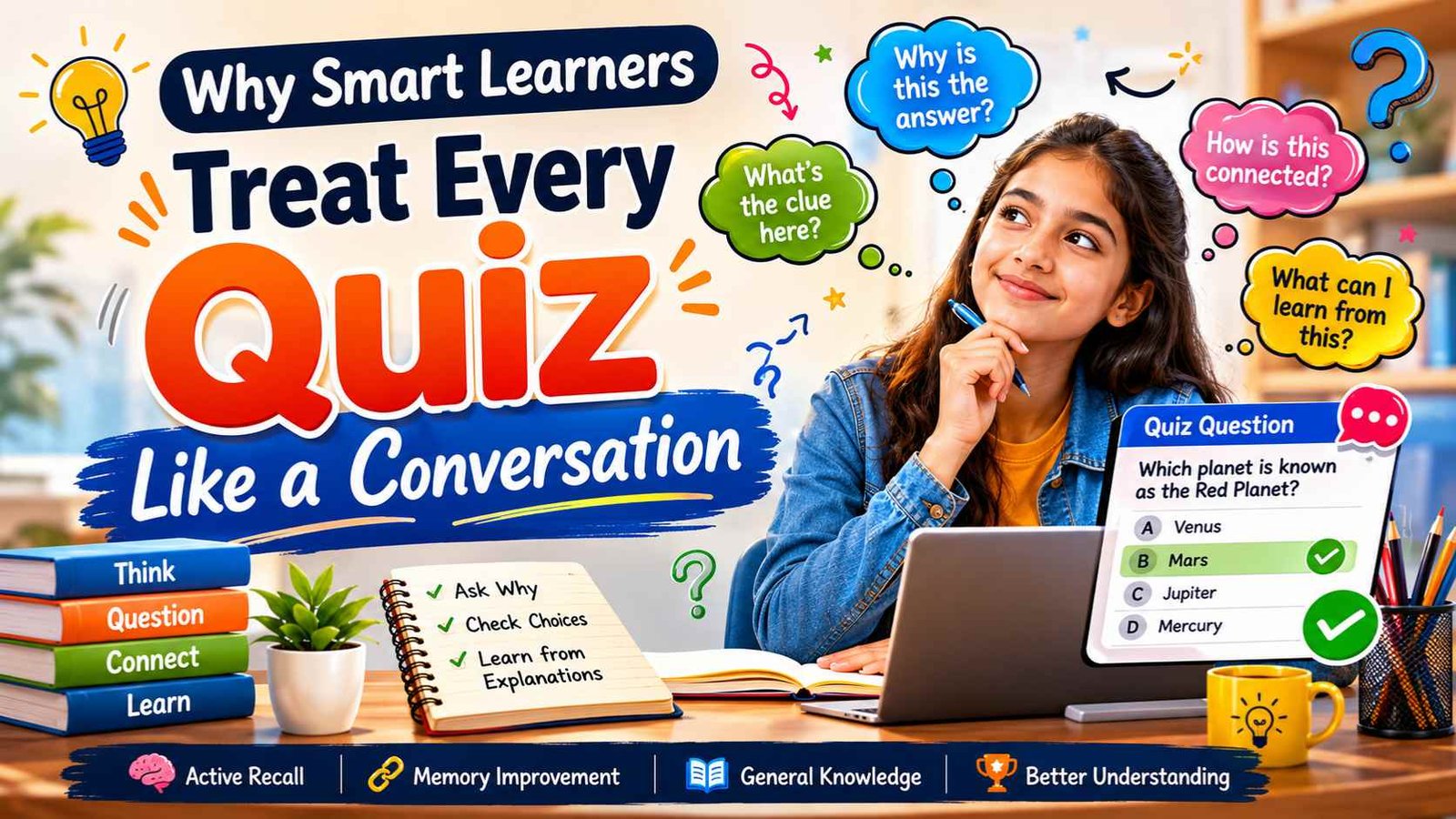
For example, if the quiz asks:
Which planet is known as the Red Planet?
A rushed learner may quickly click Mars and move on.
A smart learner may think:
“Okay, Mars is called the Red Planet because of its reddish surface. That color comes from iron oxide, almost like rust. Venus is not red. Jupiter has the Great Red Spot, but it is not called the Red Planet.”
That short mental response makes the answer stronger in memory.
You did not only remember a fact. You gave the fact a reason.
Why This Helps Active Recall
Active recall means pulling information out of your memory instead of only reading it again.
Quizzes are great for this because they force your brain to search for an answer.
But the magic gets stronger when you add a little mental conversation.
Instead of only asking, “What is the answer?” you also ask:
“Why do I think this is the answer?”
“What clue helped me?”
“What do I already know about this topic?”
This makes your brain work a bit harder, but in a useful way. It is like turning on more lights in the room. The answer becomes easier to find later because you gave it more connections.
That is why educational quizzes can support memory improvement when they are used thoughtfully.
How Smart Learners “Talk Back” to Quiz Questions
You do not need a notebook, a timer, or a complicated study system. You can do this in a few seconds.
Here are simple ways to respond to a quiz question mentally.
1. Ask, “What is this question really testing?”
Some questions test a basic fact.
Others test understanding.
For example:
Which gas do plants absorb during photosynthesis?
The answer is carbon dioxide.
But the deeper idea is that plants use carbon dioxide, water, and sunlight to make food. So the question is not only about one gas. It is connected to how plants live.
That one extra thought helps the fact stick.
2. Notice the Clues in the Wording
Quiz questions often give small hints.
A question may say:
Who was the first person to walk on the Moon?
The word first matters.
The answer is not just any astronaut. It is Neil Armstrong.
Smart learners slow down enough to notice words like:
first
largest
smallest
oldest
main
most likely
best describes
These clue words guide your thinking. They keep you from answering too fast.
3. Explain Your Answer Before Checking
Before you click or reveal the answer, try saying in your mind:
“I think the answer is ___ because ___.”
This is powerful.
For example:
“I think the answer is the Pacific Ocean because it is the largest ocean on Earth.”
That short explanation makes the quiz feel less like guessing and more like learning.
4. Connect the Fact to Something You Already Know
Memory loves connections.
If a quiz asks about the Eiffel Tower, you might connect it to Paris, France, world landmarks, tourism, or engineering.
If a quiz asks about photosynthesis, connect it to plants, sunlight, oxygen, and food chains.
Each connection gives your brain another path back to the answer.
That is useful for students, adults, parents helping kids, and casual learners who enjoy online quizzes for general knowledge.
Practical Example: A Quiz Question as a Conversation
Let’s say the question is:
Which country is famous for the ancient city of Machu Picchu?
Choices:
A. Mexico
B. Peru
C. Egypt
D. Greece
A rushed learner may pick Peru and move on.
A smart learner thinks:
“Machu Picchu is in the Andes Mountains. The Inca civilization was in South America. Mexico has Aztec and Maya history, but Machu Picchu is not there. Egypt has pyramids. Greece has ancient temples. So the answer is Peru.”
That is a conversation.
The question asked something. The learner responded with clues, comparisons, and background knowledge.
The score may only show one correct answer, but the brain learned much more than one fact.
Wrong Answers Are Part of the Conversation
Wrong answers are not just mistakes.
They are replies from your brain that need correction.
That may sound strange, but it is helpful.
When you choose a wrong answer, your brain is showing you something. Maybe you confused two countries. Maybe you recognized a word but did not understand it. Maybe you rushed. Maybe the answer choices looked similar.
That wrong answer is giving feedback.
A Wrong Answer Can Reveal a Weak Connection
Suppose a learner sees this question:
Which continent is the Sahara Desert located in?
They choose Asia, but the correct answer is Africa.
That mistake may show that the learner knows the Sahara is a huge desert, but has not strongly connected it to North Africa.
Now the learner can repair the connection:
“Sahara equals North Africa.”
That small correction can be more memorable than getting the answer right immediately.
Wrong Answers Make You Compare Ideas
Wrong answer choices are useful because they make you ask:
“Why is this one wrong?”
That question matters.
If the correct answer is Peru, and one wrong choice is Mexico, the learner can compare Inca history with Aztec and Maya history.
Now the quiz is teaching more than one fact.
This is why answer explanations are so important. A good explanation does not only say what is correct. It helps you understand why the other answers do not fit.
Why Answer Explanations Matter
Answer explanations are where the conversation continues after the quiz.
Without explanations, a quiz can feel like a scoreboard.
With explanations, it becomes a learning page.
A helpful explanation can show:
why the correct answer is right
why a common wrong answer is tempting
how the fact connects to a bigger topic
what to remember next time
For example, after a geography question, the explanation might add a location, a landmark, or a simple memory clue.
That tiny note can turn a forgotten answer into lasting knowledge.
This is especially useful for daily quizzes because learners may not have time for a full lesson. A short explanation gives them a quick learning reward.
How This Improves Focus
Treating a quiz like a conversation also improves focus.
When you simply click answers, your attention can drift. You may start guessing. You may finish the quiz without remembering much.
But when you mentally respond to each question, your attention has a job.
You are looking for clues.
You are checking your reasoning.
You are comparing choices.
You are asking, “Does this answer make sense?”
That keeps your mind active. It also makes online quizzes feel less empty and more useful.
How This Builds Curiosity
Curiosity often begins with a small gap.
You see a question and realize, “Wait, I should know this.”
Or you get an answer wrong and wonder, “How did I miss that?”
That little spark is valuable.
A smart learner follows it.
A history question can lead to a short reading session. A science quiz can make you look up how something works. A geography quiz can make you curious about a country you barely knew before.
This is one reason general knowledge quizzes are enjoyable. They open small doors. You do not need to enter every room, but you can choose the ones that interest you.
For a simple place to build that habit, you can explore this Bing Homepage Quiz guide and use it as part of your daily quiz practice.
Quizzes Work Best With Reading, Reflection, and Explanation
Quizzes are useful, but they are not magic.
A quiz can help you recall facts, test understanding, and notice what you do not know. But deeper learning usually needs more than clicking answers.
That is why quizzes work best when paired with:
reading
short explanations
reflection
discussion
real examples
follow-up questions
Think of the quiz as the conversation starter.
The explanation is the follow-up.
The reading gives background.
Reflection helps the idea stay with you.
This balanced approach is better than treating quizzes as either pure entertainment or serious exams only. They can be both enjoyable and educational.
Daily Quizzes Can Build a Strong Learning Habit
Daily quizzes work because they are small.
You do not need to study for two hours. You only need a few focused minutes.
That makes the habit easier to repeat.
And repeated learning matters.
A few questions each day can slowly build your general knowledge. You may learn a science fact today, a history fact tomorrow, and a geography fact the next day. Over time, those small facts begin to connect.
That is how a casual quiz habit can become a quiet memory improvement routine.
Practical Tips for Treating Every Quiz Like a Conversation
1. Pause Before Answering
Do not click too fast.
Give your brain a few seconds to search.
Even a short pause can improve recall.
2. Say “Because” in Your Mind
Before choosing an answer, complete this sentence:
“I think it is ___ because ___.”
This forces you to explain your thinking.
3. Read Every Answer Choice
Sometimes the first familiar answer is not the best one.
Read all the choices before deciding.
This helps you avoid careless mistakes.
4. Study the Wrong Answers
Do not ignore wrong choices.
Ask why they are wrong. They often teach related facts.
5. Use Explanations as Mini-Lessons
After the quiz, read the explanation slowly.
Look for one detail worth remembering.
6. Keep a Small Fact List
Write down facts that surprise you.
This can be a notebook, phone note, or simple document.
You do not need to save everything. Just save the facts that make you say, “Oh, that’s interesting.”
7. Repeat Topics You Miss Often
If you keep missing geography questions, take more geography quizzes.
If science questions confuse you, start with easier science quizzes.
Smart learners do not avoid weak areas. They revisit them.
Why This Helps Different Types of Learners
Students can use this method to understand school topics better.
Adults can use it to keep learning without feeling like they are back in a classroom.
Parents can use quizzes to start small learning conversations with children.
Casual learners can use online quizzes to build general knowledge in a fun way.
The method is simple enough for anyone:
Read the question.
Think.
Answer.
Ask why.
Learn from the explanation.
That is the conversation.
A Simple Daily Quiz Routine
Here is an easy routine you can follow:
Choose one short quiz.
Answer slowly.
For each question, explain your choice in your mind.
After the quiz, review wrong answers.
Pick one new fact to remember.
Use that fact in a sentence or tell someone about it.
This routine may only take a few minutes, but it turns passive clicking into active learning.
And that is the difference.
FAQs
1. What does it mean to treat a quiz like a conversation?
It means you do not answer silently and move on. You mentally respond to each question by asking why, noticing clues, comparing choices, and learning from the explanation.
2. Can quizzes really improve memory?
Yes, quizzes can support memory because they use active recall. You are pulling information from your mind instead of only reading it. Memory improves even more when you explain your answers and review mistakes.
3. Are wrong answers bad for learning?
No. Wrong answers can be very useful. They show what you misunderstood, confused, or rushed through. When you review them carefully, they help correct weak spots in your knowledge.
4. How often should I take daily quizzes?
A few minutes a day is enough to build a habit. The goal is not to take as many quizzes as possible. The goal is to think carefully, learn from explanations, and remember one or two useful facts each time.
Final Thoughts
Smart learners know that a quiz is more than a score.
It is a small conversation with your own knowledge.
Every question gives you a chance to recall, reason, connect, and correct. Every wrong answer gives you feedback. Every explanation gives you a little more understanding.
So the next time you take an online quiz, do not just click and leave.
Pause.
Think.
Ask why.
Let the question talk to you, and talk back to it.
That is how a simple quiz becomes a smarter way to learn.
Author

Sayanara focuses on the “why” behind the news and writes clear, well-sourced explainers. She developed careful verification habits while editing cultural essays, tracing claims back to primary sources. She’s exploring future study in philosophy (UC Berkeley is on her shortlist; no current affiliation). Her work is original, transparently cited, and updated with corrections when needed. Off the page, she coaches a local debate team and plays jazz piano..