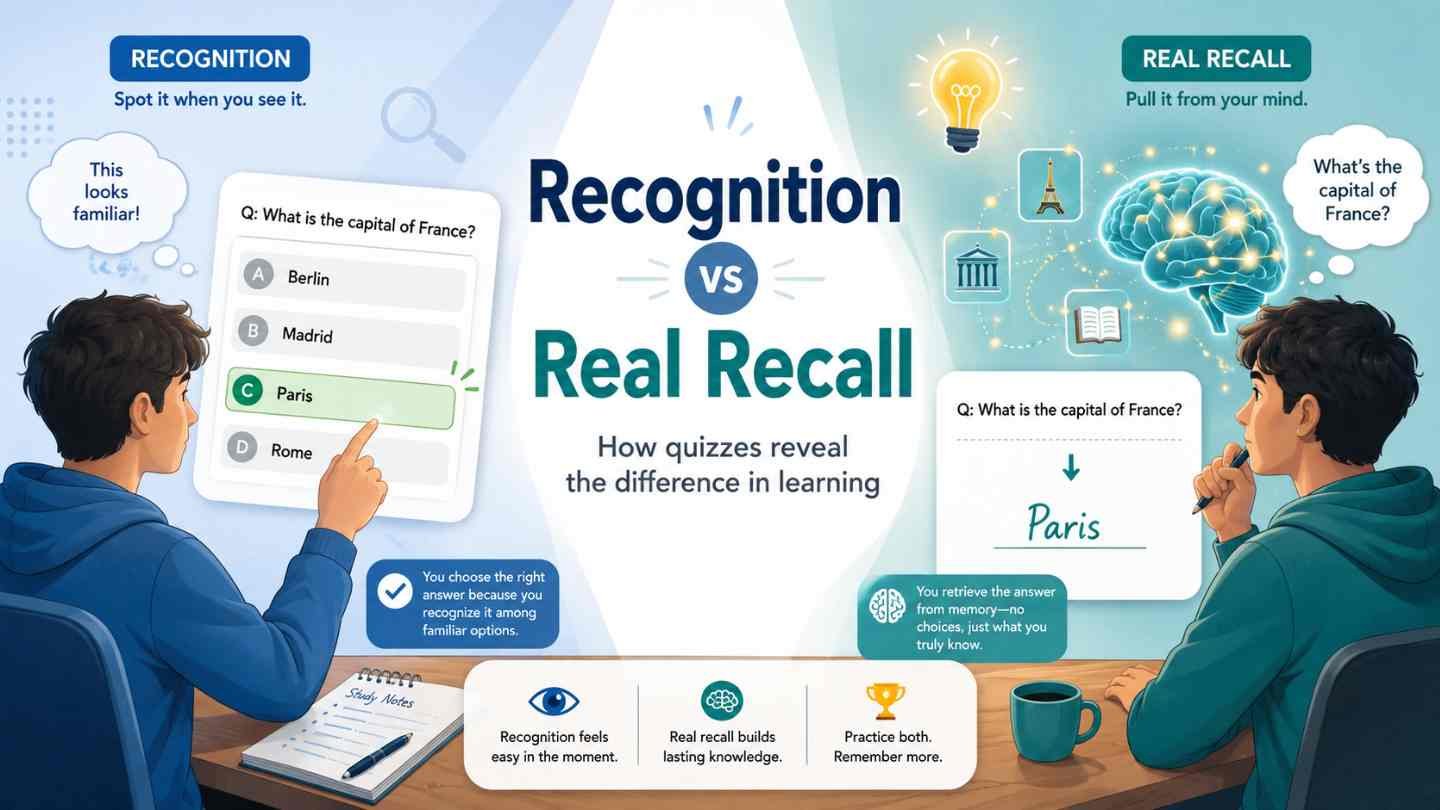
Most quiz players know this feeling: you see four answer choices, one of them looks familiar, and your brain says, “That must be it.” Sometimes you’re right. Sometimes you’re only recognizing something you’ve seen before. That small difference matters because recognition and recall are not the same kind of learning.
The fresh angle here is simple: a quiz is not just a test of what you know. It is also a mirror that shows how you know it. Did you truly remember the answer, or did the answer only feel familiar once it appeared on the screen? When you understand that difference, every quiz becomes more useful for memory improvement, daily learning, and stronger general knowledge.
What Is Recognition?
Recognition happens when you identify the correct answer after seeing it. For example, if a quiz asks, “Which planet is known as the Red Planet?” and the choices are Venus, Mars, Jupiter, and Saturn, you may instantly pick Mars because it looks familiar. The answer was already in front of you, so your job was to spot it.
That is not useless. Recognition helps you connect old information with new clues. It can also help you rebuild memory when you are unsure. But recognition can trick you because familiar does not always mean correct. A wrong answer can look believable simply because you have heard the word before.
What Is Real Recall?
Real recall happens when you can bring the answer out of memory without seeing the choices first. Using the same example, if someone asks, “What planet is called the Red Planet?” and you answer “Mars” before seeing any options, that is recall. Your brain had to search, retrieve, and produce the answer.
This is usually a stronger sign of learning. It means the fact is not just sitting in your memory as a familiar label. You can access it when needed. In quiz learning, real recall is the difference between saying, “I know that when I see it,” and saying, “I can explain that even without help.”
Why Recognition Feels Easier Than Recall
Recognition feels easier because the choices give your brain a shortcut. You do not have to build the answer from scratch. You only have to compare options and choose the one that seems right. That is why multiple-choice quizzes can feel smoother than open-ended questions.
Recall takes more effort because there are no visible clues waiting for you. Your mind has to pull the answer from memory. This effort is exactly why recall practice is powerful. The brain tends to remember better when it has to work a little, not when everything is handed to it too quickly.
The Common Quiz Trap: “I Knew That!”
Many people finish a quiz and say, “I knew that!” after seeing the correct answer. But did they really know it before the answer appeared? That is the little trap. Seeing the answer can create a feeling of confidence that was not there during the question.
This does not mean you failed. It simply means the quiz showed you where your memory is still weak. If the answer only made sense after you saw it, that topic may need one more review. Good quiz learning is not about pretending you knew everything. It is about noticing the difference between familiar facts and facts you can recall clearly.
How Recognition Helps Learning
Recognition is still useful, especially when you are learning something new. It gives your brain a starting point. If a name, date, place, or idea looks familiar, that can help you reconnect with information you have seen before. In educational quizzes, recognition can also reduce frustration because the choices give you enough support to keep going.
The key is to treat recognition as a doorway, not the finish line. When you choose an answer because it looks familiar, pause for a second and ask why it feels right. Can you explain it? Can you connect it to another fact? That tiny step turns a simple guess into a learning moment.
Why Real Recall Builds Stronger Memory
Real recall strengthens memory because it forces your brain to retrieve information. Retrieval is like a mental workout. The more often you bring a fact back without relying on answer choices, the easier it becomes to remember later. This is why answer review matters so much after daily quizzes.
For example, if a quiz asks about the capital of Canada and you pick “Ottawa” from the choices, that is recognition. After the quiz, cover the answer and ask yourself, “What is the capital of Canada?” If you can answer “Ottawa” without looking, you are training real recall. That extra step takes only a few seconds, but it makes the learning stick better.
How to Use Quizzes to Strengthen Recall
1. Guess the Answer Before Looking at the Choices
Before reading the options, try to answer the question in your head. Even if you are unsure, give your memory a chance to work first. This turns a normal multiple-choice question into recall practice.
For example, if the question asks, “Who wrote Romeo and Juliet?” pause before looking below. If “Shakespeare” comes to mind first, great. If not, then look at the choices and see whether one of them helps. That short pause trains your focus and prevents lazy clicking.
2. Explain Why the Answer Is Correct
After choosing an answer, ask yourself why it is correct. You do not need a long explanation. One simple sentence is enough. If you picked “Mars” as the Red Planet, say, “Mars is called the Red Planet because iron-rich dust gives it a reddish color.”
This is where real learning gets stronger. You are no longer just choosing a label. You are connecting the answer to meaning. That connection helps memory improvement because facts become easier to retrieve when they have context.
3. Review Wrong Answers Without Shame
Wrong answers are not wasted questions. They show you the gap between recognition and recall. Maybe the correct answer looked familiar after you saw it, but you could not remember it in the moment. That tells you the information is nearby in memory but not strong yet.
During answer review, focus on the reason behind the correct answer. Do not only say, “Okay, it was B.” Say what B means and why the other choices were wrong. This simple habit makes educational quizzes much more valuable.
4. Mark Your “Familiar but Unsure” Answers
Not all correct answers are equally strong. Sometimes you pick the right one but only because it looked familiar. Mark those questions mentally as “not fully learned yet.” They deserve a quick review because they may not hold up without choices next time.
This is especially useful for general knowledge quizzes. You may recognize famous names, countries, inventions, or historical events, but recognition alone can be shaky. A fast review helps turn familiar information into real recall.
5. Retest Yourself Later Without Choices
After finishing a quiz, choose three questions and ask them again without the answer choices. This does not need to feel like studying. Just cover the options, say the answer, and explain it in one sentence.
This works well with daily quizzes because the habit is small and repeatable. One quiz a day can become more than entertainment. It can become a simple memory routine that builds focus, curiosity, and stronger recall over time.
A Simple Example of Recognition vs. Recall
Imagine this question:
Which ocean is the largest in the world?
A. Atlantic Ocean
B. Indian Ocean
C. Pacific Ocean
If you pick Pacific Ocean after seeing the choices, that is recognition. If you can answer “Pacific Ocean” before seeing the choices, that is recall. If you can also explain that it covers more area than any other ocean, that is even better learning.
That final layer matters. Real recall is not only about naming the answer. It is also about understanding enough to explain it. When you can explain a fact in your own words, you are less dependent on hints.
Why This Matters for Daily Quiz Learning
Daily quizzes are powerful because they give your brain regular contact with facts. A single quiz may feel small, but repeated practice adds up. The danger is clicking through too quickly and mistaking familiar-looking answers for true knowledge.
To get more from quiz learning, slow down just enough to notice your thinking. Did you remember the answer? Did the choices help you too much? Did you guess correctly but still feel unsure? These small observations turn every quiz result into useful feedback.
For more daily quiz practice, you can visit Expand Your Knowledge with the Daily Bing Homepage Quiz.
Recognition Is Helpful, But Recall Is Stronger
Recognition should not be treated as a bad thing. It helps you learn, especially when you are still building knowledge. It can guide your memory, reduce confusion, and make hard questions feel more approachable. For beginners, recognition is often the first step toward understanding.
But real learning becomes stronger when you can answer without seeing choices. If you can explain the answer in your own words, the knowledge is more stable. That is the goal: not just picking what looks right, but knowing why it is right.
Final Thoughts
The difference between recognition and recall can change the way you use quizzes. Recognition helps you spot familiar answers, but real recall proves that the information is easier to retrieve from memory. Both have value, but they are not equal.
The next time you play a quiz, pause before looking at the choices. Try to answer first, then use the options to check your thinking. Review the answers you guessed, explain the ones you got right, and pay attention to what only felt familiar. That is how a simple quiz becomes a better tool for memory, focus, curiosity, and daily learning.
Author

Sayanara focuses on the “why” behind the news and writes clear, well-sourced explainers. She developed careful verification habits while editing cultural essays, tracing claims back to primary sources. She’s exploring future study in philosophy (UC Berkeley is on her shortlist; no current affiliation). Her work is original, transparently cited, and updated with corrections when needed. Off the page, she coaches a local debate team and plays jazz piano..