Many people imagine learning as a set of separate rooms. Science belongs in one room, history in another, geography somewhere down the hall, and culture in a room filled with art, food, music, and traditions. In real life, however, these subjects rarely stay apart. They constantly overlap, influence one another, and help explain why the world looks and works the way it does.
Learning a little from several fields creates something more useful than a random collection of facts. It builds a mental map—a growing network of places, events, ideas, causes, and human experiences. Once that map begins to form, new information becomes easier to place, compare, question, and remember.
This is one of the most practical benefits of general knowledge. You do not need advanced expertise in every subject. Even a basic understanding of science, history, geography, and culture can help you follow conversations, interpret news, make everyday decisions, and recognize connections that might otherwise remain hidden.
General Knowledge Works Best as a Connected Mental Map
A single fact can be interesting, but a connected fact is much more useful. Knowing that the Nile is one of the world’s most famous rivers is a starting point. Understanding how it supported agriculture, influenced ancient Egyptian civilization, shaped settlement patterns, and remains important to several modern countries turns that isolated fact into part of a larger picture.
This is how broad general knowledge gradually becomes meaningful. One idea gives you a place to attach another. A scientific explanation may clarify a historical event, while a map may explain why two cultures developed different foods, languages, or trading relationships.
Think of each subject as a layer on the same map:
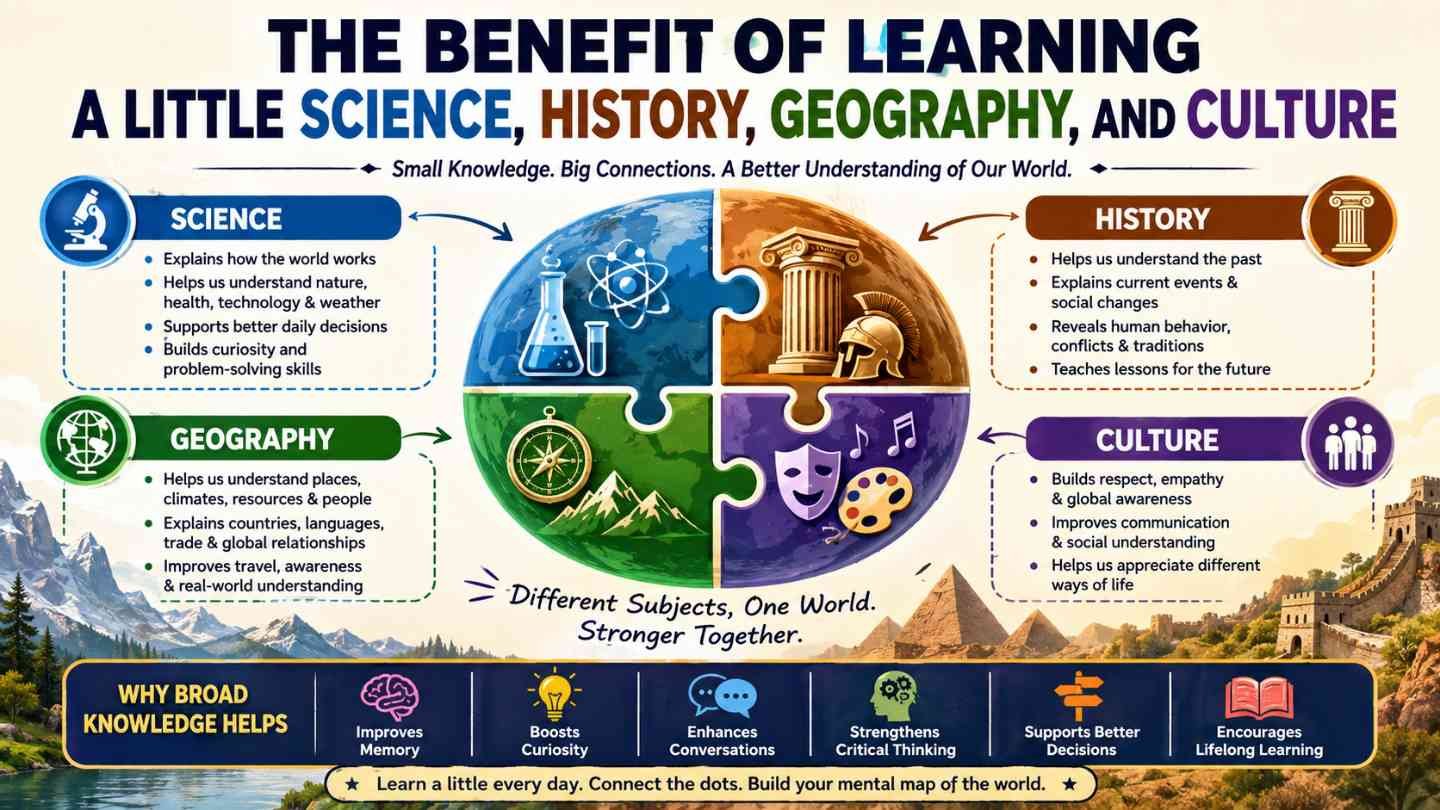
- Science explains natural processes and how physical systems work.
- History shows how events, decisions, and human behavior unfold over time.
- Geography explains where events happen and how location shapes them.
- Culture reveals how people create meaning, identity, customs, and community.
When these layers are combined, facts stop feeling like loose pieces of trivia. They begin to form a usable picture of the world.
How Science, History, Geography, and Culture Connect
The boundaries between subjects are helpful for organizing school lessons, but the world itself does not follow classroom categories. A drought is scientific because it involves weather patterns and water systems. It is geographic because some regions are more vulnerable than others. It can become historical when it causes migration or political change, and cultural when communities adapt their food, rituals, work, or traditions.
The same pattern appears in nearly every major topic. The Industrial Revolution involved scientific discoveries, new technology, expanding cities, trade routes, labor movements, and changes in family life. The spread of crops such as potatoes, coffee, sugar, and rice cannot be understood through agriculture alone; it also involves climate, colonization, economics, migration, and cultural habits.
Learning across subjects helps readers notice these links. Instead of asking only, “What happened?” they begin asking, “Where did it happen, why did it happen there, what natural conditions mattered, and how did people respond?” That shift from recalling facts to examining relationships is where general knowledge becomes genuinely valuable.
Why Broad General Knowledge Helps in Everyday Life
Most daily situations do not require specialist-level knowledge. They often require enough background to understand what is being discussed, recognize a questionable claim, or ask a useful follow-up question.
A little weather knowledge can help you understand storm warnings. Basic geography can make international news less confusing. Historical context can reveal why a disagreement between countries has lasted for generations. Cultural knowledge can prevent an awkward assumption when meeting someone from a different background.
Broad learning can also make ordinary experiences richer. A trip becomes more meaningful when you know something about the landscape, local history, architecture, religion, or food. A museum display becomes easier to appreciate when you recognize the period or region it represents. Even watching a film can become more interesting when you notice historical references, scientific ideas, or cultural influences woven into the story.
General knowledge does not guarantee that every judgment will be correct. It does, however, provide more points of reference. Those reference points help people slow down, compare information, and avoid treating every new claim as if it exists without context.
What Science Knowledge Adds to Your Mental Map
Science knowledge helps explain the systems operating around us, often in ways that are directly relevant to ordinary choices. You do not need to be a laboratory researcher to benefit from understanding basic ideas about cause and effect, evidence, measurement, probability, energy, ecosystems, or the human body.
Understanding Nature and Weather
Basic science makes natural events less mysterious. Knowing how evaporation, condensation, air pressure, and temperature interact makes weather forecasts easier to understand. Learning about plate tectonics gives earthquakes and volcanoes a physical explanation rather than leaving them as isolated disasters on the news.
Science also helps readers understand environmental relationships. A change in rainfall can affect crops, rivers, wildlife, food prices, and migration. Once these links are visible, nature no longer appears as a collection of separate events.
Making Better Health and Technology Decisions
Everyday health information often includes claims about nutrition, exercise, infection, sleep, medicines, and risk. Basic scientific thinking encourages people to look for reliable evidence, distinguish correlation from causation, and remain cautious about dramatic claims based on a single example.
Technology becomes easier to navigate as well. A basic understanding of data, electricity, digital security, algorithms, and artificial intelligence can help people use modern tools more thoughtfully. Science knowledge will not answer every question, but it can help people recognize which questions should be asked.
Developing a Habit of Testing Claims
Perhaps the most useful scientific habit is not memorizing formulas. It is learning to ask how something is known. What evidence supports the claim? Could there be another explanation? Was the result tested more than once?
These questions are valuable far beyond science. They can be applied to advertisements, social media posts, political claims, historical interpretations, and even personal assumptions.
What History Knowledge Adds to Your Mental Map
History knowledge gives present-day events a timeline. Without it, current issues can appear suddenly, as though they began with the latest headline. History reveals that many modern borders, alliances, conflicts, institutions, and traditions developed through long chains of decisions and consequences.
Understanding Current Events and Social Change
A basic awareness of empires, colonization, industrialization, independence movements, wars, and political reforms can make world news more understandable. It helps readers see why certain regions share languages, why some borders are disputed, or why particular anniversaries carry deep emotional importance.
History also shows that societies change unevenly. New laws may arrive before attitudes change, while technological progress may create both opportunity and disruption. Seeing similar patterns in earlier periods can make present-day debates easier to examine without assuming that every development is entirely new.
Learning About Human Behavior
History is filled with ambition, fear, cooperation, prejudice, courage, compromise, and unintended consequences. Studying these patterns does not provide a perfect formula for predicting the future, but it reminds us that human decisions are shaped by pressure, incentives, beliefs, institutions, and limited information.
This perspective can encourage humility. People in the past did not know how their stories would end. Like us, they acted with partial knowledge and often disagreed about what should happen next.
Understanding Traditions and Institutions
Many customs become clearer when their origins are known. Holidays, ceremonies, national symbols, legal systems, political structures, and religious traditions often carry traces of earlier events. History knowledge helps people see these practices not as permanent features of life, but as ideas that developed in particular circumstances.
What Geography Knowledge Adds to Your Mental Map
Geography is more than memorizing capitals and locating countries. It examines how physical environments and human activity influence each other. Mountains, coastlines, rivers, deserts, climate zones, and natural resources all affect how communities travel, trade, build, farm, and communicate.
Understanding Countries and Climates
A map immediately adds context to a story. Knowing whether a country is landlocked, mountainous, tropical, densely populated, or surrounded by powerful neighbors can explain many of its opportunities and challenges.
Climate influences food production, housing, transportation, clothing, and work. It can also shape tourism, energy needs, disease patterns, and access to water. Geography knowledge helps readers understand why solutions that work in one region may not fit another.
Seeing How Resources Shape Relationships
Natural resources often influence trade and international relationships. Countries may depend on others for oil, metals, grain, water, technology, or shipping access. Rivers and seas can connect regions through commerce, but they can also become sources of disagreement.
Geography makes these relationships visible. It shows why ports matter, why shipping routes receive global attention, and why control of a mountain pass, canal, island, or river basin can affect events far beyond its immediate location.
Connecting Places, Languages, and Migration
Languages and cultures often spread along trade routes, migration paths, and former political boundaries. Geography helps explain why neighboring regions may share foods and customs, or why communities separated by great distances may still have historical connections.
It also makes travel more thoughtful. Instead of viewing destinations as isolated attractions, travelers can understand how landscapes, livelihoods, history, and culture shape the character of a place.
What Cultural Knowledge Adds to Your Mental Map
Cultural knowledge includes languages, beliefs, customs, arts, stories, celebrations, food, social expectations, and everyday habits. It helps people understand not only what others do, but also why those practices may carry meaning.
Building Respect and Empathy
It is easy to judge unfamiliar behavior using the standards of one’s own experience. Cultural knowledge creates a pause between observation and judgment. It encourages people to ask whether a custom has a religious, historical, social, or environmental explanation.
This does not mean every practice must be accepted without question. It means differences should be understood accurately before conclusions are drawn. Respect begins with recognizing that people may organize family life, hospitality, time, communication, and community in different ways.
Improving Communication
Words, gestures, humor, eye contact, personal space, and levels of formality can vary across cultures. What sounds friendly in one setting may sound too direct or too distant in another. Basic cultural awareness can reduce misunderstandings in travel, work, education, and online communication.
It also makes conversation more interesting. Familiarity with another person’s region, traditions, arts, or celebrations provides thoughtful topics beyond stereotypes.
Appreciating Different Ways of Life
Cultural learning reveals how communities express identity and adapt to their surroundings. Traditional foods may reflect local crops and trade history. Music may preserve stories of migration, struggle, faith, or celebration. Architecture may respond to climate, available materials, social customs, and religious beliefs.
Culture is therefore not an isolated category. It is often the human expression of geography, history, and shared experience.
One River, Five Different Subjects
A river provides a clear example of how one topic can connect several fields.
From a geographic perspective, a river has a source, a course, tributaries, a drainage basin, and an outlet. Its location influences cities, borders, farming areas, and transportation routes.
From a scientific perspective, rivers are part of the water cycle. Their flow is affected by rainfall, snowmelt, erosion, sediment, vegetation, pollution, and climate.
From a historical perspective, rivers have supported settlements, agriculture, military movement, exploration, and the growth of civilizations. Control of a river crossing or port could shape trade and conflict.
From an economic perspective, rivers may provide irrigation, fishing, transport, electricity, and water for households or industry. Decisions about dams and water use can benefit one community while creating difficulties for another.
From a cultural perspective, rivers appear in songs, legends, religious practices, festivals, and national identities. A waterway may be both a physical resource and a symbol of home.
Learning one river fact through these different lenses makes it easier to remember because the fact has several connections. It is no longer floating alone in memory.
How Cross-Subject Learning Strengthens Thinking
Learning across different subjects can support curiosity because one answer naturally leads to another question. A quiz question about a volcano may lead to plate tectonics, island geography, local mythology, historical eruptions, and the communities living nearby.
It can also support memory improvement. Information is often easier to recall when it is linked to a story, place, image, cause, or comparison. A capital city connected to a river, historical event, language, and famous landmark has more memory pathways than a name memorized by itself.
Critical thinking benefits because readers learn to examine an issue from several angles. A food shortage, for example, might involve weather, transportation, economics, conflict, policy, and cultural habits. Looking for multiple causes reduces the temptation to accept explanations that are neat but incomplete.
Broad knowledge also improves conversation and decision-making. It gives people more ways to participate in discussions and more background for evaluating options. The goal is not to appear knowledgeable about everything, but to understand enough to listen, connect, and ask sensible questions.
You Do Not Need to Become an Expert in Every Subject
The value of lifelong learning does not depend on mastering every field. Expertise requires deep study, practice, and careful attention to a specific area. General knowledge serves a different purpose: it provides orientation.
A person can understand the basic role of vaccines without becoming an immunologist. Someone can recognize the importance of the Silk Road without specializing in ancient trade. A traveler can learn respectful local customs without becoming an anthropologist.
A little accurate knowledge can be enough to identify what matters, understand a basic explanation, or recognize when expert guidance is needed. The aim is not to replace specialists. It is to avoid moving through the world without any framework for understanding their work.
Broad learning should therefore be approached with curiosity rather than pressure. You are building a map, not attempting to memorize the entire territory.
Connected Understanding Matters More Than Collecting Facts
There is a difference between learning facts and collecting them. A disconnected fact may help answer one quiz question, but it can disappear quickly because it has nowhere to belong. A connected fact becomes part of an explanation.
When you learn that a city became an important trading center, look beyond the label. Was it near a river, coast, mountain pass, or resource? Which groups traveled there? What goods, languages, technologies, and beliefs moved through it?
This approach prevents broad learning from becoming shallow. General knowledge becomes more useful when readers understand relationships, causes, contrasts, and consequences. Accuracy still matters, but context is what gives a fact lasting value.
Practical Ways to Learn a Little Every Day
Daily learning does not require long study sessions. Ten or fifteen focused minutes can be enough to add another useful piece to your mental map.
Use Educational Quizzes as Starting Points
Educational quizzes are effective when they do more than mark answers right or wrong. A good explanation can show why an answer is correct, why another choice is tempting, and how the topic connects to a broader idea.
Readers who enjoy current trivia can use a resource such as this bing quiz guide as a starting point for daily quiz learning. Questions about films, famous people, music, and popular culture can also open unexpected paths into history and society through entertainment quizzes.
After answering, spend a moment on the explanation. The explanation is usually where real learning begins.
Review Wrong Answers
A wrong answer reveals a gap more clearly than an easy correct answer. Instead of rushing to the next question, identify what caused the mistake. Did you confuse two dates, countries, scientists, terms, or historical periods?
Write one sentence explaining the correct answer in your own words. Then connect it to something you already know. This simple recall practice turns an error into a stronger memory cue.
Read Short Articles With a Purpose
Choose one short article and look for four things: the scientific element, the historical background, the geographic setting, and the cultural impact. Not every article will contain all four, but searching for them builds the habit of connected thinking.
For example, an article about coffee can lead to plant science, tropical climates, colonial trade, labor history, café culture, and modern business. A familiar everyday object suddenly becomes a doorway into several fields.
Use Maps, Timelines, and Documentaries
Maps show relationships that paragraphs sometimes hide. Timelines reveal sequence, overlap, and cause. Documentaries can combine images, interviews, locations, and explanations in a way that makes unfamiliar subjects easier to visualize.
Use these tools actively rather than passively. Pause to locate a place, compare two dates, or summarize the central idea. Small acts of participation make learning more memorable.
Follow Curiosity One Step Further
When a fact catches your attention, ask one additional question. Where did this happen? What caused it? Who was affected? Is the situation still important today?
You do not need to open twenty tabs or conduct a full research project. Following curiosity one step further is often enough to connect a new fact to your growing mental map.
A Simple Four-Subject Learning Routine
Try this routine for ten to fifteen minutes a day:
- Science: Learn one process, discovery, health concept, animal fact, or natural phenomenon.
- History: Learn one event, person, invention, movement, or historical cause.
- Geography: Locate one country, city, river, mountain, sea, or climate region on a map.
- Culture: Explore one tradition, language, artwork, food, celebration, or social custom.
Finish by writing or saying one connection between at least two of the subjects. You might connect a climate to a traditional food, a river to an ancient city, or an invention to a major social change.
Once a week, use a mixed quiz to test recall. Review the answers you missed, reread the explanations, and add those facts to subjects you already understand. This routine keeps daily learning manageable while steadily strengthening your overall map.
Final Thoughts
The benefit of learning a little science, history, geography, and culture is not simply that you will know more answers. The deeper benefit is that the world begins to feel less scattered.
Science explains processes. History adds time and consequence. Geography provides location and physical context. Culture reveals how people experience, interpret, and express life. Together, these subjects turn isolated information into a connected mental map.
You do not need to become an expert in every field. A steady habit of reading, questioning, reviewing, and taking educational quizzes can gradually build useful general knowledge. Focus less on collecting impressive facts and more on understanding how each new fact connects to something larger.
Frequently Asked Questions
1. Why is general knowledge important in everyday life?
General knowledge gives people background for understanding conversations, news, travel, technology, health information, and social issues. It does not provide perfect judgment, but it offers useful reference points for asking questions and evaluating claims.
2. Is it better to learn many subjects or focus on one?
Both approaches have value. Specialized study builds depth, while learning across several subjects provides context and helps readers recognize connections. A balanced approach can include one area of deeper interest alongside broad daily learning.
3. Can quizzes really improve general knowledge?
Quizzes can support learning when they include accurate answer explanations and encourage recall. Their value increases when readers review wrong answers, connect new information to familiar topics, and revisit important facts later.
4. How much time should I spend on daily learning?
Even ten to fifteen focused minutes can be useful. Consistency matters more than completing a large amount of material in one session. A short quiz, map activity, article, or timeline review can become part of a sustainable routine.
5. How can I remember facts from different subjects?
Connect each fact to a place, cause, image, story, comparison, or existing idea. Explain the fact in your own words and test yourself later without looking at the answer. Connected recall is generally more useful than repeatedly rereading an isolated statement.
Author

John turns financial data into clear, factual stories. He holds a degree in Accountancy and spent several audit seasons reconciling ledgers and verifying documentation. He studies business cases and is exploring future graduate study in management (MIT is one of the schools he’s considering; no current affiliation). Every piece is concise, well-sourced, and fact-checked, with prompt corrections when needed. Off the clock, he teaches budgeting to local teens and restores vintage bikes.