Most people treat a quiz question like a tiny finish line. You choose an answer, check if you got it right, and move on. But the real learning often happens in the few seconds after the answer appears.
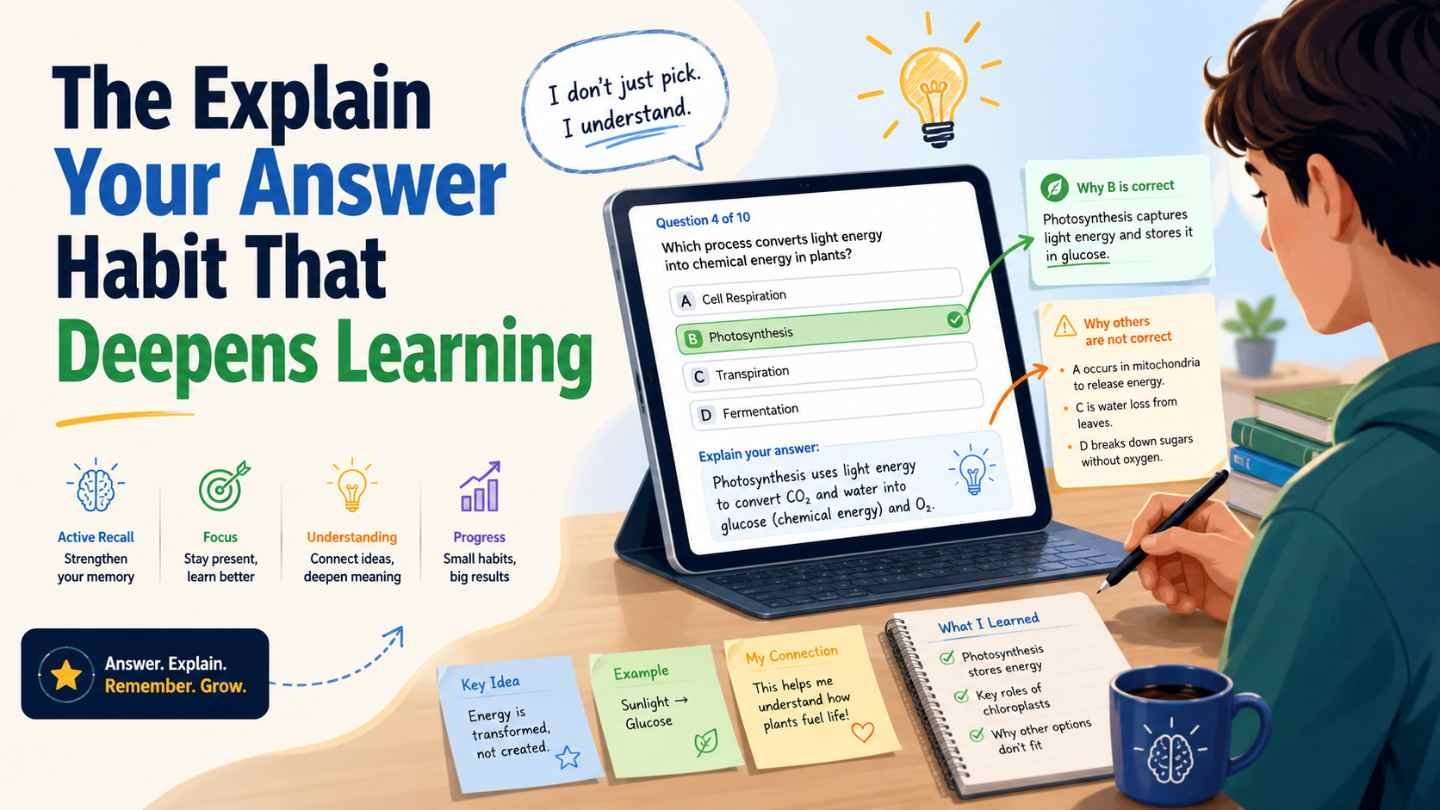
That is where the explain your answer habit becomes powerful. Instead of only asking, “Was I right?” you ask, “Why was this answer right?” or “Why did I choose that?” It turns a simple quiz into a thinking tool.
The fresh angle is this: explaining your answer is not just a study trick. It is a way to catch the story your brain is telling itself. Sometimes that story is accurate. Sometimes it is half-right. Sometimes it is just a confident guess wearing a nice jacket.
What Does “Explain Your Answer” Mean?
To explain your answer means you do not stop at the choice you picked. You briefly describe the reason behind it in your own words. You might explain why the correct answer fits, why the wrong choices do not fit, or why your first guess felt tempting.
For example, if a quiz asks, “Which planet is known as the Red Planet?” and you answer Mars, the explanation could be simple: “Mars is called the Red Planet because iron oxide on its surface gives it a reddish color.” That one sentence does more than confirm the answer. It connects the fact to a reason.
This matters because many learners recognize answers without fully understanding them. A name may look familiar. A date may sound right. A word may trigger a memory. But when you explain the answer, you find out whether you truly understand it or only recognize it.
Why Explaining Your Answer Deepens Learning
Quizzes are already useful because they make you retrieve information from memory. That process is called active recall. But when you add an explanation, you go one step deeper. You are not only pulling out an answer; you are organizing the reason behind it.
This helps with memory improvement because your brain remembers connected ideas better than isolated facts. A bare fact is easy to forget. A fact with a reason, example, or comparison has more hooks in your memory.
It also improves focus. When you know you must explain your answer, you stop clicking through questions casually. You begin reading more carefully, noticing keywords, and thinking about what the question is really asking.
The Difference Between Knowing and Explaining
There is a big difference between choosing the right answer and being able to explain it. Choosing can happen through recognition. Explaining requires understanding.
Imagine a general knowledge quiz asks, “Who wrote Pride and Prejudice?” You choose Jane Austen because the name looks familiar. That may be correct, but your learning becomes stronger when you add: “Jane Austen wrote Pride and Prejudice, a classic English novel known for its social commentary and the characters Elizabeth Bennet and Mr. Darcy.”
Now the answer is no longer floating alone. It is attached to a book, an author, a style, and a memory cue. That is why answer explanations are so helpful in educational quizzes. They help facts become part of a bigger picture.
How This Habit Helps With Correct Answers
Correct answers are easy to rush past. That is a mistake. A right answer can still hide weak understanding.
When you get an answer correct, ask yourself: “Did I know this clearly, or did I just recognize it?” If you knew it clearly, explain it in one short sentence. If you only guessed well, mark it as something to review.
For example, you might say, “I got this right because I remembered that photosynthesis uses sunlight, carbon dioxide, and water to produce glucose and oxygen.” That quick explanation strengthens the memory and makes the answer easier to recall later.
How This Habit Helps With Wrong Answers
Wrong answers are not failures. They are useful signals. They show where your memory, understanding, or attention needs repair.
When you get a question wrong, do not only memorize the correct option. Ask why your chosen answer seemed believable. Did you mix up two similar terms? Did you miss a keyword? Did you rely on a half-remembered fact?
For example, if you chose “evaporation” when the correct answer was “condensation,” your explanation might be: “I confused two parts of the water cycle. Evaporation is liquid turning into vapor, while condensation is vapor turning back into liquid.” That correction is much stronger than simply saying, “The answer is condensation.”
How This Habit Helps With Guessed Answers
Guessed answers deserve special attention because they can trick you. A lucky guess feels like knowledge, but it may not be reliable.
After a guessed answer, write or say: “I guessed this because…” Then explain the clue you used. Maybe you eliminated two obviously wrong options. Maybe one answer sounded familiar. Maybe you noticed a pattern in the choices.
This is helpful because it separates real knowledge from lucky accuracy. In daily quizzes, guessed answers are common. The goal is not to shame yourself for guessing. The goal is to turn the guess into a learning moment.
How to Handle Tricky Answer Choices
Some quiz questions are tricky because the answer choices are close. Two options may sound correct. One may be partly true but not the best answer. Another may use familiar words in the wrong way.
When this happens, explain why the correct answer is better than the tempting wrong answer. This is one of the best ways to deepen learning because it trains your brain to notice small differences.
For example, in a history quiz, “cause” and “effect” choices can be easy to confuse. A strong explanation might be: “This event happened after the war, so it was an effect, not a cause.” That small distinction helps you understand the timeline, not just the answer.
A Simple Method: The 3-Sentence Answer Review
You do not need to write a long paragraph after every quiz question. A short review is enough. Try this simple method:
- My answer was: ______
- The correct answer is right because: ______
- I missed it / knew it / guessed it because: ______
This works well for educational quizzes, general knowledge quizzes, and even entertainment quizzes. For example, after trying a fun topic like the Bing Entertainment Quiz, you can still use the habit to remember names, films, music facts, awards, and pop culture details more clearly.
Why It Works So Well With Daily Quizzes
Daily quizzes are perfect for this habit because they are short. You do not need a full study session. You only need a few extra seconds after each question.
A quiz like the Bing Homepage Quiz guide can become more useful when you treat every answer as a small learning checkpoint. You answer, check, explain, and move forward. Over time, that routine builds stronger recall without making learning feel heavy.
Daily practice also helps you notice patterns. You may discover that you often miss geography questions because you confuse regions. You may find that science terms look familiar but are hard to explain. Those small discoveries make your next review more focused.
Practical Tips for Building the Habit
Start with only three questions per quiz. You do not have to explain every answer at first. Choose one correct answer, one wrong answer, and one guessed answer. That gives you a balanced view of what you know.
Use simple language. Your explanation does not need to sound academic. In fact, plain language is better because it shows whether you really understand the idea.
Pay attention to “almost right” choices. These are often the best teachers. When two choices feel close, compare them directly and explain the difference.
Review explanations after the quiz. Good answer explanations help you correct weak ideas before they become repeated mistakes. The habit works best when you check facts, read the explanation, and adjust your understanding.
Common Mistakes to Avoid
One common mistake is copying the explanation without thinking about it. Reading an explanation is helpful, but saying it in your own words is better. That is what turns passive review into active recall.
Another mistake is only reviewing wrong answers. Correct answers deserve a second look too, especially if you guessed or felt unsure. A right answer with weak reasoning can become a wrong answer next time.
Also, avoid overexplaining. You do not need five sentences for every question. One clear reason is often enough. The goal is not to write an essay; the goal is to prove to yourself that the answer makes sense.
The Balanced Truth About Answer Explanations
The explain your answer habit is powerful, but it is not magic. It works best when you combine it with fact-checking, review, and honest correction. If your explanation is based on a misunderstanding, repeating it will only make the mistake stronger.
That is why answer explanations matter. They help you compare your reasoning with the correct information. When your explanation matches the facts, your memory becomes stronger. When it does not, you get a chance to fix the problem before it sticks.
Quizzes are not only about scores. They are also about feedback. And explaining your answer is one of the simplest ways to turn feedback into real learning.
Key Takeaway
The explain your answer habit helps you move from “I picked the right option” to “I understand why this is right.” It strengthens memory, improves focus, reveals weak spots, and makes quiz learning more useful. Whether your answer is correct, wrong, guessed, or tricky, a short explanation can turn one question into a deeper learning moment.
FAQs About the Explain Your Answer Habit
1. What does “explain your answer” mean in quiz learning?
It means giving a short reason for why an answer is correct, wrong, guessed, or confusing. Instead of only checking the result, you think about the reasoning behind it.
2. Why does explaining answers improve memory?
Explaining connects a fact to meaning. Your brain remembers information better when it is linked to a reason, example, or comparison instead of standing alone.
3. Should I explain every quiz answer?
Not always. If you are short on time, explain the most useful ones: wrong answers, guessed answers, and tricky choices. You can also explain a few correct answers to make sure you truly understand them.
4. What should I do when I get an answer wrong?
Ask why your answer seemed right. Then compare it with the correct answer and explain the difference. This helps correct the misunderstanding instead of only memorizing the right option.
5. Is this useful for general knowledge quizzes?
Yes. General knowledge covers many topics, so explanations help connect scattered facts. They make names, dates, places, and concepts easier to remember later.
6. How long should an answer explanation be?
One or two sentences is usually enough. The best explanation is clear, simple, and accurate. Long explanations are not necessary unless the topic is complex.
7. Can this habit help with guessed answers?
Yes. It helps you separate lucky guesses from real knowledge. When you explain why you guessed, you learn which clues helped and which facts you still need to review.
8. What if my explanation is wrong?
That is still useful because it reveals the misunderstanding. Check the facts, read the answer explanation, and rewrite the idea in your own words. That correction is where a lot of real learning happens.
Author

Sandy turns complex topics into concise, readable pieces. She built strong research and source-checking habits while helping archive community history projects. She’s exploring future study in the humanities (the University of Oxford is on her shortlist; no current affiliation). Her work is original, clearly cited, and updated when corrections are needed. Offline, she organizes neighborhood book swaps and sketches city scenes.