Repeating the same sentence over and over can feel productive for a few minutes. You see the words again. They look familiar. You may even think, “Yes, I know this already.”
Then the quiz starts.
Suddenly, the exact wording is gone. The idea feels blurry. You remember seeing it, but you cannot explain it, use it, or connect it to anything else.
That is the problem with plain rereading. It often repeats the surface of an idea without waking up the thinking behind it.
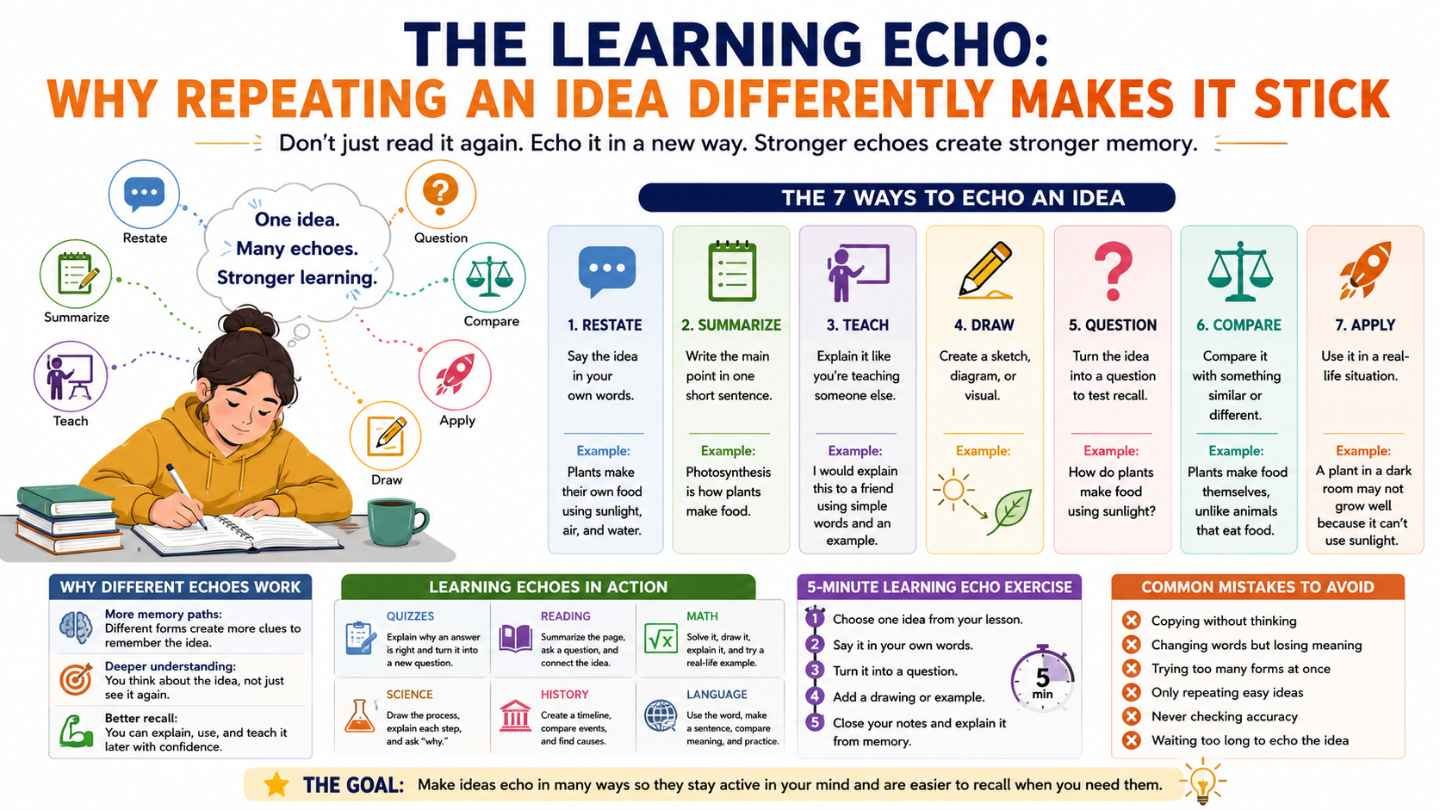
A stronger method is to repeat the same idea in different ways. Say it in your own words. Turn it into a question. Draw it. Compare it. Teach it. Apply it to a real example.
Each version sends the idea back through your mind from a slightly different angle. That repeated return is what we can call The Learning Echo.
What Is “The Learning Echo”?
The Learning Echo is the practice of repeating one idea in several different forms so it becomes easier to understand, remember, and use.
It is not about copying the same note ten times. It is about making the idea “echo” through different actions.
For example, instead of rereading this sentence:
“Photosynthesis is the process plants use to make food from sunlight, carbon dioxide, and water.”
You could echo it like this:
Restate It
Plants use sunlight, air, and water to make their own food.
Ask It
How do plants make food using sunlight?
Draw It
Sun → leaf → plant food.
Teach It
Plants do not eat the way animals do. They make food inside their leaves using light.
Apply It
A plant kept in darkness may struggle because it cannot use sunlight for photosynthesis.
That is one idea repeated five ways. Each version strengthens the memory because your brain has to rebuild the meaning instead of just looking at the same words again.
Why Repeating the Same Way Often Fails
Rereading feels easy because the material is already in front of you. You do not have to search your memory. You do not have to explain. You do not have to make choices.
That ease can be misleading.
When you reread a paragraph, you may recognize the words without truly owning the idea. Recognition says, “I have seen this before.” Understanding says, “I can explain this without looking.”
Those are not the same thing.
The Learning Echo pushes you beyond recognition. It asks you to handle the idea actively. When you restate, summarize, compare, or apply something, you are testing whether the idea has actually become usable.
Why Repeating an Idea Differently Helps Memory
Memory becomes stronger when an idea has more than one path back to it.
If you only remember a definition exactly as written, you may forget it when the wording changes. But if you have explained it, drawn it, questioned it, and used it in an example, you have more ways to find it again.
Different forms create different memory clues.
A drawing gives you a visual clue.
A question gives you a retrieval clue.
A personal example gives you an emotional or real-life clue.
A comparison gives you a connection clue.
A short summary gives you a simple language clue.
The idea becomes less like a single fragile note and more like a sound that keeps bouncing back from different directions.
The Difference Between Repetition and Useful Repetition
Not all repetition is equal.
Repeating the same sentence exactly may help with short-term familiarity, but it can become dull fast. Your attention drops because nothing new is happening.
Useful repetition changes the task.
You are still working with the same idea, but your mind has to do something slightly different each time.
Read it once.
Explain it once.
Question it once.
Use it once.
Connect it once.
That kind of repetition does not feel as automatic, but that is the point. The small effort is what helps the idea stick.
How to Turn One Lesson Into Several Useful Forms
You do not need a complicated system. Start with one important idea from a lesson, article, video, quiz, or book. Then turn it into different forms.
1. Restate the Idea in Plain Language
Ask yourself, “How would I say this without using the textbook wording?”
If the original idea is:
“Inflation reduces purchasing power.”
You could restate it as:
“When prices rise, the same amount of money buys less than before.”
That plain version is easier to remember because it sounds like something you actually understand.
2. Summarize It in One Sentence
A summary forces you to choose what matters most.
After reading a section about the American Revolution, your one-sentence summary might be:
“The American Revolution grew from political, economic, and legal conflicts between the colonies and Britain.”
That single sentence becomes a handle for the larger topic.
3. Turn It Into a Question
Questions are powerful because they make your brain search.
Instead of writing:
“The water cycle includes evaporation, condensation, and precipitation.”
Turn it into:
“What are the main stages of the water cycle?”
Now you have created a mini-quiz for yourself.
This works especially well with online quizzes. After answering a question, do not just check whether you were right. Turn the answer into a new question and explain why it is correct. A simple homepage quiz guide can also help you practice this habit with short daily questions.
4. Teach It Like You Are Helping a Beginner
Teaching reveals gaps quickly.
You do not need a classroom. Explain the idea to an imaginary friend, a younger sibling, or even your phone recorder.
For example:
“Fractions are just parts of a whole. If a pizza has eight slices and you eat two, you ate two out of eight slices, or 2/8.”
If your explanation gets tangled, that is useful information. It shows you where to review.
5. Draw a Simple Version
You do not need artistic talent. Stick figures, arrows, boxes, and labels are enough.
For a history lesson, draw a timeline.
For a science process, draw arrows.
For a math problem, draw a model.
For a language lesson, draw a word map.
Drawing makes you decide how the parts fit together.
6. Compare It With Something Similar
Comparison sharpens understanding.
Ask:
“How is this like something I already know?”
“How is it different?”
“What could I confuse it with?”
For example, in language learning, you might compare “borrow” and “lend.”
Borrow means you receive something temporarily.
Lend means you give something temporarily.
The contrast helps you remember both words more clearly.
7. Apply It to a Real Situation
An idea becomes easier to remember when it is connected to life.
If you are learning about percentages, apply them to discounts.
If you are learning about interest rates, apply them to loans.
If you are learning about ecosystems, apply them to a garden or aquarium.
If you are learning about persuasive writing, apply it to an advertisement you saw today.
Application tells your brain, “This is not just information. This can be used.”
Practical Examples of Learning Echoes in Different Subjects
Quizzes
After answering a quiz question, do not stop at right or wrong.
Suppose the question asks:
“What planet is known as the Red Planet?”
Answer: Mars.
Create a learning echo:
Mars is called the Red Planet because iron-rich dust gives it a reddish appearance.
Question: Why does Mars look red?
Comparison: Mars is red-looking, while Earth appears blue from space because of water.
Memory hook: Red planet = rusty dust.
Now the answer is not just a memorized word. It has meaning attached.
Reading
When reading a chapter, choose one key idea and echo it.
Original idea:
“The main character changes because of repeated failure.”
Echo it:
Summary: The character becomes stronger after setbacks.
Question: What causes the character to change?
Application: This is similar to real life because mistakes can build patience.
Teaching version: The story shows growth through struggle, not instant success.
This makes reading more active and less forgettable.
Math
Math improves when you repeat the same concept in different forms.
For example, take the idea of equivalent fractions.
2/4 = 1/2
Echo it:
Words: Two out of four parts is the same amount as one out of two parts.
Drawing: Shade two of four boxes, then shade one of two boxes.
Real life: Half a chocolate bar is the same whether it is cut into two pieces or four pieces.
Question: Why can different fractions show the same value?
Now the concept is visual, verbal, practical, and mathematical.
Science
For Newton’s third law:
“For every action, there is an equal and opposite reaction.”
Echo it:
Plain language: When one object pushes another, the second object pushes back.
Example: A swimmer pushes water backward, and the water pushes the swimmer forward.
Drawing: Arrows pointing in opposite directions.
Question: Why does pushing backward help something move forward?
The idea becomes easier to recall because it is connected to motion you can picture.
History
For a lesson on ancient civilizations:
Original idea:
“Rivers helped early civilizations grow.”
Echo it:
Plain version: People settled near rivers because water helped farming, travel, and trade.
Examples: Nile, Tigris, Euphrates, Indus, Yellow River.
Question: Why were rivers important to early cities?
Comparison: A river acted like a natural road and water source.
Instead of memorizing a list, you understand the pattern.
Language Learning
For a new word, do not only translate it once.
Take the Spanish word “casa,” meaning house.
Echo it:
Say it aloud: casa.
Use it in a sentence: Mi casa es pequeña.
Draw it: a small house.
Compare it: casa = house, not room.
Question: How do I say “my house” in Spanish?
The word becomes active instead of sitting silently in a vocabulary list.
Everyday Life
Learning echoes are not only for school.
If you learn that saving money works better when it is automatic, echo the idea:
Plain version: Make saving happen before you spend.
Example: Set an automatic transfer after payday.
Question: What amount could I save without noticing too much?
Application: Start with a small weekly transfer.
The idea becomes a behavior, not just advice.
Self-Study
When studying alone, the Learning Echo keeps you from drifting into passive reading.
After watching a short lesson online, pause and ask:
What was the main idea?
Can I say it in one sentence?
Can I give an example?
Can I turn it into a quiz question?
Can I use it today?
That small routine makes self-study sharper because you are not just consuming information. You are reshaping it.
A Simple Five-Minute Learning Echo Exercise
Use this after reading a page, watching a lesson, answering a quiz, or reviewing notes.
Minute 1: Choose One Idea
Pick one idea worth remembering. Keep it small.
Do not choose “the whole chapter.” Choose one concept, rule, event, formula, quote, or explanation.
Minute 2: Say It Simply
Write the idea in your own words.
Make it clear enough that a beginner could understand it.
Minute 3: Turn It Into a Question
Create one question that tests the idea.
Example:
“What causes evaporation?”
“Why did this historical event matter?”
“How do I use this formula?”
“What does this word mean in context?”
Minute 4: Add an Example or Drawing
Use a real-life example, quick sketch, timeline, diagram, or comparison.
This gives the idea another memory path.
Minute 5: Use It Without Looking
Cover your notes and explain the idea from memory.
Even if your explanation is imperfect, you are training recall. Fix the weak parts afterward.
Common Mistakes to Avoid When Repeating Ideas
Mistake 1: Copying Without Thinking
Copying notes can feel neat and productive, but it may not prove understanding.
Better: Copy less, explain more.
Mistake 2: Changing the Words but Not the Meaning
A learning echo should keep the main idea accurate.
Do not simplify so much that the meaning becomes wrong. Plain language is helpful, but careless shortcuts can create confusion.
Mistake 3: Trying Too Many Forms at Once
You do not need to restate, draw, teach, compare, question, and apply every single idea.
Use two or three forms for ordinary lessons. Save deeper echoes for important or difficult topics.
Mistake 4: Only Repeating Easy Ideas
It feels good to repeat what you already know, but growth usually happens where the idea is still a little uncomfortable.
Choose ideas that feel important, confusing, or easy to forget.
Mistake 5: Never Checking Accuracy
When you explain something from memory, check it afterward.
The goal is not just to feel confident. The goal is to become clearer and more accurate.
Mistake 6: Waiting Too Long to Echo the Idea
The best time to create a learning echo is soon after you meet the idea.
A quick echo right after a lesson can stop the idea from fading into vague familiarity.
How to Use Learning Echoes With Quizzes
Quizzes are perfect for this method because each question already gives you a small learning target.
After each answer, ask:
Why is this answer correct?
Why are the other choices wrong?
How would I explain this in one sentence?
What similar question could appear next time?
Where have I seen this idea in real life?
This turns a quiz from a score-checking activity into a memory-building activity.
Even missed answers become useful. In fact, a wrong answer can create a stronger echo because it gets your attention. The key is to correct it actively, not just glance at the answer and move on.
How to Use Learning Echoes When Notes Feel Messy
Sometimes notes become a pile of disconnected facts. The Learning Echo can help organize them.
Choose one messy note and ask:
What is the main idea here?
What example explains it best?
What category does it belong to?
What question does it answer?
What can I compare it with?
This turns scattered information into connected knowledge.
For example, instead of having random notes about rent, groceries, insurance, and interest rates, you might summarize the bigger idea:
“Household budgets can feel tight even when income rises because fixed costs and debt payments reduce flexibility.”
That sentence becomes the echo that organizes the details.
Why The Learning Echo Builds Understanding, Not Just Memory
Memory is not only about holding facts. It is also about knowing what those facts mean and when to use them.
A student may memorize a formula but fail to solve a word problem.
A reader may remember a quote but miss its meaning.
A language learner may know a word but not use it naturally.
A quiz taker may remember an answer but not recognize the same idea in a new question.
The Learning Echo helps because it moves knowledge around.
When you explain an idea, you test meaning.
When you draw it, you test structure.
When you compare it, you test boundaries.
When you apply it, you test usefulness.
When you question it, you test recall.
The more ways you can handle an idea, the less fragile it becomes.
FAQ
What is The Learning Echo?
The Learning Echo is a study method where you repeat the same idea in different ways, such as restating, summarizing, teaching, drawing, questioning, comparing, and applying it.
Is this better than rereading?
For many learners, yes. Rereading can help with familiarity, but repeating an idea differently usually creates stronger recall and deeper understanding because it requires active thinking.
How many times should I repeat an idea?
Start with three forms: explain it in your own words, turn it into a question, and give one example. Add more forms for difficult topics.
Can I use this for quizzes?
Yes. After each quiz question, explain why the answer is correct, turn it into a new question, and connect it to an example. This makes quiz practice more useful.
Does drawing really help if I am bad at art?
Yes. The drawing does not need to look good. Arrows, boxes, symbols, timelines, and stick figures can still help you understand how ideas connect.
How long does a learning echo take?
A basic learning echo can take five minutes or less. The goal is not to make studying longer. The goal is to make each review more active.
Final Thought
Repeating an idea does not have to mean staring at the same words until they feel familiar.
The better move is to make the idea return in a new shape.
Say it differently.
Question it.
Draw it.
Teach it.
Compare it.
Use it.
Each version is an echo. And when an idea echoes through your mind often enough, it becomes easier to remember, easier to explain, and easier to use when it matters.
Author

Andrew turns deep, well-sourced research into clear, engaging quizzes. He spent years in newsroom fact-checking, learning to verify every claim and correct errors quickly. He’s immersed in business case studies and plans to pursue graduate study in business management, with Harvard on his shortlist. He cites sources transparently and keeps his work original with proper attribution. Off the screen, he mentors adult learners and trains for half-marathons.