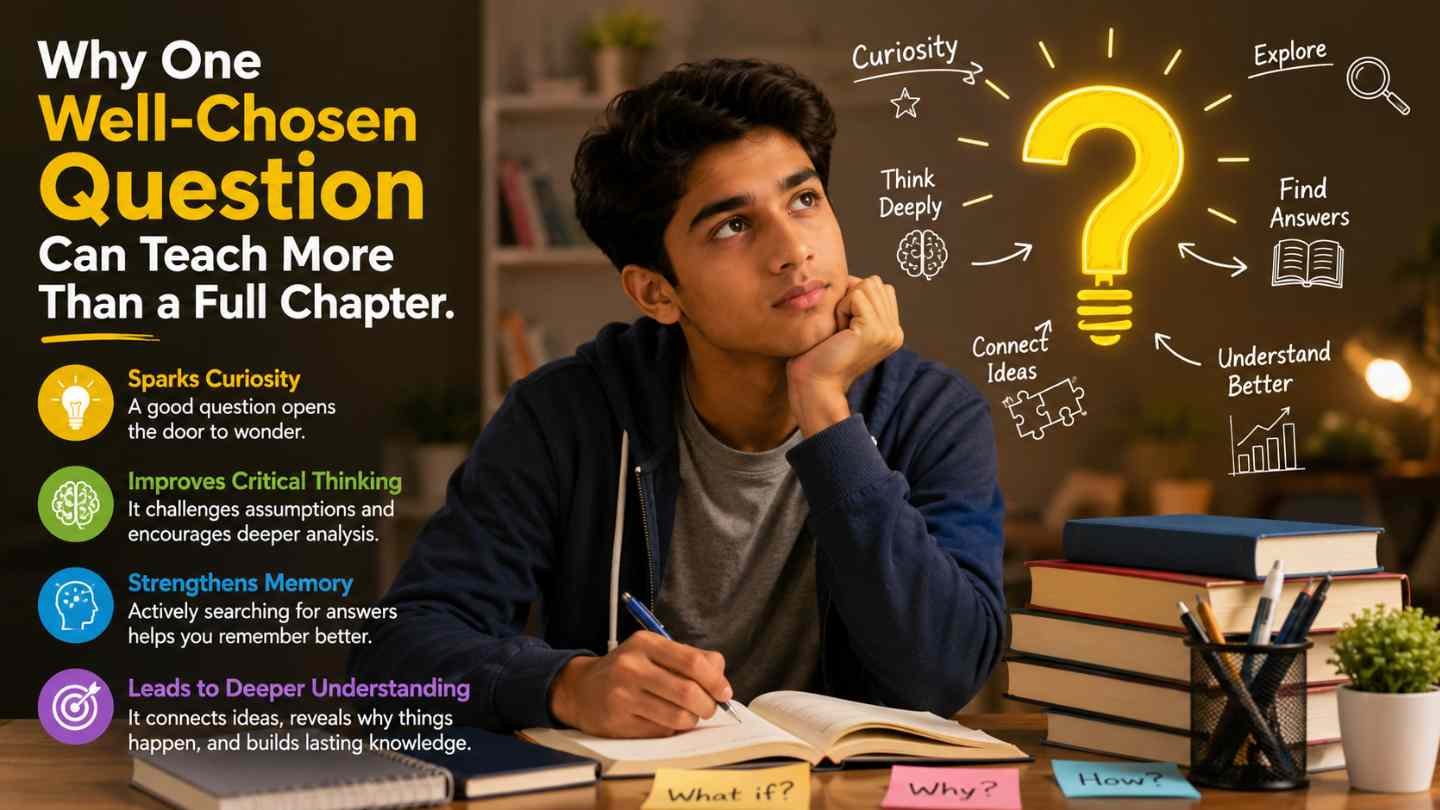
A full chapter can contain dozens of facts, explanations, dates, and examples. Yet sometimes, one carefully chosen question stays in the mind longer than everything else on the page.
That is because a strong question does more than ask for information. It creates a reason to think. It invites the learner to pause, notice connections, test assumptions, and search for an answer that feels meaningful.
Good questions turn learning from a passive activity into an active one. Instead of simply receiving information, you begin working with it.
What Makes a Question “Well-Chosen”?
A well-chosen question is not necessarily difficult. It is thoughtful, focused, and open enough to encourage exploration.
For example, compare these two questions:
- What year did the French Revolution begin?
- Why were ordinary people willing to risk their lives during the French Revolution?
The first question checks whether you remember a date. The second asks you to think about inequality, political power, hunger, public anger, and human motivation.
Both questions have value, but the second one can open the door to an entire chapter’s worth of understanding.
A useful question often does at least one of the following:
- Reveals a connection
- Challenges an assumption
- Encourages explanation
- Creates curiosity
- Applies an idea to real life
- Makes the learner compare possibilities
The best questions do not merely ask, “What is the answer?” They also make us wonder, “Why does this answer matter?”
A Question Gives the Brain a Purpose
Reading without a question can feel like walking through a large building without knowing what you are looking for. You may see many things, but very little stands out.
A question gives the brain a target.
Suppose you are reading a chapter about climate change. Without a guiding question, you might underline definitions, statistics, and scientific terms. Much of that information may disappear from memory a few days later.
Now imagine beginning with this question:
How could a two-degree increase in temperature affect the food on my table?
Suddenly, the chapter becomes personal. You begin noticing information about drought, crop production, transportation, food prices, and weather patterns. The facts are no longer isolated. They are pieces of a larger answer.
The question organizes your attention.
Thoughtful Questions Spark Curiosity
Curiosity often begins when we notice a gap between what we know and what we want to understand.
A well-chosen question creates that gap without making the learner feel completely lost. It offers enough familiarity to feel approachable, but enough mystery to encourage investigation.
Consider the question:
Why does the moon look larger near the horizon?
Many people have observed this, but fewer know how to explain it. That small mystery can lead to lessons about visual perception, distance, comparison, astronomy, and even the way the brain interprets its surroundings.
Curiosity makes people more willing to read, search, discuss, and experiment. Instead of learning because they were told to, they learn because they genuinely want to know.
Curiosity Changes the Role of the Learner
When curiosity is absent, learning can feel like information being delivered to you.
When curiosity is present, you become the investigator.
You begin asking follow-up questions:
- Is my first explanation correct?
- What evidence supports it?
- Are there other possible answers?
- Does this happen everywhere?
- How could I test it?
One useful question frequently produces several better ones.
Questions Strengthen Critical Thinking
Critical thinking involves more than knowing facts. It means examining evidence, recognizing assumptions, comparing explanations, and deciding whether a conclusion is reasonable.
Questions make these mental processes visible.
For example, imagine seeing a popular claim online that says a certain habit guarantees success. Rather than accepting or rejecting it immediately, you could ask:
What evidence would prove that this claim is true?
That question encourages you to examine the source, the sample size, the definition of success, and possible exceptions. You may also ask whether the claim confuses correlation with causation.
A full article about media literacy might explain all these ideas. One well-chosen question can prompt you to practice them immediately.
Questions Help Us Challenge Assumptions
Many mistakes begin with assumptions we do not realize we are making.
Imagine that a student performs poorly on a test. A quick conclusion might be, “I am bad at this subject.”
A better question would be:
Which part of my preparation failed: understanding, memory, practice, or time management?
That question transforms a broad negative judgment into a useful investigation. The student may discover that the problem was not ability at all. Perhaps they understood the lessons but did not practice retrieving the information under time pressure.
Questions help separate facts from emotional conclusions.
Why Questions Improve Memory
Information becomes easier to remember when the brain has actively searched for it.
If you read an answer immediately, you may recognize it without truly learning it. Recognition can create the illusion that you know something. But when you try to answer a question before checking the explanation, your brain must retrieve, organize, and express the information.
This effort strengthens memory.
That is one reason quizzes can be powerful learning tools when they are used for more than scoring. A good quiz question creates a moment of active recall. Reviewing why an answer is correct adds context and reinforces the connection.
For instance, an engaging history quiz for building historical understanding can encourage learners to retrieve facts, notice patterns between events, and identify topics they want to explore further.
The educational value does not end when the correct answer appears. The most useful moment may come afterward, when the learner asks:
Why was my answer right or wrong?
Questions Create Mental Hooks
A question gives new information somewhere to attach.
Suppose someone simply tells you that octopuses have three hearts. You may remember the fact for a few minutes.
But imagine first being asked:
Why might an octopus need more than one heart?
Now you are thinking about its body, movement, underwater environment, and circulation. When you discover the answer, the fact has a richer mental structure around it.
It is no longer a floating piece of trivia. It belongs to a story.
One Question Can Lead to Deeper Understanding
Memorization tells you what happened. Understanding helps you explain why it happened, how it connects to other ideas, and when it might matter again.
A powerful question can move learning through several levels:
- Recall the information.
- Explain it in your own words.
- Connect it to something else.
- Apply it in a different situation.
- Examine its limitations.
Take the simple scientific question:
Why does ice float?
Answering it properly can lead to the structure of water molecules, density, temperature, aquatic ecosystems, and the survival of life beneath frozen lakes.
A single question becomes a pathway through several related concepts.
Practical Examples from School
Questions can improve almost any school subject when they move beyond basic recall.
Mathematics
Instead of only asking, “What formula should I use?” ask:
Why does this formula work, and what would happen if one value changed?
This encourages students to understand the relationship between numbers rather than mechanically following steps.
Science
Instead of memorizing the parts of a plant, ask:
What would happen to the plant if one of these parts stopped working?
The question turns a diagram into a functioning system.
Literature
Instead of asking only who the main character is, ask:
What belief causes the character to make their most damaging decision?
This opens discussion about motivation, conflict, personality, and consequences.
History
Instead of memorizing a sequence of events, ask:
Which event made the outcome almost impossible to avoid?
Students must weigh causes rather than simply list them.
Geography
Instead of asking where a city is located, ask:
How has its location influenced the way people live and work there?
This connects geography to climate, transportation, trade, culture, and population.
Using Better Questions in Quizzes
Quiz questions are often treated as tiny tests. They can also be starting points for learning.
After answering a question, pause before moving on. Ask yourself:
- What clue helped me?
- Was I certain or guessing?
- What related fact does this remind me of?
- What would make the other options correct?
- What new question does this answer create?
News quizzes are especially useful for this approach because current events rarely exist in isolation. A headline may connect to history, economics, geography, science, or public policy.
Working through a daily news quiz for current-events learning can become more educational when you investigate the background behind unfamiliar answers instead of focusing only on the final score.
One question about an election, scientific discovery, international agreement, or cultural event may lead to a much broader understanding of the world.
Asking Questions While Reading
Many people reach the end of a page without remembering what they have just read. Their eyes moved across the words, but their minds had no specific task.
Before reading, choose one question you want the text to answer.
For example:
- What problem is the author trying to solve?
- Which idea would the author most want me to remember?
- What evidence is strongest?
- What does the author assume the reader already believes?
- Where could this idea be useful in real life?
After reading, answer the question without looking back immediately. Then return to the text and see what you missed.
This small habit makes reading more active and helps reveal whether you truly understood the material.
Questions in Everyday Life
Learning does not happen only in classrooms, books, or quizzes. Daily decisions provide constant opportunities to ask better questions.
Imagine that you repeatedly spend more money than expected each month. The surface question might be:
Where did my money go?
A more useful question could be:
Which situations make me spend without planning?
That question may reveal habits involving stress, convenience, social pressure, or boredom. It leads to a deeper understanding of behavior rather than a simple review of receipts.
Other everyday questions might include:
- Why does this task always take longer than I expect?
- What made this conversation become tense?
- Which part of my routine gives me the most energy?
- What evidence am I using to make this decision?
- Am I solving the real problem or only the most visible symptom?
A thoughtful question can turn an ordinary experience into a practical lesson.
Better Questions for Self-Learning
Self-learning gives you freedom, but it also removes the structure normally provided by a teacher. Questions can create that structure.
Before studying a topic, ask:
What would I need to explain to prove that I understand this?
This keeps you from collecting information without developing usable knowledge.
During your study session, ask:
- What is still unclear?
- Which part can I explain without notes?
- What example could I create myself?
- How does this connect to something I already know?
- Where might this idea fail or become less useful?
At the end, try answering one final question:
What can I now see, explain, or do that I could not do before?
That question measures learning more meaningfully than the number of pages completed.
The Five-Minute Question Exercise
This exercise can be used with a lesson, article, video, quiz, conversation, or personal problem.
Minute 1: Choose the Topic
Pick one thing you recently encountered. It could be a historical event, a news story, a scientific idea, a difficult decision, or a chapter from a book.
Write the topic in one short sentence.
Minute 2: List Three Questions
Write three questions about the topic:
- One beginning with what
- One beginning with why
- One beginning with how
Do not worry about creating perfect questions yet.
Minute 3: Choose the Strongest Question
Select the question that is most likely to reveal a connection, cause, consequence, or practical application.
Questions beginning with “why” or “how” are often useful, but the wording matters more than the first word.
Minute 4: Answer Without Looking Anything Up
Write what you currently think the answer is. Include uncertainties instead of hiding them.
You might write, “I think this happened because…, but I am not sure whether…”
This step activates prior knowledge and exposes gaps.
Minute 5: Check and Improve
Use a reliable source, your notes, or the original material to check your response.
Then add one sentence:
The most important thing I misunderstood or overlooked was…
That final sentence turns correction into learning.
Common Mistakes to Avoid
Asking Questions That Are Too Broad
“What is everything I should know about science?” is too large to guide useful thinking.
Narrow it down:
Why do some materials conduct electricity while others do not?
A focused question gives you a practical starting point.
Asking Only Recall Questions
Dates, names, formulas, and definitions matter. However, relying only on recall can produce shallow knowledge.
After asking “What is it?” continue with:
- Why does it matter?
- How does it work?
- What caused it?
- What is it connected to?
- Where could it be applied?
Looking Up the Answer Too Quickly
Searching immediately removes the productive struggle that helps strengthen memory.
Spend a short moment forming your own answer first. Even an incomplete attempt prepares your brain to understand and remember the correction.
Treating Every Question as Equally Useful
Some questions create clarity. Others produce distraction.
A useful question should move you closer to understanding the main idea. It should not send you into an unrelated maze unless that exploration has a clear purpose.
Using Questions to Confirm What You Already Believe
A biased question such as “Why is this idea obviously wrong?” assumes the conclusion before the investigation begins.
A more balanced version is:
What evidence supports or challenges this idea?
Good questions should help you examine reality, not merely defend your first opinion.
Asking Without Reflecting on the Answer
A question has limited value when the answer is read and immediately forgotten.
Pause afterward. Summarize the answer, connect it to prior knowledge, or explain it to someone else. Reflection completes the learning process.
How Teachers and Parents Can Use One Powerful Question
Teachers and parents do not always need to provide longer explanations. Sometimes, asking the right question gives learners room to discover the idea themselves.
After a child makes a mistake, instead of immediately correcting it, ask:
What part of your answer are you most confident about?
This reduces defensiveness and helps identify where the reasoning changed direction.
After reading a story, ask:
Which decision changed everything?
After a science activity, ask:
What result surprised you, and why?
After a disagreement, ask:
What do you think the other person believed was happening?
These questions encourage explanation, empathy, reflection, and independent thought.
How to Recognize a Powerful Question
A strong learning question often has three qualities.
First, it is specific enough to explore. You know what subject or problem it is pointing toward.
Second, it cannot be answered meaningfully with a random guess or a simple yes or no.
Third, it continues producing value after the first answer. It reveals a connection, creates a follow-up question, changes your interpretation, or helps you make a better decision.
One useful test is to ask:
Will answering this question change what I understand or what I do?
When the answer is yes, the question is probably worth your attention.
Frequently Asked Questions
Can one question really replace an entire chapter?
Not always. A chapter may contain important details, evidence, and context that cannot be reduced to one sentence. However, one thoughtful question can provide the purpose and structure needed to understand the chapter more deeply.
The question does not necessarily replace the information. It helps unlock it.
Are open-ended questions always better?
No. Recall questions are useful for checking facts, vocabulary, formulas, and basic knowledge. Open-ended questions become especially valuable when the goal is explanation, application, comparison, or critical thinking.
Strong learning usually involves both.
What should I do when I cannot answer a question?
Begin with what you know, identify what is missing, and then look for reliable information. Not knowing the answer is not a failure. It is the point where real learning often begins.
How many questions should I ask while studying?
Quality matters more than quantity. One focused question explored carefully may be more useful than twenty questions answered in a hurry.
Start with one main question and allow follow-up questions to develop naturally.
Can this method help with test preparation?
Yes. Turn headings, notes, and key ideas into questions, then answer them without looking at the material. This practices retrieval and reveals which areas still need review.
A Better Way to Measure Learning
Finishing a chapter can feel productive, but page count is not the same as understanding.
A better measure is whether you can explain the central idea, connect it to something else, apply it to a new situation, and identify what remains uncertain.
A well-chosen question helps all four happen.
The next time you open a book, begin a lesson, answer a quiz, or face an everyday problem, do not rush to collect more information. Pause and choose one question worth exploring.
That question may teach you more than the next twenty pages—not because the pages are unimportant, but because the question gives them meaning.
Author

John turns financial data into clear, factual stories. He holds a degree in Accountancy and spent several audit seasons reconciling ledgers and verifying documentation. He studies business cases and is exploring future graduate study in management (MIT is one of the schools he’s considering; no current affiliation). Every piece is concise, well-sourced, and fact-checked, with prompt corrections when needed. Off the clock, he teaches budgeting to local teens and restores vintage bikes.