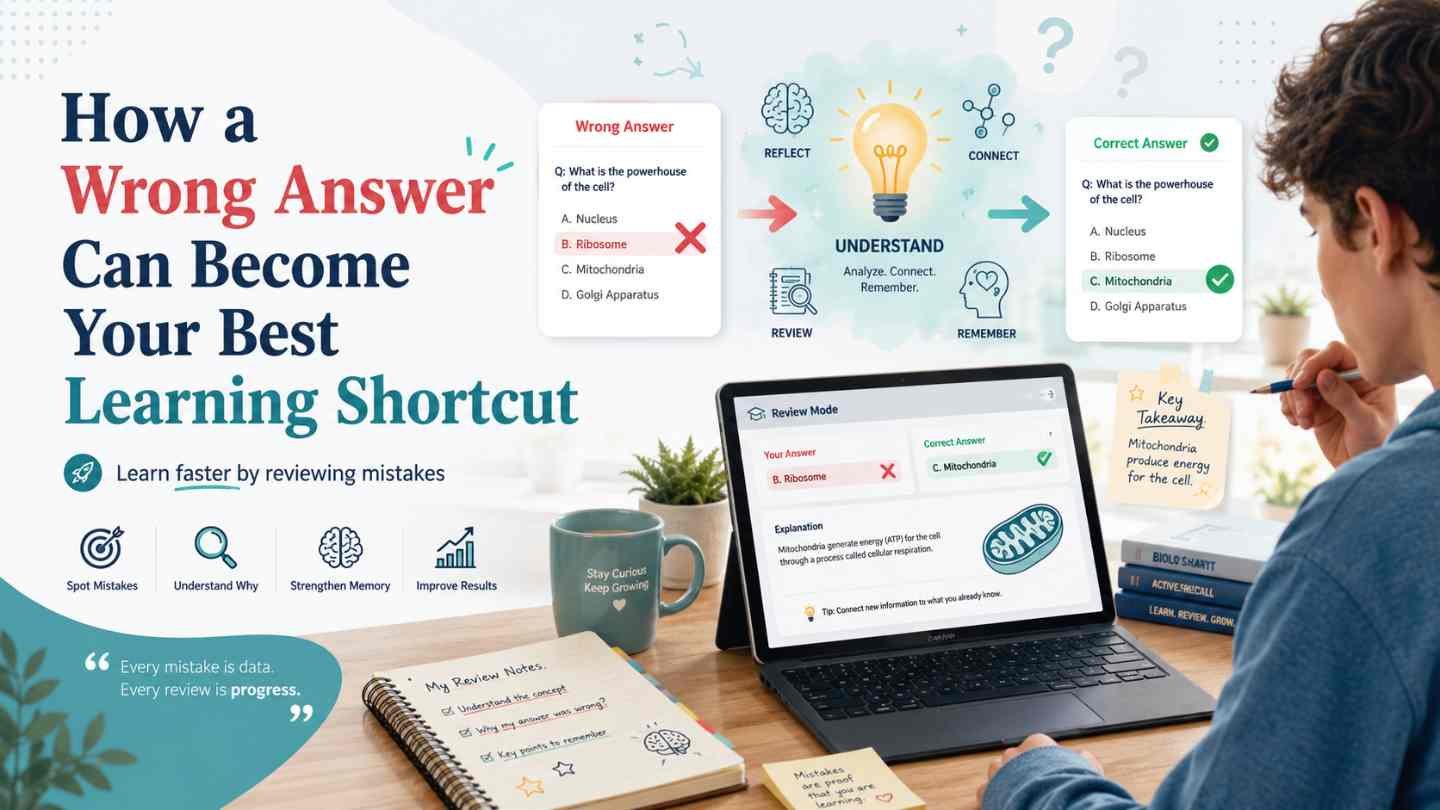
A wrong answer can feel annoying at first. You choose an option, expect to be right, then the quiz tells you otherwise. But that small mistake can become one of the fastest ways to learn, especially when you take a moment to understand what happened.
Here is the fresh angle: a wrong answer is not just a mistake. It is a little learning signal. It shows you where your memory is blurry, where your guess was too quick, or where you almost understood something but missed one important detail.
That is why quiz learning works so well. A quiz does not only test what you know. It also reveals what you only recognize, what you half-remember, and what you need to review again.
Why a Wrong Answer Can Help You Learn Faster
A wrong answer gives your brain a clear target. Instead of studying everything again, you can focus on the exact idea that confused you. That makes it a learning shortcut because it points directly to the weak spot.
For example, you may answer that the capital of Australia is Sydney because it is the most famous city. When the correct answer is Canberra, the mistake teaches you something useful: fame and capital city are not always the same thing. That one correction can stick better than simply reading the fact in a list.
This is where educational quizzes become powerful. They turn general knowledge into active recall practice. You are not just looking at facts; you are trying to pull the answer from memory, which helps reveal what is strong and what needs work.
A Wrong Answer Shows What You Misunderstood
Sometimes a wrong answer means you misunderstood the question. You may know the topic, but you missed a keyword, a date, a comparison, or a small clue. That kind of mistake is useful because it teaches you to read more carefully next time.
For example, a quiz question may ask, “Which planet is closest to the Sun?” If you answer Earth because you were thinking about life-supporting planets, the issue is not that you know nothing about space. The issue is that your brain followed the wrong clue. That is a fixable mistake.
This is why answer review matters. When you review the explanation, you can see whether the problem was memory, focus, wording, or confusion between two similar facts.
A Wrong Answer Shows What You Guessed
Not every wrong answer comes from misunderstanding. Sometimes you simply guessed. That is not bad, but it is helpful to admit it.
Guessing can reveal topics you have heard about but do not truly understand yet. You may recognize a name, place, event, or science term, but recognition is not the same as knowledge. A wrong answer exposes that gap in a very clear way.
When you use daily quizzes, this happens often. You may recognize a historical figure, a sports headline, or a science word, but the quiz forces you to choose one answer. If you guess wrong, your brain now has a reason to pay closer attention to the explanation.
A Wrong Answer Shows What You Almost Knew
Some wrong answers are actually good signs. They show that you were close. Maybe you picked the right category but the wrong person, the right century but the wrong year, or the right idea but the wrong term.
That “almost knew it” moment is valuable. It means the information is not completely new to you. Your brain already has a connection, and the correction can make that connection stronger.
For example, if you confuse Isaac Newton with Galileo in a science quiz, the mistake gives you a chance to separate their contributions. Newton becomes connected with gravity and motion. Galileo becomes connected with astronomy, telescopes, and observations. One wrong answer can help organize two facts more clearly.
How Wrong Answers Improve Memory
Memory improves when your brain has to work a little. That is why recall practice is stronger than simply rereading. When you answer a quiz question, you force your mind to search for the answer.
If you get it wrong, the correction creates a small “wait, I thought it was…” moment. That surprise can make the correct answer more memorable. Your brain notices the difference between what it expected and what is true.
This is why a wrong answer can help with memory improvement. The mistake creates contrast. Instead of seeing a fact as random information, you now see it as the answer that corrected your earlier thinking.
How to Turn Wrong Answers Into Review Notes
The best way to use a wrong answer is to write a short review note. Keep it simple. Do not copy a long explanation unless you really need it.
Use this format:
Question: What did I get wrong?
My answer: What did I choose?
Correct answer: What is right?
Reason: Why is it right?
Memory clue: What will help me remember it next time?
For example:
Question: What is the capital of Australia?
My answer: Sydney
Correct answer: Canberra
Reason: Sydney is famous, but Canberra is the capital city.
Memory clue: Famous city is not always the capital.
That kind of note is short, clear, and useful. It turns a wrong answer into a small memory tool.
Use Wrong Answers to Ask Better Questions
A wrong answer becomes even more useful when it leads to a better question. Instead of only asking, “What is the correct answer?” ask, “Why did I choose the wrong one?”
That question helps you understand your thinking. Did you rush? Did two choices look similar? Did you remember an old fact incorrectly? Did the question include a clue you ignored?
This habit makes quiz learning deeper. You are not just collecting correct answers. You are learning how your mind handles information, guesses, and familiar-looking choices.
Build a Simple Wrong Answer Review Habit
You do not need a complicated study system. After each quiz, choose three wrong answers and review them properly. That is enough to build steady progress.
First, read the explanation. Second, explain the correct answer in your own words. Third, write one memory clue. Fourth, try to answer the same question again later without looking.
This habit works well with daily quizzes because it is small and repeatable. A few minutes of review each day can make general knowledge easier to remember over time.
Use Quizzes to Find Your Learning Patterns
Wrong answers can reveal patterns. You may notice that you often miss date-based history questions, science vocabulary, world geography, or questions with tricky wording. Once you see the pattern, you can review smarter.
For example, if you keep missing questions about world capitals, you do not need to review all general knowledge topics. You can focus on geography for a few days. If you often miss entertainment or news questions, you may need more context, not just more trivia.
This is why quizzes are useful beyond the score. The score tells you how you did. The wrong answers tell you what to fix.
Why Explanations Matter More Than the Score
A wrong answer only becomes useful when you review the explanation. Without review, the mistake may simply disappear from your mind. You might even repeat the same error in the next quiz.
The explanation is where real learning happens. It shows why the correct answer is right and why the other options are not. That difference matters because it helps your brain build a stronger, cleaner memory.
So, do not treat the quiz result as the finish line. Treat it as the start of the review. The learning shortcut begins after the answer is revealed.
How Daily Quizzes Make Wrong Answers Less Frustrating
Daily quizzes make learning feel lighter because mistakes become normal. You answer a few questions, check your result, learn something new, and move on. Over time, wrong answers stop feeling like failure and start feeling like clues.
This is helpful for curiosity too. A wrong answer can make you want to know more. You may miss one question about a historical event, then suddenly feel interested enough to read the background.
That is one reason quick quiz formats work so well. You can explore facts in small pieces without feeling overwhelmed. You can try a daily challenge like the Bing Daily Homepage Quiz guide or test your thinking with the Genius Quiz challenge and use every missed answer as a review clue.
Practical Tips for Learning From Wrong Answers
1. Do Not Skip the Explanation
The correct answer alone is not enough. Read why it is correct. The reason behind the answer is what helps memory become stronger.
2. Mark Guessed Answers
Even if you guessed correctly, mark it. A lucky guess still shows weak knowledge. Review it the same way you would review a wrong answer.
3. Compare Similar Choices
Many quiz mistakes happen because two choices look close. Compare them side by side. Ask what makes one correct and the other wrong.
4. Turn the Mistake Into a Memory Clue
A memory clue can be a short phrase, connection, or example. Keep it easy to remember. The simpler it is, the more useful it becomes.
5. Revisit the Question Later
Do not review once and forget it. Try the same question again after a day or two. If you can answer it without help, the mistake has become real learning.
Example: Turning a Wrong Answer Into a Shortcut
Imagine a quiz asks: “Which organ pumps blood throughout the body?” You answer “lungs,” but the correct answer is “heart.” That mistake shows a mix-up between breathing and circulation.
A useful review note would be: “Lungs help with oxygen exchange; the heart pumps blood.” That one sentence clears the confusion. Now you have a simple memory clue that separates two related body systems.
This is how a wrong answer becomes a shortcut. It does not just tell you that you were wrong. It helps you understand the exact difference you need to remember.
The Best Mindset for Wrong Answers
The best mindset is simple: a wrong answer is feedback, not a final judgment. It does not mean you are bad at learning. It means the quiz found something that needs attention.
That is actually good news. Hidden weak spots are harder to fix. Visible weak spots are easier to review, practice, and remember.
When you treat mistakes this way, quizzes become more enjoyable. You are no longer trying to protect a perfect score. You are using every result to become sharper.
FAQs About Wrong Answers and Quiz Learning
1. Why is a wrong answer useful in learning?
A wrong answer is useful because it shows exactly where your knowledge is weak, unclear, or incomplete. It gives you a specific point to review instead of making you study everything again.
2. Can wrong answers improve memory?
Yes, wrong answers can support memory improvement when you review them properly. The correction creates contrast between what you thought and what is true, which can make the correct answer easier to remember.
3. What should I do after getting a quiz question wrong?
Read the explanation, identify why your answer was wrong, and write a short note in your own words. Then try to answer the question again later without looking.
4. Is guessing bad during quizzes?
Guessing is not bad, but you should mark guessed answers for review. A guess can reveal topics you recognize but do not fully understand yet.
5. How can I turn a wrong answer into a learning shortcut?
Focus on the reason behind the mistake. Ask what confused you, what clue you missed, and what simple memory clue can help you answer correctly next time.
6. Are daily quizzes good for learning?
Daily quizzes can be very helpful because they give regular recall practice. They work best when you review explanations instead of only checking your score.
7. Why do I keep choosing answers that look familiar?
Familiar answers feel safe because your brain recognizes them. But recognition is not the same as true understanding. Quizzes help reveal the difference.
8. Should I review only wrong answers?
Wrong answers are important, but you should also review guessed answers and confusing correct answers. Sometimes you get the right answer without fully knowing why.
9. How many wrong answers should I review after each quiz?
Start with three. Reviewing a few mistakes carefully is better than rushing through many corrections without understanding them.
10. What if I feel discouraged by wrong answers?
Try to see them as clues, not failures. Each wrong answer gives you a clear place to improve, and that makes your next review more focused.
Final Thoughts
A wrong answer can become your best learning shortcut because it shows you exactly what needs attention. It can reveal what you misunderstood, what you guessed, and what you almost knew. That makes your review more focused and your memory stronger.
But the shortcut only works when you slow down long enough to learn from the mistake. Read the explanation, understand why the correct answer is right, and turn the lesson into a simple note or memory clue. Over time, those small corrections can make quiz learning more useful, more enjoyable, and much easier to remember.
Author

Robert creates quizzes grounded in real-life issues and clear sourcing. He has moderated online communities, where he verified facts and kept discussions balanced. He’s preparing to apply for a Social Work degree in the UK (the University of Edinburgh is on his list; no current affiliation). His work uses transparent citations and original writing with proper attribution, and updates or corrections are noted when needed. Off the page, he volunteers at a local food bank and hikes long-distance trails.