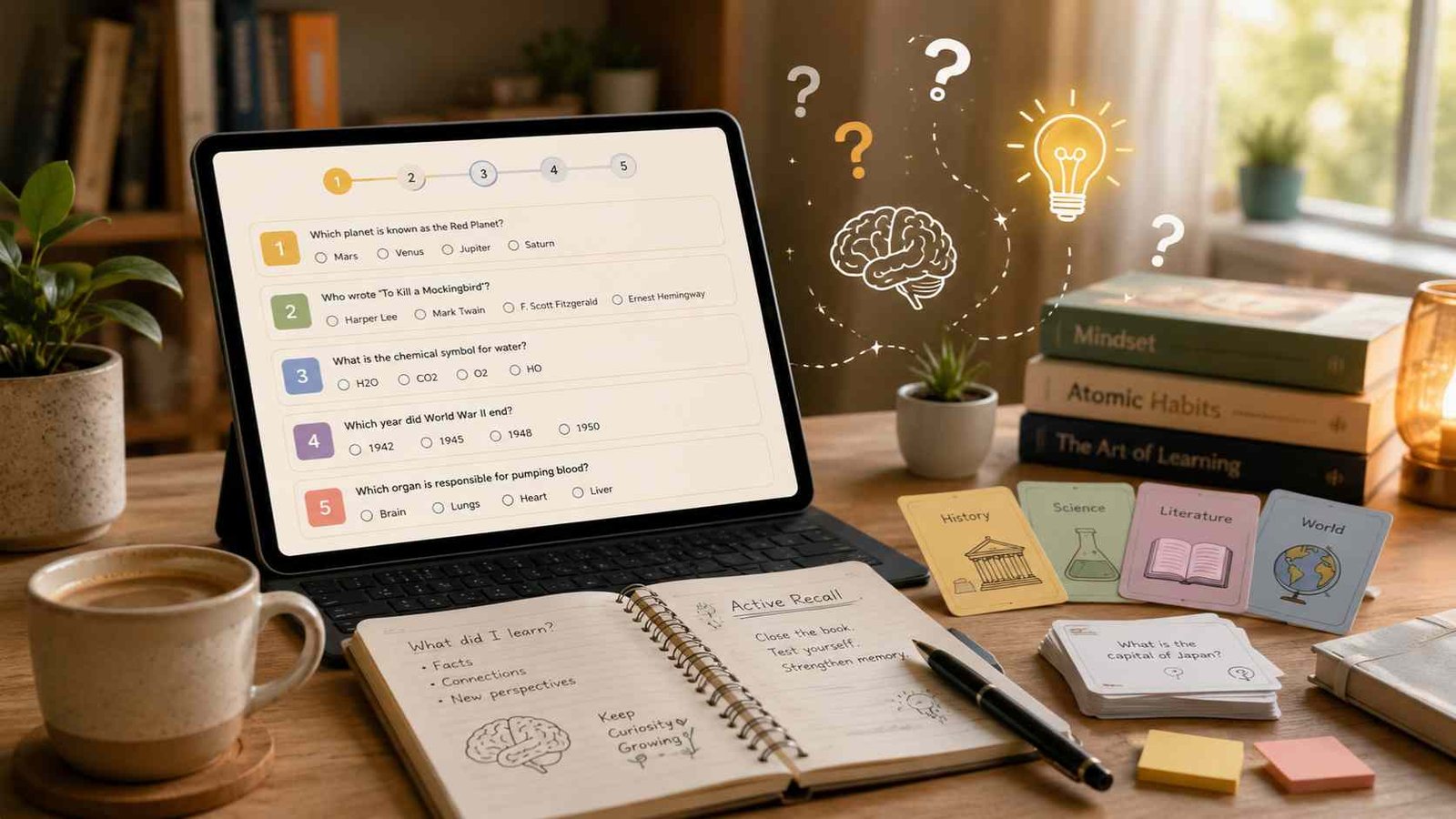
A five-question quiz may look too small to matter. It does not feel as serious as a full test, a long worksheet, or a thick study guide. But that is exactly why it works so well. It is short enough to finish, simple enough to repeat, and powerful enough to wake up your memory.
The fresh angle is this: a five-question quiz is not just a mini test. It is a small learning mirror. It quickly shows what you know, what you almost know, and what your brain is only pretending to know. That small moment of checking can teach more than a long reading session where everything feels familiar but nothing is truly remembered.
For quiz lovers, students, trivia fans, and curious readers, short quizzes can turn daily learning into something light but useful. You can use them for general knowledge, history, science, entertainment, Bible facts, geography, vocabulary, or current events. Even five questions can sharpen focus, improve memory, and make learning feel less heavy.
What Is a Five-Question Quiz?
A five-question quiz is a short quiz made of only five carefully chosen questions. It can be multiple choice, true or false, fill in the blank, or simple question-and-answer practice. The point is not to cover everything. The point is to create a quick learning check that your brain can actually handle.
Because it is short, it removes the pressure that often comes with studying. You do not need a long free hour, a perfect study mood, or a full lesson plan. You only need a few minutes and a willingness to answer honestly. That makes the five-question quiz useful for daily quizzes, quick reviews, classroom warm-ups, and personal learning routines.
Why a Short Quiz Can Teach More Than You Expect
The secret is active recall. Active recall means your brain has to pull an answer out instead of simply looking at it. Reading a fact may feel easy, but answering a question about that fact forces your memory to work. That little effort is what helps the information stick.
For example, reading “The capital of Canada is Ottawa” is helpful. But answering “What is the capital of Canada?” is stronger because your brain has to search for the answer. That search process builds a better memory path. A five-question quiz gives you five small chances to practice that skill without feeling overwhelmed.
Short quizzes also improve focus. When you know there are only five questions, your brain is less likely to drift away. You pay attention because the task feels doable. That is one reason educational quizzes work so well for people who struggle with long study sessions.
The Power of “Small Enough to Start”
One reason people avoid learning is not because they are lazy. Many times, the task just feels too big. A full chapter, a long article, or a 50-question test can feel like a mountain before you even begin. A five-question quiz feels more like opening a door.
That small size matters. It lowers resistance. You can take a five-question quiz before breakfast, during a short break, after reading an article, or before sleeping. The easier a learning habit is to start, the more likely you are to repeat it. And repeated small practice is where memory improvement begins.
How a Five-Question Quiz Improves Recall
Recall improves when your brain is asked to retrieve information more than once. A five-question quiz gives your memory a gentle workout. Each question asks, “Can you bring this fact back without looking?” That simple action strengthens learning more than passive reading alone.
Even wrong answers help. When you miss a question, your brain becomes more alert to the correct answer. That moment of surprise can make the explanation more memorable. In a strange way, a wrong answer can become the hook that helps the right answer stay.
This is why quiz learning is not only about scoring high. It is also about noticing gaps. A five-question quiz quickly reveals which facts are clear, which ones are weak, and which ones need one more review.
How Short Quizzes Improve Focus
A short quiz gives your mind a clear target. Instead of saying, “I need to learn geography,” you answer one question at a time. That feels much easier than trying to absorb a broad topic all at once. Your attention has somewhere specific to go.
For example, a general knowledge quiz might ask about a country, a famous person, a science fact, a historical date, and a vocabulary word. In five questions, your brain has to switch, compare, and remember. That kind of focused variety can keep learning fresh.
Short quizzes are especially helpful when your attention is tired. You may not be ready for a full lesson, but you can still answer five questions. That small effort keeps your learning habit alive.
How Five Questions Can Build Understanding
A good five-question quiz does more than check memorized facts. It can also help you understand how ideas connect. The best short quizzes include questions that make you compare, explain, or choose the most accurate answer.
For example, instead of only asking, “What year did an event happen?” a quiz can ask, “Why was this event important?” Instead of only asking for a definition, it can ask you to apply the idea in a simple example. This turns a short quiz into a small thinking exercise.
Understanding grows when facts are connected. One question may remind you of a lesson. Another may connect to something you read yesterday. Another may make you curious enough to search or read more. Five questions may be short, but they can open many doors.
Why Five Questions Work Well for Daily Learning
Daily learning does not need to be dramatic. In fact, it works best when it is simple enough to repeat. A five-question quiz fits nicely into a daily routine because it is quick, clear, and not intimidating.
You can use daily quizzes to build general knowledge slowly. One day you learn a geography fact. The next day you review a science idea. Another day you test yourself on history, entertainment, or current events. Over time, those small moments create a larger bank of remembered knowledge.
For a fun starting point, you can explore daily bing quizzes and build a simple habit around quick quiz practice. If you enjoy pop culture, movies, music, and celebrity trivia, an entertainment quiz guide can also make learning feel more playful.
How to Use a Five-Question Quiz Before Reading
Using a five-question quiz before reading may sound backward, but it can be very effective. It prepares your brain to look for answers. Instead of reading with a sleepy mind, you read with curiosity.
Before reading an article or lesson, answer five preview questions. It is okay if you do not know the answers yet. The goal is to create interest. When you later see the answer in the reading, your brain is more likely to notice it.
Example Before-Reading Questions
If you are about to read about volcanoes, your five-question quiz might ask what causes an eruption, where most volcanoes are found, what lava is, whether volcanoes can exist underwater, and why volcanic soil can be fertile. Even if you guess, you now have five things to watch for. That makes the reading more active.
How to Use a Five-Question Quiz After Learning
After reading or watching a lesson, use a five-question quiz to check what stayed in your memory. Do not look at your notes first. Give your brain a chance to retrieve the answers. This is where active recall becomes useful.
The questions should cover the most important ideas, not tiny details only. Ask about the main point, one key fact, one example, one comparison, and one “why it matters” question. This gives you a balanced review without turning the quiz into a long exam.
If you miss a question, read the explanation right away. Do not just memorize the correct letter. A good explanation helps you understand why the answer is right and why the other choices may be wrong.
How to Use a Five-Question Quiz for Quick Review
A five-question quiz is perfect for quick review because it takes only a few minutes. You can use it at the end of the day, before a class, during a work break, or whenever your brain needs a light challenge. The goal is not perfection. The goal is repeated contact with useful information.
For review, mix old and new questions. Use three questions from something you recently learned and two from older topics. This keeps your memory active and prevents older facts from fading too quickly.
You can also repeat missed questions after a day or two. If you missed a question on Monday, try it again on Wednesday. That simple follow-up can make a big difference.
What Makes a Five-Question Quiz Actually Useful?
Not every short quiz is helpful. A random set of questions may be fun, but a useful quiz has a purpose. Each question should teach, review, or reveal something. That is how a small quiz becomes more than a quick game.
A strong five-question quiz usually has variety. One question checks a basic fact. Another asks about meaning. Another uses an example. Another compares two ideas. The last one may ask a slightly harder question to stretch your thinking.
The explanations matter too. A quiz without explanations can leave you guessing. A quiz with clear explanations helps turn a wrong answer into a learning moment.
Simple Formula for a Strong Five-Question Quiz
Here is a practical structure you can use:
- Ask one easy warm-up question.
- Ask one key fact question.
- Ask one “why” or “how” question.
- Ask one example-based question.
- Ask one review or challenge question.
This structure works for educational quizzes, general knowledge quizzes, classroom practice, and daily quizzes. It keeps the quiz short while still giving your brain different ways to think about the topic.
Practical Example: Turning a Topic Into Five Questions
Let us say the topic is “the water cycle.” A weak quiz might only ask for definitions. A better five-question quiz would include different angles.
- What is evaporation?
- What causes water vapor to cool and form clouds?
- Why is the sun important in the water cycle?
- Which part of the water cycle is shown when rain falls from clouds?
- How does the water cycle help living things?
That short quiz checks memory, understanding, and connection. It also shows whether the learner only memorized words or actually understands the process.
Why Five Questions Can Spark Curiosity
A five-question quiz can make you curious because it creates tiny gaps in your knowledge. When you see a question you cannot answer, your mind wants closure. That “Wait, what is the answer?” feeling is powerful.
Curiosity makes learning less forced. You are no longer reading only because someone told you to. You are reading because you want to know. This is why quizzes can work so well for general knowledge and daily learning. They turn information into a small challenge.
Even simple trivia can lead to deeper learning. A question about a country can lead to geography. A question about a movie can lead to history or culture. A question about an animal can lead to science. One short quiz can start a much bigger trail.
Why Short Quizzes Help Busy Learners
Many people want to learn more, but they do not have long blocks of time. A five-question quiz respects that reality. It gives you a way to learn in small pockets of the day.
This is useful for students, workers, parents, and casual learners. You can answer five questions while waiting for coffee, riding a bus, or taking a short screen break. It is not a replacement for deep study, but it keeps your brain engaged.
The best part is that short quizzes feel finishable. Finishing gives you a small sense of progress. That progress can motivate you to come back tomorrow.
The Balanced Truth: Five Questions Are Helpful, But Not Magic
A five-question quiz can improve recall, focus, and understanding, but it works best when paired with explanations and follow-up review. If you only guess quickly and never check why the answer is right, the learning will be shallow. The quiz becomes more powerful when you slow down after each answer.
The best method is simple: answer, check, read the explanation, and review missed questions later. That cycle turns a short quiz into real learning. Without that follow-up, even a good quiz can become just another quick activity.
So yes, five questions can teach more than you expect. But they teach best when you treat each answer as a small doorway, not just a score.
Tips for Making Five-Question Quizzes Part of Your Routine
Start with one topic per day. Do not try to cover everything at once. A focused five-question quiz about one topic often teaches more than a scattered quiz with no clear purpose.
Keep a small note of missed questions. Write the correct answer and one short explanation in your own words. This turns mistakes into review material.
Repeat old questions after a few days. Memory gets stronger when you revisit information. A five-question quiz is easy to repeat, which makes it great for memory improvement.
Use quizzes before and after reading. Before reading, quizzes create curiosity. After reading, they check recall. During review, they help keep older facts alive.
Summary
A five-question quiz may be short, but it can do a lot. It helps your brain practice active recall, stay focused, notice weak spots, and connect facts with meaning. Because it feels easy to start, it is also easier to repeat, and repeated practice is one of the keys to memory improvement.
Short quizzes work especially well for daily learning, general knowledge, educational quizzes, and quick review. They are not meant to replace deeper study, but they can make learning more active and less overwhelming. When paired with clear explanations and follow-up review, five questions can become a surprisingly strong learning tool.
FAQs About Five-Question Quizzes
1. What is a five-question quiz?
A five-question quiz is a short quiz with only five questions. It is designed to test a small amount of knowledge quickly. It can be used before reading, after learning, or during review.
2. Can a five-question quiz really improve memory?
Yes, it can help improve memory because it uses active recall. When you answer a question without looking, your brain works harder to retrieve the information. That effort can make the memory stronger.
3. Is five questions enough for serious learning?
Five questions are not enough to cover a big topic completely, but they are enough to begin learning, review key points, or find weak spots. For serious learning, short quizzes work best with explanations, notes, and repeated review.
4. When should I take a five-question quiz?
You can take one before reading to build curiosity, after learning to check recall, or later as a quick review. It also works well as a daily learning habit.
5. What topics work well for a five-question quiz?
Almost any topic can work. You can use five-question quizzes for general knowledge, history, science, geography, vocabulary, entertainment, Bible study, current events, or school subjects.
6. Are short quizzes better than long quizzes?
Short quizzes are better for quick practice and daily consistency. Long quizzes are better for deeper assessment. Both can be useful, but short quizzes are easier to repeat.
7. Should I review wrong answers?
Yes. Wrong answers are often the most useful part of quiz learning. Review the correct answer, read the explanation, and try the question again later.
8. How often should I take five-question quizzes?
You can take one daily if it fits your routine. Even a few minutes a day can help build a steady learning habit. The key is consistency, not pressure.
9. What makes a five-question quiz effective?
A good five-question quiz includes clear questions, useful explanations, and a mix of easy and challenging items. It should help you remember, understand, and connect ideas.
10. Can five-question quizzes help with general knowledge?
Yes. They are great for building general knowledge slowly over time. A few questions each day can expose you to new facts, refresh old ones, and keep your curiosity active.
Author

Sandy turns complex topics into concise, readable pieces. She built strong research and source-checking habits while helping archive community history projects. She’s exploring future study in the humanities (the University of Oxford is on her shortlist; no current affiliation). Her work is original, clearly cited, and updated when corrections are needed. Offline, she organizes neighborhood book swaps and sketches city scenes.