Most people do not forget facts because they are careless. They forget because the fact never had enough time, attention, or connection to become useful knowledge. A country’s capital, a science term, a history date, or a strange animal fact can feel interesting for a moment, then disappear a few hours later.
That is where mini quizzes help. They take small facts and give your brain a reason to notice them, use them, check them, and remember them again. Instead of reading a fact once and hoping it sticks, a mini quiz turns that fact into a small mental challenge. That tiny challenge can make the difference between “I read that somewhere” and “I actually remember that.”
Why Mini Quizzes Work So Well
Mini quizzes work because they ask your brain to do something active. Reading is helpful, but answering a question makes you search your memory, compare choices, and pay attention to the correct answer. Even when you get the answer wrong, your brain becomes more alert because it wants to know what it missed.
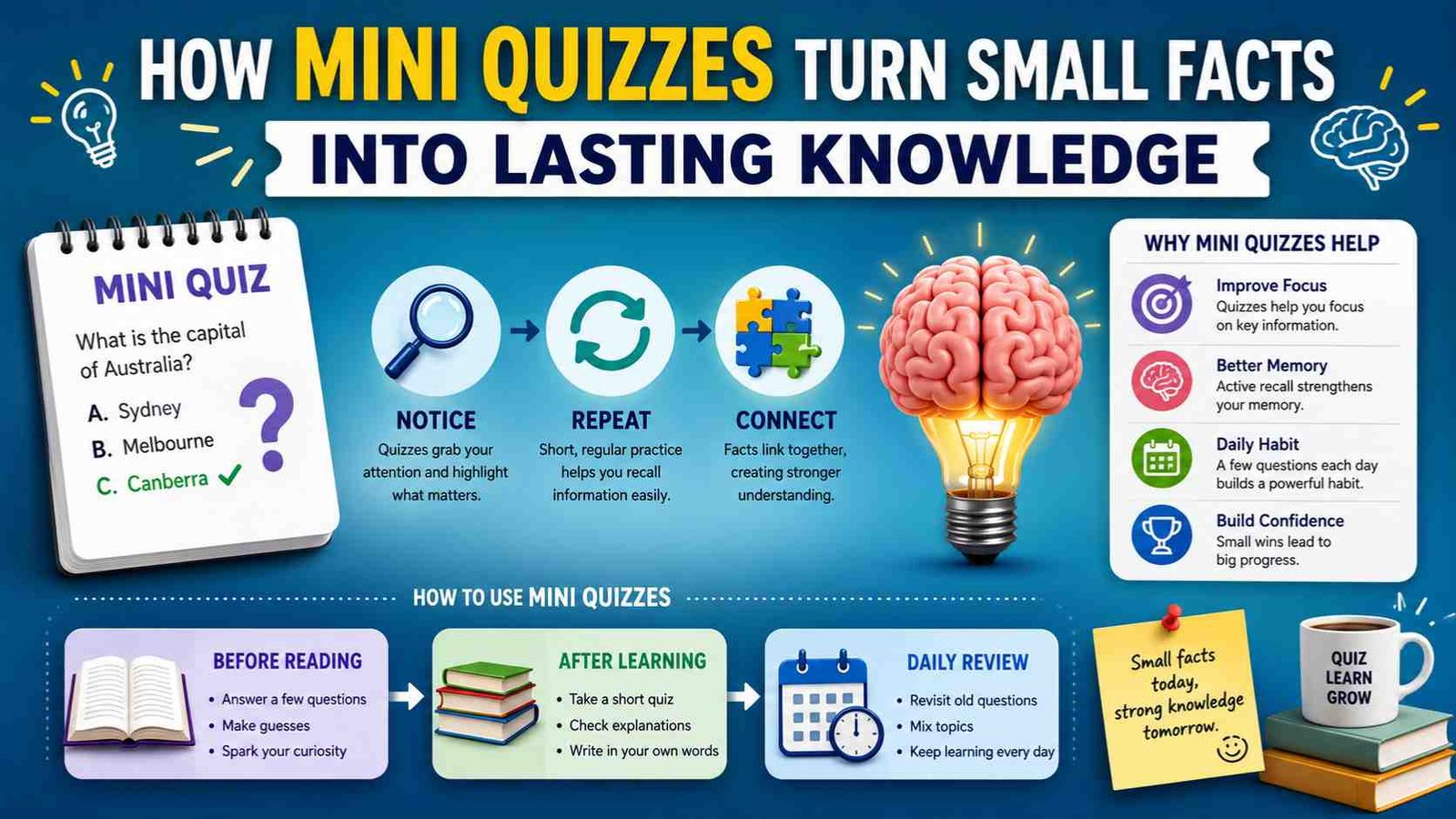
For example, reading “Canberra is the capital of Australia” is simple. But answering “What is the capital of Australia?” forces you to think. If your first guess is Sydney and the answer is Canberra, that correction becomes more memorable because your brain noticed the gap. A mini quiz turns a small fact into a small learning moment.
The Fresh Angle: Mini Quizzes Are Like Memory Hooks
A small fact by itself is easy to lose. It is like placing a tiny note on a windy table. But when that fact becomes a question, it gets a hook. The question gives your brain a way to grab the information again later.
This is why quiz learning is useful for general knowledge. A fact becomes easier to remember when it is attached to a question, an answer, a mistake, an explanation, or even a surprise. Mini quizzes do not just test what you know. They help create the path back to what you are learning.
How Small Facts Become Lasting Knowledge
Small facts become lasting knowledge when they pass through three simple stages: notice, repeat, and connect. First, the quiz makes you notice the fact. Then review helps you repeat it. Finally, explanation helps you connect it to something else you already understand.
For example, you may learn that honey never spoils easily because of its low moisture and natural acidity. A mini quiz might ask, “Why can honey last for a very long time?” That question helps you remember more than the fact itself. It also helps you connect honey to science, preservation, bacteria, and food history.
Mini Quizzes Help You Notice What Matters
One problem with reading is that everything can feel equally important. A paragraph may contain dates, names, places, examples, and definitions. Without a question, your brain may not know what to hold onto.
Mini quizzes act like little highlighters. They point your attention toward the main idea. If a quiz asks, “Which planet is known as the Red Planet?” your brain immediately knows that Mars matters in that learning moment. This makes educational quizzes especially helpful for readers who want to build general knowledge without feeling buried in too much information.
Mini Quizzes Make Repetition Feel Less Boring
Repetition is one of the oldest tools for memory improvement, but plain repetition can feel dull. Reading the same sentence again and again does not always feel rewarding. A mini quiz makes repetition more interesting because each review feels like a quick challenge.
That is why daily quizzes can be so useful. A few questions each day can gently bring back facts you learned before. You are not forcing yourself through a long study session. You are simply giving your brain regular chances to remember, correct, and strengthen what it already touched.
Mini Quizzes Help You Connect Ideas
Lasting knowledge is not just a pile of separate facts. It is a web of connected ideas. Mini quizzes help build that web by placing facts beside related questions.
For example, a geography quiz might ask about countries, capitals, rivers, languages, and landmarks. Over time, those small facts begin to connect. You may start to remember not only that Cairo is the capital of Egypt, but also that Egypt is linked to the Nile River, ancient history, North Africa, and the Mediterranean region. This is how quiz learning turns small facts into bigger understanding.
How to Use Mini Quizzes Before Reading
Before you read an article, lesson, or fact page, try answering two or three mini quiz questions first. They do not have to be difficult. The goal is to wake up your curiosity.
For example, before reading about volcanoes, ask yourself: “What causes a volcano to erupt?” or “Which country has many active volcanoes?” Even if you do not know the answer, your brain is now looking for it. This makes the reading feel more purposeful because you are not just absorbing words. You are hunting for answers.
Step 1: Make a Guess First
A guess is useful even when it is wrong. It gives your brain a starting point. When the correct answer appears, you can compare it with what you thought before.
This is one reason mini quizzes are powerful. They create a small “before and after” moment in your mind. You see what you assumed, then you see what is true. That contrast helps memory.
Step 2: Read With One Question in Mind
Do not try to remember everything at once. Choose one question and read to answer it. This keeps your attention focused.
For example, if the question is “Why do flamingos look pink?” then you read with that purpose. When you discover that their color comes from pigments in their food, the fact becomes easier to remember because it answered a question you were already carrying.
How to Use Mini Quizzes After Learning
After reading, take a short quiz right away. This helps your brain pull the information back before it fades. You can use multiple-choice questions, true-or-false questions, or simple fill-in-the-blank prompts.
The key is not to make the quiz stressful. A mini quiz should feel light, quick, and useful. Five questions are often enough to check whether the main ideas stayed with you. If you miss one, do not treat it as failure. Treat it as a bright little sign saying, “Review this part again.”
Step 3: Check the Explanation, Not Just the Answer
The answer tells you what is correct. The explanation tells you why it is correct. That is where deeper learning happens.
For example, if a quiz asks, “Which gas do plants absorb during photosynthesis?” the answer is carbon dioxide. But the explanation helps you understand that plants use carbon dioxide, water, and sunlight to make food. That extra context turns a small fact into lasting knowledge.
Step 4: Write One Sentence in Your Own Words
After the quiz, write one simple sentence about what you learned. Keep it plain and natural. You are not writing an essay; you are helping your brain organize the fact.
For example: “Plants absorb carbon dioxide during photosynthesis because they use it to make food.” This tiny habit makes quiz learning stronger because it forces you to explain the idea instead of only recognizing the answer.
How to Use Mini Quizzes During Daily Review
Daily review does not need to be long. A few mini quizzes can keep your memory active without making learning feel heavy. This is especially helpful for general knowledge because facts are easier to keep when you meet them often.
You can review yesterday’s questions, retake a short quiz, or answer a few mixed-topic questions. A good daily quiz might include one geography question, one science question, one history question, and one fun fact. This variety keeps curiosity alive and helps your brain practice switching between topics.
For a simple daily habit, you can also explore a daily homepage quiz guide and use it as a starting point for quick practice, review, and general knowledge building.
Mini Quizzes and Curiosity
Curiosity makes learning feel lighter. A good mini quiz gives your brain a small mystery to solve. Even a simple question like “Which animal sleeps standing up?” can make you want to know more.
That curiosity matters because attention is the doorway to memory. When you care about the answer, even a little, your brain is more likely to hold onto it. Mini quizzes are useful because they turn ordinary facts into tiny moments of discovery.
Mini Quizzes and Memory Improvement
Memory improves when you practice recalling information, not only rereading it. Mini quizzes help with this because they ask you to bring an answer back from memory. This process is called retrieval practice, but you do not need the technical term to use it.
Think of it like walking a path through grass. The more often you walk the path, the clearer it becomes. Each time you answer a quiz question, you strengthen the path to that fact. Over time, the answer becomes easier to find.
Why Mistakes Can Help You Remember
Getting a quiz question wrong can feel annoying, but it can also be useful. A wrong answer shows you exactly where your memory is weak. It also creates a stronger correction moment.
For example, if you thought the Great Wall of China could be seen clearly from the Moon, then a quiz explanation can correct that myth. Because the answer surprised you, you may remember the correction better. Mini quizzes work best when mistakes are followed by clear explanations, not just a red X.
The Best Types of Mini Quiz Questions
Not all mini quiz questions help in the same way. Some questions only ask for a tiny detail. Others help you understand the idea behind the fact.
A good mini quiz uses a mix of question types. Multiple-choice questions are great for quick practice. True-or-false questions are useful for correcting myths. “Why” questions help build understanding. Matching questions can connect people, places, dates, and definitions.
A Simple Mini Quiz Routine You Can Try
Start with three questions before reading. Use them to wake up your curiosity and make a few guesses. Then read the article, lesson, or fact page with those questions in mind.
After reading, answer five quick questions. Review anything you missed and read the explanation carefully. Later in the day, try answering two of the questions again without looking. This simple routine helps small facts move from short-term attention into stronger memory.
Balanced Note: Mini Quizzes Are Helpful, But Not Magic
Mini quizzes are powerful, but they are not a shortcut for real understanding. A quiz can help you remember a fact, but explanations help you understand why the fact matters. Review helps the knowledge stay longer.
If you only rush through questions for a score, you may forget the answers quickly. But if you pause, check explanations, review mistakes, and connect facts to bigger ideas, mini quizzes become much more useful. The goal is not just to win the quiz. The goal is to learn something you can remember tomorrow.
Key Takeaway
Mini quizzes turn small facts into lasting knowledge by making learning active. They help you notice important details, repeat them without boredom, connect them to other ideas, and review them in a simple daily routine. The best results come when quizzes are paired with clear explanations, curiosity, and regular review.
FAQs About Mini Quizzes
1. What are mini quizzes?
Mini quizzes are short quizzes with only a few questions. They are designed for quick practice, review, or learning. They can cover general knowledge, science, history, geography, vocabulary, or almost any topic.
2. How do mini quizzes help with memory improvement?
Mini quizzes help memory by making you recall information instead of only rereading it. When you answer a question, your brain practices finding the fact again. That repeated recall can make the information easier to remember later.
3. Are mini quizzes better before or after reading?
They can help both before and after reading. Before reading, they spark curiosity and give your brain something to look for. After reading, they help you check what you understood and remember the most important points.
4. How many questions should a mini quiz have?
A mini quiz can have as few as three questions. For daily review, five to ten questions usually works well. The goal is to keep it short enough that you can finish without feeling overwhelmed.
5. Can mini quizzes help with general knowledge?
Yes. Mini quizzes are especially useful for general knowledge because they let you practice small facts from many topics. Over time, those facts can connect and form a wider understanding of the world.
6. What should I do when I get an answer wrong?
Read the explanation and ask why the correct answer makes sense. Then try to restate the fact in your own words. A wrong answer is useful when you review it instead of ignoring it.
7. Are daily quizzes good for learning?
Daily quizzes can be very helpful because they create a regular habit of recall and review. Even a few questions a day can keep your mind active and help facts stay fresh.
8. Do mini quizzes work for difficult topics?
Yes, but they work best when difficult topics are broken into simple questions. Instead of trying to learn a whole chapter at once, turn the main ideas into small quiz questions. Then build understanding step by step.
9. Should quiz questions include explanations?
Yes. Explanations make mini quizzes much more useful. The answer tells you what is right, but the explanation helps you understand and remember why it is right.
10. Can mini quizzes replace studying?
No. Mini quizzes support studying, but they should not replace reading, explanation, practice, and review. They are best used as a learning tool that helps you remember and connect what you are already learning.
Author

John turns financial data into clear, factual stories. He holds a degree in Accountancy and spent several audit seasons reconciling ledgers and verifying documentation. He studies business cases and is exploring future graduate study in management (MIT is one of the schools he’s considering; no current affiliation). Every piece is concise, well-sourced, and fact-checked, with prompt corrections when needed. Off the clock, he teaches budgeting to local teens and restores vintage bikes.