Most people treat wrong answers like tiny failures. They see the red mark, feel annoyed for a second, and move on. But in quiz learning, a wrong answer can be more useful than a correct one because it shows you exactly where your brain guessed, rushed, misunderstood, or forgot something important.
That is where a wrong answer notebook becomes powerful. It is not just a list of mistakes. It is a personal learning map that shows what you need to review, what keeps confusing you, and what facts deserve a second look. For anyone who enjoys educational quizzes, daily quizzes, general knowledge questions, or memory improvement, this simple habit can turn missed answers into steady progress.
What Is a Wrong Answer Notebook?
A wrong answer notebook is a place where you record quiz questions you got wrong, along with the correct answer and a short explanation. It can be a physical notebook, a notes app, a spreadsheet, or even a section in your study journal. The format does not matter as much as the habit.
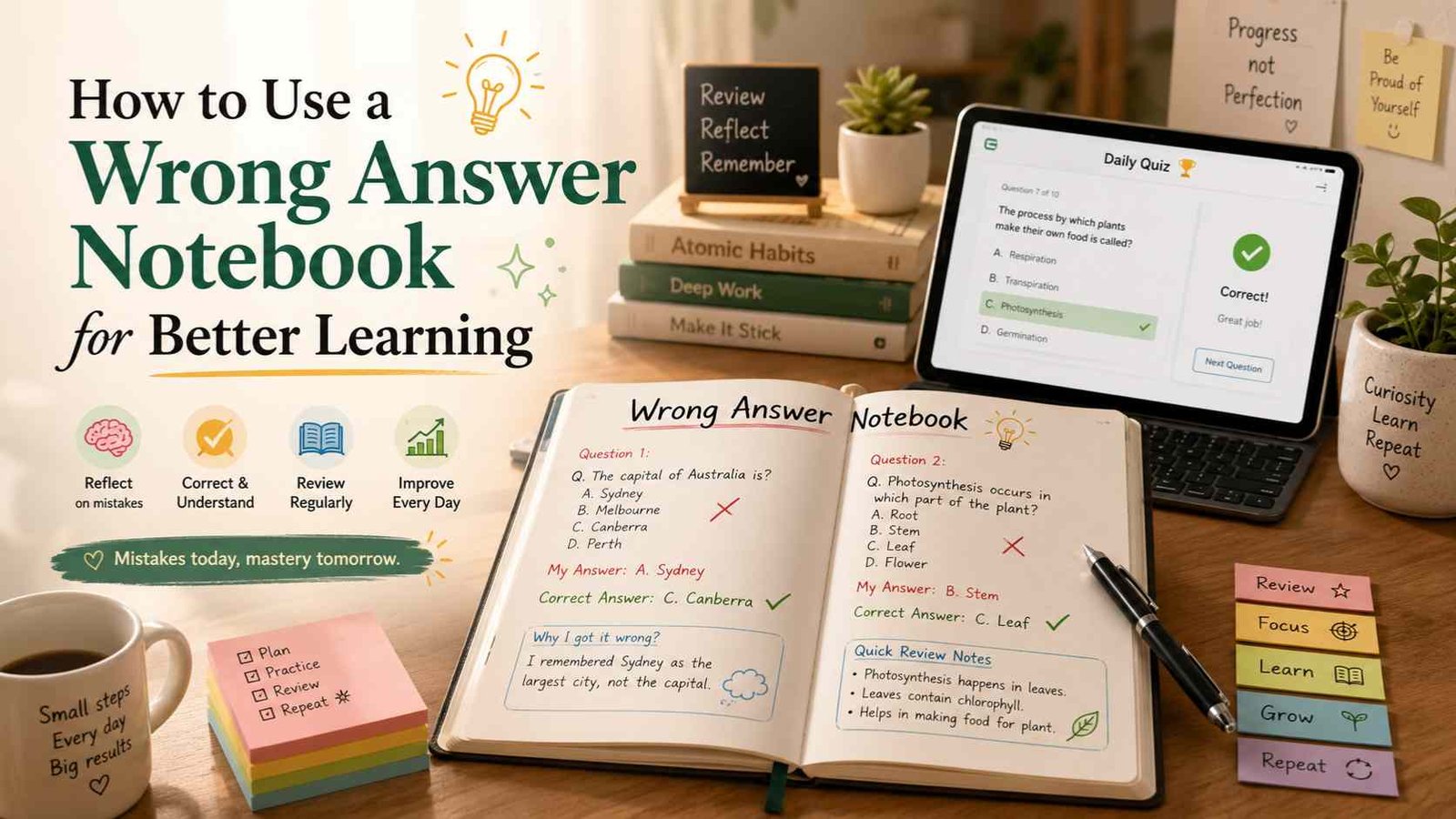
The goal is simple: do not let wrong answers disappear. When you write them down, you give yourself a chance to understand the mistake instead of repeating it. For example, if you answered that Sydney is the capital of Australia, your notebook would show the question, your wrong answer, the correct answer, and a quick note: “Australia’s capital is Canberra, not Sydney. Sydney is a major city, but not the capital.”
Why Wrong Answers Help You Learn Better
A correct answer can feel good, but a wrong answer often teaches more. It exposes the exact point where your knowledge broke down. Maybe you confused two similar names. Maybe you remembered a fact halfway. Maybe the question had a tricky wording that made you choose too quickly.
Reviewing mistakes also supports memory improvement because it forces active thinking. Instead of reading facts passively, you ask, “Why did I miss this?” That small question makes your brain work harder, and harder thinking often leads to stronger memory. In daily quizzes, this matters a lot because repeated review helps turn weak knowledge into familiar knowledge.
The Fresh Angle: Treat Mistakes Like Search History for Your Brain
A wrong answer notebook is not a punishment book. Think of it more like your brain’s search history. It shows what your mind tried to find, where it clicked the wrong result, and what answer it should choose next time.
This makes learning feel less personal and more practical. You are not saying, “I am bad at geography” or “I never remember history.” You are saying, “I keep mixing up capital cities,” or “I need to review dates from World War II,” or “I rush when science questions include similar terms.” That shift makes mistakes easier to fix.
How to Set Up a Wrong Answer Notebook
1. Create Simple Sections
Keep your notebook easy to use. If the setup is too complicated, you will stop using it after a few days. A good format includes the quiz question, your answer, the correct answer, a short explanation, and a review note.
You can divide your notebook by topic, such as history, science, geography, entertainment, sports, Bible trivia, or general knowledge. You can also keep everything in date order if you prefer daily quiz practice. The best system is the one you will actually maintain.
2. Write the Question Clearly
Do not only write the correct answer. Write enough of the question so you understand the context later. A single word like “Canberra” will not help much when you review it next week.
For example, write: “What is the capital of Australia?” Then add your wrong answer and the correct answer. This helps you practice the full idea, not just memorize a loose fact.
3. Record Your Wrong Answer Honestly
This part matters more than people think. Write the answer you chose, even if it feels silly afterward. Your wrong answer reveals the pattern behind the mistake.
If you wrote “Sydney,” that tells you something. You may be confusing the most famous city with the capital. If you wrote “Melbourne,” maybe you remember that Melbourne was once important historically but forgot the current capital. These details help you understand how your thinking went off track.
4. Add the Correct Answer
Next, write the correct answer in a clear way. Make it easy to spot when you review. You do not need a long textbook explanation every time, but you should know exactly what the right answer is.
For example: “Correct answer: Canberra.” Simple. Clean. No drama. The notebook should help you learn, not make you feel like you are doing paperwork for a quiz court.
5. Explain the Answer in Your Own Words
This is the step that makes the wrong answer notebook useful. Do not just copy the correct answer and move on. Add one or two sentences explaining why it is correct.
For example: “Canberra is the capital of Australia. Sydney is bigger and more famous, but Canberra was chosen as the capital city.” That short explanation gives your memory a hook. The next time you see a similar question, you are less likely to fall for the same trap.
A Simple Wrong Answer Notebook Template
You can use this format for quiz learning:
Date: June 1, 2026
Topic: Geography
Question: What is the capital of Australia?
My Answer: Sydney
Correct Answer: Canberra
Why I Missed It: I confused the most famous city with the capital.
Review Note: Famous city does not always mean capital city.
Here is another example:
Date: June 1, 2026
Topic: Science
Question: What gas do plants absorb during photosynthesis?
My Answer: Oxygen
Correct Answer: Carbon dioxide
Why I Missed It: I mixed up what plants absorb with what they release.
Review Note: Plants absorb carbon dioxide and release oxygen during photosynthesis.
This format works because it is short, but it still captures the mistake, the correction, and the reason behind it.
How to Use It With Daily Quizzes
Daily quizzes are perfect for a wrong answer notebook because they give you small learning moments every day. You do not need to study for hours. You only need to collect the few questions that challenged you and review them later.
For example, after taking a general knowledge quiz, write down only the questions you missed or guessed. If you enjoy quiz-style learning, you can try a daily challenge like the Bing Homepage Quiz guide and use your notebook to track the questions that surprised you. If you prefer pop culture, movies, music, and celebrities, an entertainment-style quiz such as the Bing Entertainment Quiz practice guide can also give you fun mistakes worth reviewing.
How Often Should You Review Your Wrong Answers?
Reviewing once is helpful, but reviewing more than once is where the real improvement happens. A simple schedule works best: review your wrong answers the next day, again after three days, and once more after a week. You do not need to reread everything forever.
During review, cover the correct answer and try to answer the question again. If you get it right, mark it as improved. If you miss it again, add a stronger explanation or a memory clue. The point is not to shame yourself for forgetting; the point is to make the answer easier to remember next time.
Turn Mistakes Into Better Questions
One smart way to use a wrong answer notebook is to rewrite missed questions in your own words. This makes you think more deeply about the idea behind the answer. Instead of only memorizing one question, you learn the topic around it.
For example, if you missed “What is the largest planet in the solar system?” do not stop at “Jupiter.” Add related review questions: “Which planet is known for the Great Red Spot?” and “Is Jupiter a gas giant or a rocky planet?” Now one wrong answer has turned into a small learning cluster.
Use Tags to Spot Patterns
After a week or two, your notebook may start showing patterns. Maybe most of your mistakes are from geography. Maybe you miss questions with dates. Maybe you do well with science facts but struggle with literature, entertainment, or world history.
Use simple tags like “capital cities,” “dates,” “definitions,” “famous people,” “sports,” or “movies.” These tags help you see what to review next. They also make study habits more targeted because you are no longer guessing what you need to improve.
Keep Explanations Short but Meaningful
A common mistake is writing too much. Your wrong answer notebook should not become a full encyclopedia. Long notes can make review tiring, especially if you are using it after daily quizzes.
Aim for short explanations that answer three things: What is correct? Why is it correct? Why did I miss it? That is enough for most educational quizzes. When a topic is more difficult, you can add a little more detail, but keep the main point easy to review.
Why This Helps Memory and Curiosity
A wrong answer notebook improves memory because it uses active recall and answer review. You are not just seeing facts again. You are testing yourself, correcting yourself, and connecting the right answer to the reason you missed it.
It also builds curiosity. A wrong answer often makes you wonder, “Wait, why is that the answer?” That question can lead you to read more, take another quiz, check a map, watch a short explanation, or explore a topic you would have ignored before. In that way, mistakes can become doorways instead of dead ends.
Mistakes Only Help When You Review Them
Here is the balanced part: getting answers wrong does not automatically make you smarter. Mistakes help only when you review them, understand them, and try again. If you keep missing the same question without checking why, the mistake becomes a habit.
A wrong answer notebook works because it slows you down just enough to learn from the miss. It gives your brain a second chance. But it should be paired with explanation, review, and real understanding. Memorizing the correct answer without knowing why may help once, but understanding helps across many quizzes.
Practical Tips to Make the Habit Stick
Start small. Record three to five wrong answers per quiz session instead of trying to capture everything. Choose the mistakes that surprised you, confused you, or seem likely to appear again.
Review your notebook before taking another quiz. This turns old mistakes into warm-up practice. You can also highlight repeated mistakes so they stand out. If you keep missing questions about countries and capitals, spend five extra minutes with a map. If you keep missing entertainment questions, group them by movies, music, TV, and celebrity trivia.
Conclusion
A wrong answer notebook is one of the simplest tools for better quiz learning. It turns missed answers into useful review notes, helps you spot weak areas, and makes daily quizzes more meaningful. Instead of forgetting your mistakes, you collect them, study them, and use them to build stronger memory.
The real power is not in writing down every wrong answer. It is in understanding why you missed it and giving yourself a better chance next time. When used consistently, a wrong answer notebook can make educational quizzes feel less like random guessing and more like steady, enjoyable learning.
Author

John turns financial data into clear, factual stories. He holds a degree in Accountancy and spent several audit seasons reconciling ledgers and verifying documentation. He studies business cases and is exploring future graduate study in management (MIT is one of the schools he’s considering; no current affiliation). Every piece is concise, well-sourced, and fact-checked, with prompt corrections when needed. Off the clock, he teaches budgeting to local teens and restores vintage bikes.