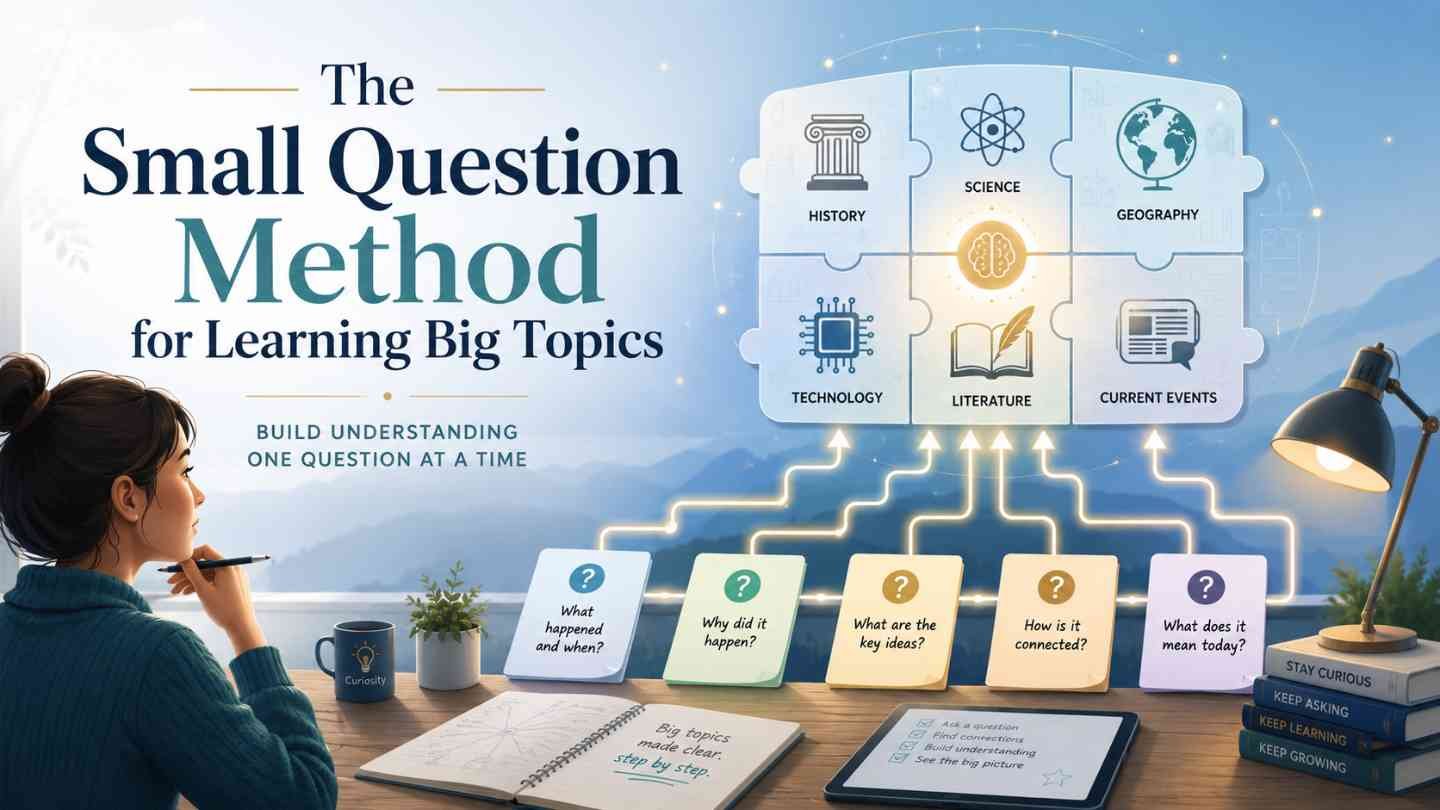
Big subjects often feel difficult before the learning even begins. A topic such as climate change, the Roman Empire, artificial intelligence, or world politics can contain so many names, dates, causes, terms, and competing ideas that it is hard to know where to focus first. Trying to understand everything at once usually creates mental clutter rather than clarity.
The small question method takes a different approach. Instead of treating a large subject as one enormous block of information, it turns the subject into a series of short, answerable questions. Each answer becomes a building block, and those blocks gradually form a clearer picture of the whole topic.
This is one reason quizzes can be more useful than they initially appear. A good quiz question does not need to explain an entire subject. It only needs to direct your attention toward one meaningful piece of it.
What Is the Small Question Method?
The small question method is a focused learning technique that breaks a broad subject into manageable questions. You answer one question, check the result, understand the explanation, and then connect that answer to the next idea.
Suppose you want to learn about the Industrial Revolution. Starting with “Explain the Industrial Revolution” may feel too broad. A more approachable starting point would be:
- Where did the Industrial Revolution begin?
- Which industry changed first?
- What role did the steam engine play?
- Why did people move into cities?
- How did factory work affect ordinary families?
Each question narrows your attention. Instead of searching through a large amount of information without direction, you have a specific fact, relationship, or explanation to find.
Why Large Topics Become Easier Through Small Questions
A complicated subject is rarely built from one complicated idea. It is usually made from many smaller ideas that interact with one another. Learning becomes easier when those pieces are examined individually before they are connected.
Small Questions Reduce Confusion
Broad questions can create uncertainty because they do not tell you where to begin. A person studying astronomy might ask, “How does the universe work?” That question is interesting, but it covers more material than anyone could reasonably answer in one sitting.
Smaller questions create useful boundaries. “What is a galaxy?” leads to “How is a galaxy different from a solar system?” That can lead to “Where is our solar system located within the Milky Way?” The learner is still exploring the universe, but now there is a visible path through the subject.
They Narrow Your Attention
Focused learning happens when your mind knows what detail to look for. A short question directs attention toward a particular name, cause, definition, sequence, comparison, or location.
For example, while reading about World War I, you might easily overlook the importance of alliances. A question such as “Which countries belonged to the Triple Entente?” encourages you to notice and remember that relationship. The question acts like a spotlight rather than asking you to absorb the entire page equally.
They Build Understanding Step by Step
One answer may seem small on its own, but several connected answers can reveal a much larger pattern. You might first learn where the Amazon River begins, which countries it crosses, what kind of climate surrounds it, and why its basin contains such rich biodiversity. Together, those facts become more than isolated trivia.
This gradual structure also makes it easier to notice missing knowledge. When one answer does not make sense, you can identify the exact gap instead of feeling that the whole subject is confusing.
Small Questions as Building Blocks
The real strength of the method is not simply that the questions are short. It is that they can be arranged in a useful order.
Imagine building a house. A pile of bricks is not yet a structure, no matter how many bricks you collect. In the same way, memorizing hundreds of unrelated facts does not automatically create understanding. The facts need connections.
A sequence about volcanoes might begin with definitions, move into causes, and finish with effects:
- What is magma?
- How does magma differ from lava?
- Why does pressure build beneath Earth’s surface?
- What causes a volcanic eruption?
- How can eruptions change nearby land and climate?
The questions become progressively more connected. By the final question, the learner is no longer recalling a single definition but using several smaller ideas to understand a process.
Practical Examples Across Different Subjects
The small question method can be used for nearly any area of learning. The format stays simple, but the type of question changes depending on the subject.
History
A broad topic such as the French Revolution can be divided into questions about people, conditions, events, and consequences:
- Who ruled France when the revolution began?
- What financial problems affected the government?
- What was the purpose of the Estates-General?
- Why was the storming of the Bastille significant?
- How did the revolution change French society?
These questions create a basic timeline while also introducing cause and effect. Once the foundation is clear, deeper questions about political philosophy, class conflict, violence, and long-term influence become easier to explore.
Science
Science topics often become confusing when definitions, processes, and results are introduced together. Small questions help separate them.
For photosynthesis, you could ask:
- Which organisms perform photosynthesis?
- Where does photosynthesis occur inside plant cells?
- What role does chlorophyll play?
- Which materials does a plant use?
- What products are created?
- Why is the process important to animals and humans?
The learner moves from identifying the process to understanding its wider importance. This is far more manageable than attempting to memorize a dense scientific explanation all at once.
Geography
A country can be studied through location, physical features, population, culture, and economy. For Canada, the sequence might begin with:
- What is the capital of Canada?
- How many provinces does Canada have?
- Which ocean lies along its western coast?
- Why is much of northern Canada sparsely populated?
- Which natural resources are important to its economy?
- How have geography and climate influenced Canadian life?
Daily educational quizzes, including a quiz bing, can introduce these details one question at a time. The important next step is connecting the answers rather than treating them as unrelated facts.
Technology
Technology becomes easier to understand when unfamiliar systems are separated into their basic functions. Someone exploring artificial intelligence could begin with:
- What does artificial intelligence mean?
- What is an algorithm?
- How is machine learning related to AI?
- What is training data?
- Why can biased data affect a system’s results?
- Where is AI used in everyday life?
The early questions establish vocabulary. The later ones introduce applications, limitations, and social consequences. This progression prevents technical terms from becoming an intimidating wall of jargon.
Literature
A novel can be explored through its setting, characters, conflicts, themes, and style. For Romeo and Juliet, useful small questions might include:
- Where is the play set?
- Why are the Montagues and Capulets in conflict?
- How do Romeo and Juliet meet?
- What role does Friar Laurence play?
- Which decisions lead to the tragedy?
- What does the play suggest about conflict and impulsive action?
The first few answers establish what happens. The later questions move toward interpretation, which is where deeper literary learning begins.
Current Events
Current events can feel especially overwhelming because stories change and several issues may overlap. A small-question approach helps separate confirmed facts from opinion and speculation.
For a major international story, ask:
- What happened?
- Where and when did it happen?
- Who is directly involved?
- What events led to the situation?
- Which claims have been confirmed?
- How are different sources explaining its importance?
- What developments should be followed next?
These questions encourage careful reading. They also reduce the risk of forming a strong conclusion after seeing only a headline or a brief social media post.
How to Turn a Broad Topic Into Quiz-Style Questions
Start by writing the subject in the center of a page. Then identify the main parts someone would need to understand it. These may include definitions, people, places, dates, causes, stages, comparisons, examples, effects, and disagreements.
For a topic such as renewable energy, the main branches might be solar power, wind power, hydropower, environmental benefits, storage problems, cost, and public policy. Each branch can then become several small questions.
Good starter questions often begin with:
- What is it?
- Where does it happen?
- Who was involved?
- When did it begin?
- How does it work?
- Why did it happen?
- What changed afterward?
- How is it different from something similar?
- Why does it matter?
Begin with questions that establish basic facts. Then move toward questions that require explanation, comparison, and connection.
The Ask, Answer, Check, Connect, and Review Method
The small question method works best when it involves more than reading the correct answer. A simple five-step routine turns each question into active learning.
1. Ask One Clear Question
Choose a question narrow enough to answer in a few words or sentences. “What caused World War II?” is still too large for a first question. “Why did Germany invade Poland in 1939?” gives the learner a more precise target.
The question should focus on one fact, idea, difference, or relationship. Avoid packing several questions into one sentence.
2. Answer Before Looking
Try to retrieve the answer from memory, even when you are uncertain. This act of searching your memory is known as active recall, and it makes the exercise more valuable than simply rereading information.
You might answer fully, give a partial answer, or make an educated guess. The goal is not to appear correct. It is to discover what your mind can currently retrieve.
3. Check the Answer
Compare your response with a reliable explanation. Notice whether you were correct, partly correct, or confused by a similar detail.
Do not stop at marking the answer right or wrong. Identify what was missing. Perhaps you remembered the right person but the wrong date, understood the outcome but not the cause, or recognized a term without being able to define it.
4. Connect It to Another Question
Ask how the answer relates to something else you know. After learning that the printing press helped books become more widely available, you might ask how greater access to books affected literacy, religion, education, and political debate.
This connection step turns facts into understanding. It also gives the memory several routes back to the information later.
5. Review It Later
Return to the question after a day, several days, or a week. Try answering it again without checking your previous notes.
Questions that remain difficult deserve more frequent review. Questions that become easy can be reviewed less often or replaced with more demanding ones.
How to Link Small Answers Into a Larger Picture
A collection of answers becomes meaningful when you can explain the relationships among them. After studying five or ten small questions, pause and ask, “What story do these answers tell together?”
You can connect answers in several ways:
- Arrange events in chronological order.
- Group facts by cause and effect.
- Compare two people, systems, places, or theories.
- Place locations on a map.
- Turn scientific steps into a process diagram.
- Summarize several answers in one paragraph.
- Explain the topic aloud without looking at your notes.
Suppose you have answered questions about the causes of a hurricane, warm ocean water, low-pressure systems, wind speed, and coastal flooding. A useful summary would explain how these pieces interact. That explanation shows whether the individual facts have formed a working mental model.
Another helpful technique is the “because chain.” Begin with a fact and repeatedly ask why it matters. For example: Cities grew rapidly during industrialization because factory jobs attracted workers. Housing became crowded because population growth happened faster than urban planning. Public health reforms developed because overcrowding and poor sanitation increased disease.
Now the learner has a connected explanation rather than three separate facts.
Using Educational Quizzes for Focused Learning
Quizzes naturally support the small question method because they divide information into short challenges. A daily quiz may introduce a historical figure, scientific term, capital city, invention, or cultural tradition in less than a minute.
The score, however, is only one part of the experience. The greater learning value comes from noticing what each question reveals. A wrong answer may expose a knowledge gap, while a correct guess may show that a fact feels familiar but is not yet secure.
After completing a quiz, choose two or three questions to explore further. Ask one follow-up question about each answer. This small habit turns a brief quiz into a path toward broader general knowledge.
Building Curiosity Without Becoming Overwhelmed
Curiosity often begins with a small surprise. You learn that a familiar invention is older than expected, that a country has more than one capital, or that two historical events happened during the same period. A good small question gives curiosity somewhere specific to go.
Instead of opening ten articles and trying to understand an entire subject in one sitting, follow one question until you can explain the answer clearly. Then choose the next question that naturally follows. This keeps learning focused without making it feel rigid.
The method is also flexible enough for busy days. Five carefully chosen questions can provide a useful daily learning session. Over time, those sessions accumulate into a much wider base of knowledge.
Common Mistakes to Avoid
One mistake is making the questions so tiny that they lose meaning. Memorizing an isolated date may be useful, but it becomes more valuable when paired with questions about what happened, why it mattered, and what followed.
Another mistake is collecting too many questions without reviewing them. A long list may look productive, yet little will remain if you never practise retrieving the answers.
It is also important not to rely only on multiple-choice recognition. Answer some questions without choices, explain ideas in your own words, and create comparisons. Recognition can support learning, but genuine recall requires producing the answer yourself.
Finally, do not assume that every complicated issue has a simple answer. Some questions involve uncertainty, conflicting evidence, or several reasonable interpretations. In those cases, the small question method should help you examine the complexity rather than erase it.
Small Questions Build Foundations, Not the Entire Structure
The small question method is excellent for beginning a difficult subject, improving focus, strengthening memory, and revealing knowledge gaps. It gives learners a practical entry point when a broad topic feels too large or unclear.
Still, a collection of quiz answers is not a complete education. Deeper learning requires context, explanation, wider reading, discussion, and exposure to different viewpoints. You need to understand not only what happened, but also why sources disagree, how interpretations developed, and which details cannot be reduced to a single fact.
Think of small questions as building blocks. They help create a strong foundation, but the finished structure depends on how thoughtfully those blocks are connected.
Key Takeaway
The small question method makes learning big topics more manageable by turning them into a sequence of focused, answerable steps. Ask one clear question, attempt the answer from memory, check it carefully, connect it to a larger idea, and review it later.
A single answer may seem minor, but connected answers can reveal timelines, processes, causes, comparisons, and patterns. Used alongside educational quizzes, active recall, thoughtful explanations, and wider reading, small questions can transform an intimidating subject into a path you can actually follow.
Author

Robert creates quizzes grounded in real-life issues and clear sourcing. He has moderated online communities, where he verified facts and kept discussions balanced. He’s preparing to apply for a Social Work degree in the UK (the University of Edinburgh is on his list; no current affiliation). His work uses transparent citations and original writing with proper attribution, and updates or corrections are noted when needed. Off the page, he volunteers at a local food bank and hikes long-distance trails.