Most lessons begin with a question and slowly work toward an answer. That approach makes sense, but it is not the only way to learn.
Sometimes the answer itself is the best place to begin.
Imagine seeing the final result of an experiment before learning how it happened, reading the outcome of a historical event before studying its causes, or checking the correct answer to a quiz question before examining the explanation. Instead of ending the learning process, the answer becomes an invitation to investigate.
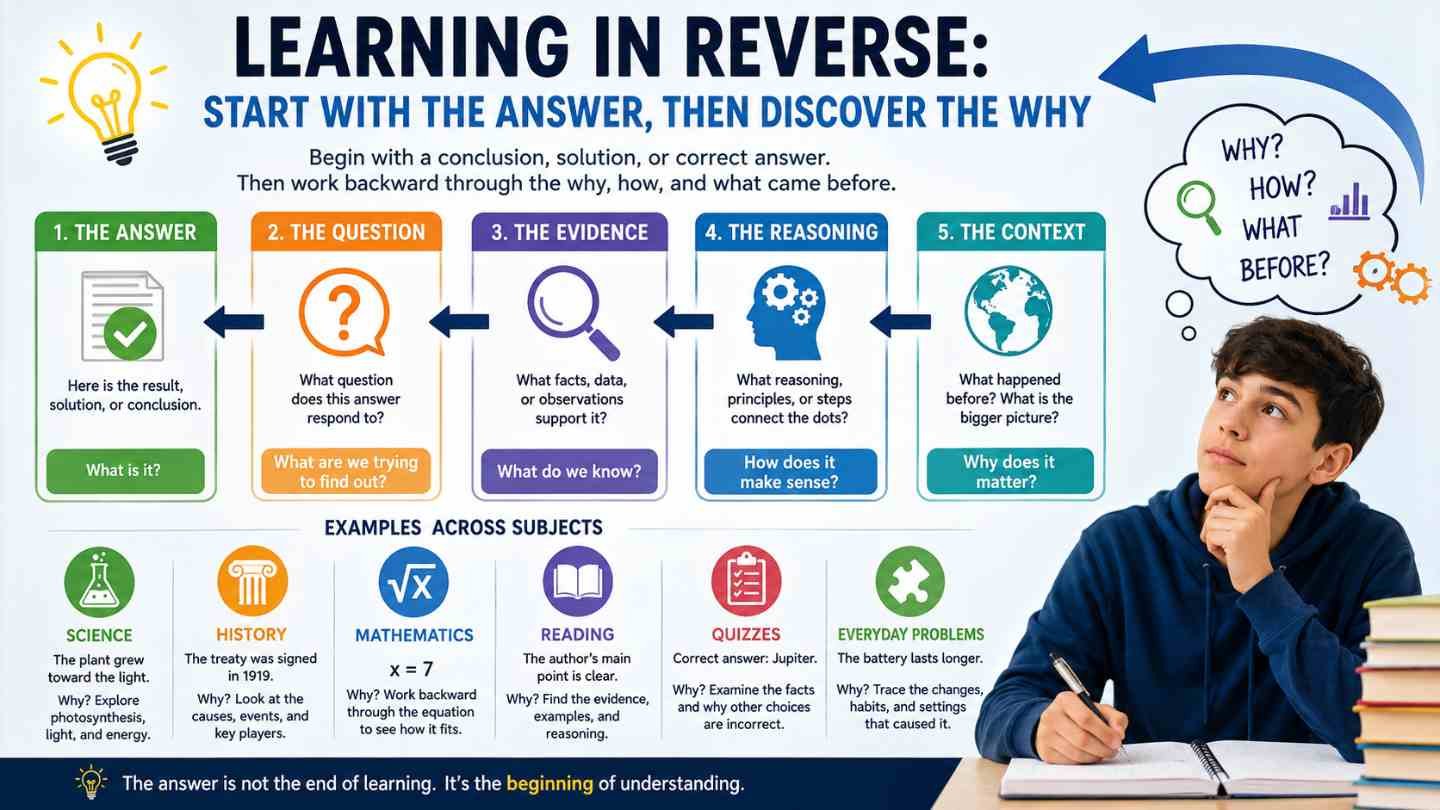
This approach can be called learning in reverse: start with the conclusion, solution, event, or correct response, then work backward to uncover the reasoning behind it.
The learner is no longer asking only, “What is the answer?” The more valuable questions become:
- Why is this correct?
- What evidence supports it?
- What happened before it?
- Which steps produced this result?
- What would have changed the outcome?
Working backward turns a finished answer into the beginning of a deeper learning journey.
What Does Learning in Reverse Mean?
Learning in reverse is a method of studying in which you examine the final result first and then trace the path that led to it.
The starting point might be:
- The solution to a mathematics problem
- The result of a scientific experiment
- The outcome of a historical event
- The meaning of a passage
- The correct response to a quiz question
- The successful resolution of an everyday problem
Instead of hiding the answer until the end, you place it in full view. Your task is to reconstruct the causes, evidence, context, decisions, or calculations behind it.
For example, suppose the answer to a geography question is “the Pacific Ocean.” You could simply memorize it and move on. Reverse learning asks you to investigate why it is correct, what comparison was being made, and which facts rule out the other oceans.
The answer becomes a clue rather than a stopping point.
Why Starting With the Answer Can Spark Curiosity
A conclusion presented without its full explanation creates a natural information gap.
You know what happened, but you do not yet know how or why it happened. That gap can make the mind curious.
Consider this statement:
A day on Venus is longer than a year on Venus.
Even without a question, the conclusion feels surprising. It encourages immediate investigation. How slowly does Venus rotate? How quickly does it orbit the Sun? What does the word “day” mean in this context?
The unusual answer pulls the learner toward the explanation.
This does not mean every fact will automatically inspire curiosity. The method works best when learners are encouraged to question the result rather than passively accept it.
Moving Backward Through Causes, Evidence, and Reasoning
Reverse learning is more than reading an answer followed by an explanation. It involves actively rebuilding the path to that answer.
A useful sequence is:
Answer → Question → Evidence → Reasoning → Context → New Questions
Suppose the conclusion is that a bridge collapsed because of structural fatigue.
You might work backward by asking:
- What signs showed that the structure was weakening?
- Which materials or components failed?
- What repeated stresses affected the bridge?
- Were inspections conducted?
- Could maintenance or design changes have prevented the collapse?
Each backward step adds depth. What began as one conclusion becomes a connected understanding of engineering, materials, maintenance, risk, and decision-making.
Learning in Reverse in Science
Science often becomes more engaging when learners first encounter a surprising result.
Starting With an Experimental Outcome
Suppose students are told:
The covered plant grew more slowly than the plant placed near a window.
They can then investigate the cause. They may explore sunlight, photosynthesis, chlorophyll, energy production, water, temperature, and other variables.
Rather than receiving a full explanation immediately, students can ask what conditions differed and which difference best explains the result.
Working Backward From a Scientific Fact
Start with the answer:
Objects fall at the same rate in a vacuum.
Now ask:
- Why do a feather and a stone fall differently in ordinary air?
- What role does air resistance play?
- Why does mass not create the difference people often expect?
- How could the claim be tested?
The fact is no longer an isolated sentence. It becomes the doorway to a scientific investigation.
Avoiding False Explanations
Reverse learning in science must remain evidence-based. Learners should not invent a cause simply because it sounds reasonable.
A possible explanation is not automatically the correct explanation. It must be tested against observations, measurements, and established scientific principles.
Learning in Reverse in History
History is usually taught in chronological order. Events are introduced one after another until students arrive at the outcome.
Reverse learning changes the direction.
Begin With the Event
Start with a major outcome, such as:
The Berlin Wall fell in 1989.
Then trace backward:
- Why was the wall constructed?
- What divided East and West Germany?
- How did the Cold War shape Berlin?
- What political and economic pressures developed?
- Which protests and policy decisions led to the opening of the border?
Beginning with the dramatic outcome can help learners see earlier events as parts of a meaningful chain rather than a collection of dates.
Separate Immediate Triggers From Deeper Causes
Historical events rarely have one simple cause. Reverse investigation helps learners distinguish between an immediate trigger and the longer conditions that made the event possible.
For example, the start of a war may be linked to one assassination, invasion, or political decision. However, working backward may reveal alliances, territorial disputes, economic pressure, nationalism, and years of rising tension.
The final event is visible. Reverse learning uncovers the layers beneath it.
Learning in Reverse in Mathematics
Mathematics is often presented as a sequence of steps leading to one answer. Starting with the solution can help learners examine whether they truly understand those steps.
Reconstructing the Calculation
Suppose the final answer is:
x = 7
The learner can work backward to create or reconstruct an equation that produces that value.
For example:
- If x + 5 = 12, subtracting 5 gives x = 7.
- If 3x = 21, dividing by 3 gives x = 7.
- If 2x − 4 = 10, adding 4 and dividing by 2 gives x = 7.
This shows that one answer can emerge from many different mathematical situations.
Checking a Solution by Substitution
Working backward is also a practical way to verify an answer.
If the equation is:
4x + 2 = 30
and the proposed answer is x = 7, substitute it into the original equation:
4(7) + 2 = 30
28 + 2 = 30
The statement is true, so the answer is confirmed.
This habit teaches learners that a solution should not merely look correct. It should survive testing.
Learning From Worked Examples
A completed example can be valuable when learners cover the intermediate steps and try to reconstruct them.
The goal is not to copy the procedure. It is to explain why each operation was necessary and what would happen if a different step were used.
Learning in Reverse While Reading
Readers often move from the opening sentence toward the author’s final conclusion. Reverse reading begins by examining the conclusion, main claim, or interpretation first.
Start With the Main Idea
Suppose the central idea of a passage is:
Small habits often shape long-term results more than occasional bursts of effort.
A reader can then return to the passage and search for:
- Examples that support the idea
- Comparisons used by the author
- Evidence or observations
- Words that signal cause and effect
- Details that challenge or qualify the claim
This turns reading into an evidence hunt.
Trace an Interpretation Back to the Text
A teacher might provide an interpretation of a story, such as:
The main character’s greatest conflict is internal rather than external.
Students can then find the dialogue, decisions, symbols, and descriptions that support or weaken that interpretation.
The interpretation is not treated as unquestionable. It becomes a claim that must be justified through the text.
Using Correct Quiz Answers as Learning Starting Points
Quizzes are often treated as tools for measuring knowledge. They can also be tools for building it.
After answering a question, the most useful moment may come when the correct response is revealed.
Ask Why the Correct Choice Works
Suppose a quiz asks:
Which planet is known for the Great Red Spot?
The correct answer is Jupiter.
Instead of stopping there, explore:
- What is the Great Red Spot?
- How long has it been observed?
- Why is it described as a storm?
- How large is it compared with Earth?
- What other features make Jupiter unusual?
One answer can produce several connected facts.
Interactive quizzes can be especially useful for this approach. A set of questions such as a gaming facts and trivia quiz can become a starting point for exploring game design, technology, character origins, and industry history rather than merely testing recall.
In the same way, a basketball knowledge quiz can lead learners into the rules of the sport, famous performances, team history, player statistics, and changes in strategy.
Examine Why the Other Choices Are Wrong
Wrong choices can be surprisingly useful.
Ask:
- Is the choice completely false?
- Is it true in another situation?
- Was it designed to sound similar to the answer?
- What detail makes it incorrect?
Understanding distractors strengthens discrimination. Learners become better at noticing the precise differences between related ideas.
Learning in Reverse in Everyday Problem-Solving
Reverse thinking is not limited to formal education. It is useful whenever you are trying to understand why something succeeded or failed.
Solving a Practical Problem
Suppose your phone battery suddenly begins lasting much longer.
Instead of simply enjoying the improvement, work backward:
- Did you reduce screen brightness?
- Was a battery-draining application removed?
- Did a software update change power usage?
- Were background processes disabled?
- Has your daily usage pattern changed?
The result is known. The task is to identify which cause most likely produced it.
Planning Backward From a Goal
Reverse learning can also begin with a desired result.
Suppose you want to complete a report by Friday afternoon. Begin with the finished report and move backward:
- When must the final review happen?
- When should the first draft be completed?
- Which data must be collected?
- Who needs to provide information?
- What must be started today?
This is sometimes called backward planning. It turns a broad goal into a sequence of manageable actions.
Investigating a Mistake
Imagine a recipe turned out too salty.
Working backward might reveal that the sauce was already seasoned, the measuring spoon was incorrect, or the liquid reduced more than expected.
The key is to avoid grabbing the first explanation. List possible causes and compare each one with the evidence.
The Difference Between Reverse Learning and Simple Memorization
Seeing the answer first can become passive memorization if the learner does nothing with it.
Memorization says:
The answer is Jupiter.
Reverse learning asks:
Why Jupiter? What feature identifies it? Why not Saturn? What related facts can I connect to this answer?
The difference is active reconstruction.
A learner using the reverse method should be able to explain the path to the answer without relying on the original explanation. Ideally, the learner should also be able to apply the reasoning to a new but related problem.
A Simple Five-Minute Reverse-Learning Exercise
Choose one answer, conclusion, or result from something you studied today.
It could come from a quiz, article, lesson, conversation, calculation, or problem you solved.
Minute 1: Write the Answer
Write the answer or conclusion in one clear sentence.
Example:
Water boils at a lower temperature at high altitudes.
Minute 2: Recreate the Question
Write the question that the answer might be responding to.
Example:
How does high altitude affect the boiling point of water?
Minute 3: List Three “Why” Questions
Ask three questions that move behind the answer:
- Why does altitude affect boiling?
- What happens to air pressure at higher elevations?
- How does lower pressure change cooking time?
Minute 4: Build the Explanation
Write two or three sentences connecting the evidence to the conclusion.
At higher elevations, atmospheric pressure is lower. Water therefore requires less heat to reach the pressure at which it begins to boil. Although it boils sooner, its temperature is lower, which can cause food to cook more slowly.
Minute 5: Create a New Question
Use what you learned to form a related question:
Why might a pressure cooker be especially useful at high altitude?
That final step moves learning beyond the original fact.
Common Mistakes to Avoid
Treating the Given Answer as Automatically Correct
An answer should be examined, not worshipped.
Check the source, evidence, calculations, and assumptions. This is especially important when the conclusion comes from an informal website, social media post, outdated material, or an unverified answer key.
Reading the Explanation Without Thinking
Seeing the answer first does not help much if you immediately read and copy the explanation.
Pause before looking at the steps. Try to predict the cause, reconstruct the method, or identify the evidence on your own.
Inventing a Story That Fits the Result
People are good at creating explanations after an outcome is known. Unfortunately, a convincing story can still be wrong.
Compare your explanation with evidence. In science, look for observations. In history, consult reliable records. In mathematics, test the solution. In everyday problems, consider multiple possible causes.
Ignoring Alternative Paths
A result may have more than one cause, and a problem may have more than one valid solution.
Do not assume the first path you discover is the only path. Exploring alternatives often reveals which parts of the reasoning are essential and which are optional.
Focusing Only on Correct Answers
Incorrect attempts contain useful information. They can reveal mistaken assumptions, skipped steps, confusing wording, or gaps in background knowledge.
Reverse learning should include the question, “Why did my original reasoning lead me somewhere else?”
Using the Method for Every Single Task
Not every lesson needs to begin with the answer. Discovery, prediction, experimentation, and productive struggle also have value.
Reverse learning works best as one tool among several. Use it when the final result is interesting enough to invite investigation or when you need to understand a process more deeply.
How Teachers and Independent Learners Can Use the Method
Teachers can present an outcome at the beginning of a lesson and ask students to explain how it might have occurred. As the class gathers evidence, early theories can be tested and refined.
Independent learners can use completed examples, answer keys, timelines, summaries, and model responses in the same way. Instead of merely reviewing them, they can hide the reasoning and try to rebuild it.
A helpful test is this:
Can I explain why the answer is correct without looking at the explanation?
When the answer is yes, the learner has moved beyond recognition toward understanding.
Final Thoughts
Starting with the answer may sound like taking a shortcut, but it can demand more thought than following a ready-made explanation from beginning to end.
The final result gives the mind something concrete to investigate. From there, the learner can move backward through causes, evidence, calculations, choices, context, and assumptions.
The answer is no longer the finish line. It becomes the first clue.
The next time you uncover a correct quiz response, solve a problem, encounter a surprising fact, or read a strong conclusion, resist the urge to move on immediately. Pause and ask the question that gives the answer its real educational value:
Why does this make sense?
Frequently Asked Questions
Is starting with the answer considered cheating?
No. It depends on how the answer is used. Copying it without understanding avoids learning, but examining it and reconstructing the reasoning can be a powerful study method.
Does reverse learning work for beginners?
Yes, although beginners may need guidance, background information, or a partly completed example. The answer should provide direction without replacing the learner’s effort.
Can this method improve quiz performance?
It can help learners understand why answers are correct and why other options are not. This can make related questions easier to answer because the learner remembers a network of ideas rather than one isolated fact.
Is reverse learning useful for mathematics?
Yes. Learners can substitute a proposed solution into an equation, reconstruct missing steps, compare different solution paths, and identify where an incorrect calculation went wrong.
Can I use reverse learning while reading?
Yes. Begin with the main claim, summary, or interpretation, then return to the text to locate the evidence, examples, and reasoning that support it.
What is the best question to ask after seeing an answer?
Begin with, “Why is this correct?” Then ask what evidence supports it, which steps produced it, what alternatives were possible, and what new question follows from it.
Author

Robert creates quizzes grounded in real-life issues and clear sourcing. He has moderated online communities, where he verified facts and kept discussions balanced. He’s preparing to apply for a Social Work degree in the UK (the University of Edinburgh is on his list; no current affiliation). His work uses transparent citations and original writing with proper attribution, and updates or corrections are noted when needed. Off the page, he volunteers at a local food bank and hikes long-distance trails.