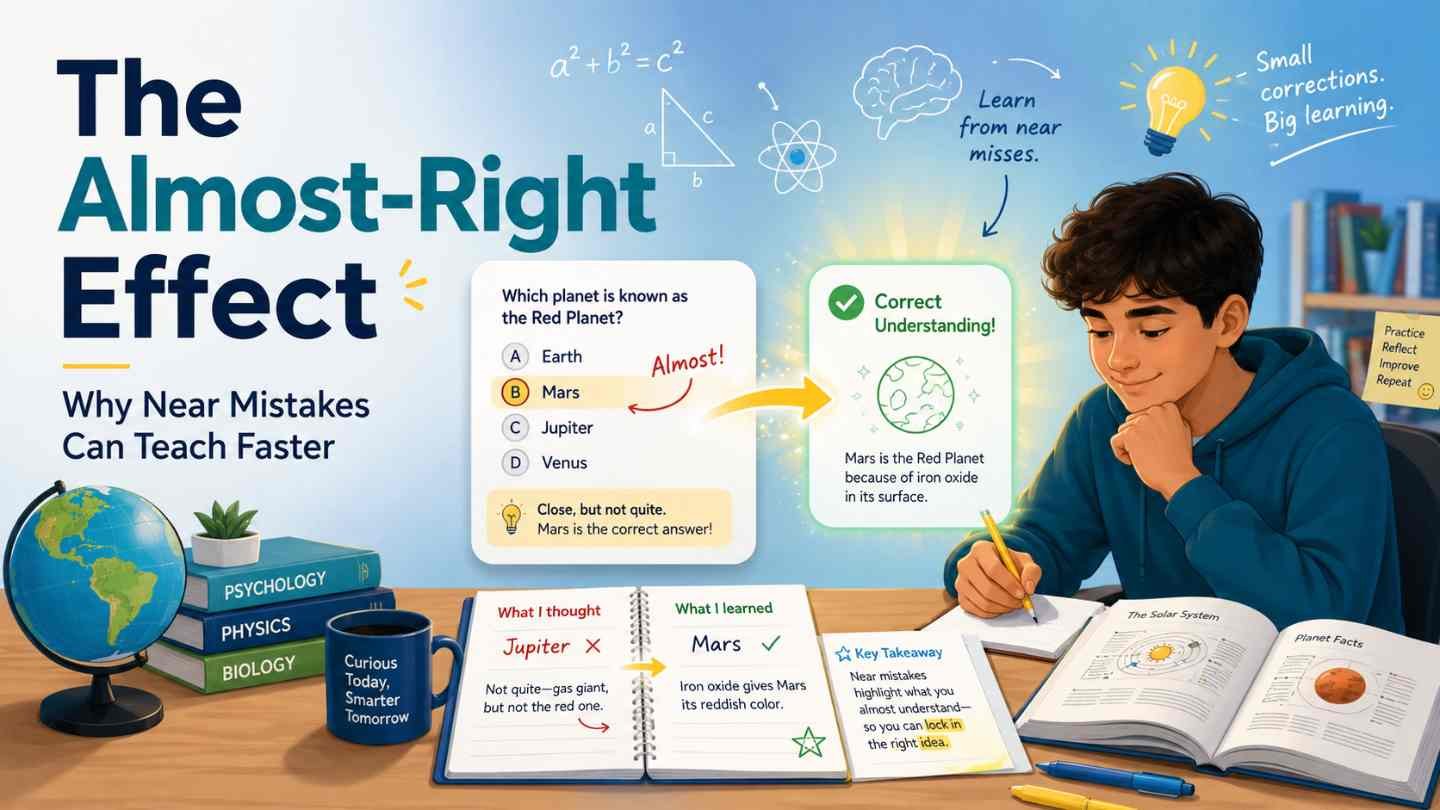
Getting an answer almost right can feel strangely annoying.
You knew the topic. You recognized the clue. You were close enough to feel confident. Then the correct answer appears, and suddenly the mistake feels worse than being completely clueless.
A wrong guess is easy to dismiss. But an almost-correct answer lingers. It makes you think, “Wait, why did I miss that?”
That moment is more useful than it feels.
Near mistakes can become powerful learning signals. They show you where your understanding is strong, where it is slightly off, and what small adjustment could make the idea stick. Instead of treating “almost right” as failure, learners can use it as a shortcut to sharper memory, better attention, and more accurate thinking.
What Is the Almost-Right Effect?
The “Almost-Right Effect” is the learning boost that happens when a close mistake reveals exactly what needs to be corrected.
It is not about celebrating errors for their own sake. It is about noticing the difference between what you thought was true and what is actually true.
An almost-correct answer gives you a useful clue:
You were not lost.
You were near the target.
You just need to adjust one detail, connection, definition, step, or assumption.
That makes the correction easier to understand and often easier to remember.
Why Being Almost Right Feels So Frustrating
Almost-right answers bother us because they expose a tiny gap in a place we thought was solid.
In a quiz, you may choose the second-best answer because it sounds familiar.
In math, you may follow the correct process but make one small sign error.
In history, you may remember the event but mix up the date, leader, or cause.
In language learning, you may understand the sentence but use the wrong verb tense.
The frustration comes from closeness. Your brain expected success, so the correction gets your attention.
That attention is valuable. It creates a moment where the mind is ready to compare, revise, and remember.
Why Near Mistakes Often Teach More Than Totally Wrong Answers
A totally wrong answer usually tells you one thing: “I do not know this yet.”
That is useful, but it is broad. You may need to start from the beginning.
An almost-right answer is more specific. It points to the exact edge of your understanding.
Near Mistakes Reveal the Real Gap
Suppose a student answers that evaporation happens when water freezes.
That answer is not just wrong; it shows confusion between changes of state.
But if the student says evaporation is when liquid water turns into gas because of heat, yet forgets that it can happen below boiling point, the gap is smaller and clearer.
The learner already understands the main idea. The missing piece is more precise.
That makes the correction easier to target.
Close Guesses Make Corrections Stick
When you guess something close, the correct answer has something to attach to.
For example, if you think Tokyo is the most populous city in the world and later learn the answer depends on whether the question means city proper, metro area, or urban area, you do more than memorize a fact. You learn to pay attention to definitions.
That small correction can improve future answers in world geography, current events, population questions, and map-based learning.
Almost-Right Answers Improve Attention
Near mistakes often happen when learners move too fast.
You recognize a keyword and jump to an answer.
You remember a formula but skip a condition.
You understand a passage but miss one word that changes the meaning.
Correcting an almost-right answer trains you to slow down at the exact point where care matters most.
How Almost-Correct Answers Sharpen Memory
Memory improves when the brain has to compare similar ideas.
That is why confusing two close answers can actually help if you review them properly.
For example:
Mitosis and meiosis sound related because both involve cell division.
Democracy and republic are often used together but are not identical.
Affect and effect look similar but work differently in sentences.
Mean, median, and mode all describe data, but each answers a different question.
When you correct close mistakes, you build cleaner mental boundaries. You stop storing ideas as vague “kind of similar” information and start noticing what makes each one distinct.
How to Turn Almost-Correct Answers Into Stronger Understanding
The key is not just checking the answer.
The key is comparing your answer with the correct one.
A simple review should answer three questions:
What did I get right?
What did I miss?
What clue should I notice next time?
That small habit changes correction from punishment into practice.
Practical Examples of Learning From Close Mistakes
Quizzes: Learn From the Distractor
Multiple-choice quizzes often include answers that are close on purpose.
If you pick the wrong choice, ask why it was tempting.
Maybe it used a familiar word.
Maybe it was true, but not the best answer.
Maybe it answered a slightly different question.
For example, if a science question asks about photosynthesis and you choose “oxygen” when the correct answer is “glucose,” the mistake reveals a useful distinction. Oxygen is produced during photosynthesis, but glucose is the main food made by the plant.
That correction is much stronger than simply marking the answer wrong. For more practice with careful science questions, a good science quiz can help you spot these close distinctions.
Math: Find the Exact Step That Changed the Answer
In math, being almost right is common.
You may use the correct formula but substitute one number incorrectly.
You may understand fractions but forget to simplify.
You may solve an equation correctly until the final sign change.
Instead of rewriting the whole problem, circle the first step where the answer went off track.
That one step is the lesson.
A near mistake in math usually says, “Your method is close. Your attention needs a checkpoint.”
Science: Separate Similar Processes
Science is full of near mistakes because many ideas are connected.
Weathering and erosion are related, but not the same.
Mass and weight are connected, but not identical.
Condensation and precipitation both involve water, but they describe different parts of the water cycle.
When you confuse two science terms, create a two-column comparison.
One side says “What they have in common.”
The other side says “What makes them different.”
That turns confusion into structure.
History: Check the Cause, Event, and Result
History mistakes often happen because learners remember the “big story” but mix up the details.
You might know that a war changed borders but forget which treaty ended it.
You might remember a revolution but confuse its cause with its result.
You might recognize a famous leader but place them in the wrong century.
When correcting history answers, ask:
Was my mistake about time, place, person, cause, or consequence?
That question helps you repair the exact connection instead of rereading everything blindly.
Reading: Notice the Word That Changed the Meaning
In reading comprehension, almost-right answers often come from missing one small word.
Words like always, never, mainly, except, before, after, or most can change the answer.
If your answer was close, go back to the sentence that supports the correct answer. Then compare it with the part of the text you relied on.
This builds careful reading.
It also teaches you not to answer based only on the general feeling of a passage.
Online Learning: Pause After the Wrong Click
Online lessons make it easy to click, check, and move on too quickly.
That is the danger.
If a platform shows you the correct answer, do not immediately continue. Take ten seconds to explain the correction in your own words.
Write one sentence:
“I thought the answer was ___ because ___, but the correct answer is ___ because ___.”
That tiny pause turns passive feedback into active learning.
Language Learning: Use Mistakes as Pattern Detectors
In language learning, almost-right mistakes are gold.
If you say the right word with the wrong tense, you are close.
If you understand a sentence but miss the gender, article, or preposition, you are close.
If your pronunciation is understood but slightly off, you are close.
Instead of feeling embarrassed, collect these mistakes as patterns.
For example:
“I keep mixing past and present tense.”
“I understand the noun, but I forget the article.”
“I can read the word, but I cannot use it naturally yet.”
A pattern is easier to fix than a random error.
Everyday Decisions: Study the Almost-Good Choice
The Almost-Right Effect is not only for school.
Maybe you bought something that was almost the right size.
Maybe you followed directions but missed one turn.
Maybe you made a schedule that almost worked but left no time for traffic, meals, or rest.
These small mistakes teach practical judgment.
Ask:
What assumption made this choice almost work?
What detail would have made it better?
That kind of reflection improves decision-making without turning every mistake into a personal failure.
Self-Study: Build a “Close Mistakes” List
When studying alone, keep a short list called “Almost Right.”
Do not fill it with every wrong answer.
Only write the mistakes where you were close enough to learn something specific.
For each one, include:
Your answer.
The correct answer.
The difference.
A reminder clue.
Example:
“My answer: erosion means rocks breaking down. Correct answer: weathering means rocks breaking down; erosion means movement. Reminder: weathering breaks, erosion carries.”
That one note is better than copying a whole textbook paragraph.
A Five-Minute Almost-Right Review Exercise
Use this after a quiz, lesson, reading session, or practice test.
Minute 1: Pick Three Near Mistakes
Choose three answers that were close, not completely random.
These are the best learning targets because your brain already has partial understanding.
Minute 2: Write What You Got Right
For each mistake, write one thing your answer understood correctly.
This prevents the review from becoming discouraging.
Example:
“I knew the question was about the water cycle.”
“I remembered the right historical period.”
“I used the correct formula.”
Minute 3: Identify the Missing Detail
Now write the exact difference between your answer and the correct answer.
Keep it short.
Example:
“I confused the cause with the effect.”
“I forgot that the question asked for the main reason.”
“I used the right operation but with the wrong sign.”
Minute 4: Create a Next-Time Clue
Turn the correction into a reminder.
Example:
“When I see ‘main reason,’ look for the strongest cause, not just a true detail.”
“When comparing two science terms, define both before choosing.”
“When solving equations, check signs before the final answer.”
Minute 5: Test Yourself Again
Cover the correct answer and try the question one more time.
Then explain why the correct answer is correct.
This final step matters. It turns recognition into recall.
Common Mistakes to Avoid When Correcting Your Answers
Mistake 1: Only Looking at the Correct Answer
Seeing the correct answer is not the same as learning it.
You need to compare it with your answer.
The learning is in the difference.
Mistake 2: Saying “I Knew That” Too Quickly
Sometimes you really did know it.
But if you missed it, something still went wrong.
Maybe you rushed.
Maybe the wording tricked you.
Maybe your memory was too vague.
“I knew that” can block the small correction that would help you next time.
Mistake 3: Reviewing Everything Equally
Not every mistake deserves the same attention.
A totally unfamiliar topic may need a full lesson.
An almost-right mistake may only need a focused correction.
Spend extra time on near mistakes because they are often the easiest to improve quickly.
Mistake 4: Memorizing Without Understanding the Difference
If you confuse two similar ideas, do not only memorize the correct one.
Compare both.
Ask:
How are they alike?
How are they different?
When would each one be the right answer?
This helps prevent the same mistake from coming back later.
Mistake 5: Treating Mistakes as Proof You Are Bad at Learning
A near mistake is not proof that you failed.
It is proof that your understanding has shape.
There is something there to refine.
That is a much better place to start than a blank page.
How Teachers and Parents Can Use the Almost-Right Effect
When a learner gives a close answer, avoid jumping straight to “wrong.”
Try saying:
“You’re close. What made you choose that?”
“That part is right. Now let’s fix the missing piece.”
“Which word in the question changes the answer?”
This keeps the learner thinking.
It also makes correction feel like a guided adjustment, not a shutdown.
How the Almost-Right Effect Builds Confidence
Confidence does not come from never being wrong.
It comes from knowing how to recover when your answer is not quite there.
Learners who understand near mistakes become less afraid of quizzes, tests, and practice questions. They know that a close answer is not wasted effort. It is information.
That mindset makes study sessions more productive.
Instead of asking, “Why did I fail?”
They begin asking, “What did this mistake show me?”
That question is where faster learning begins.
FAQ
What does “almost right” mean in learning?
“Almost right” means your answer was close enough to show partial understanding, but it missed an important detail. It might involve a mixed-up term, a small calculation error, a weak distinction, or a correct idea applied in the wrong way.
Why do near mistakes help memory?
Near mistakes help memory because they force your brain to compare similar ideas. When you notice the difference between your answer and the correct answer, the correction becomes more specific and easier to remember.
Are totally wrong answers still useful?
Yes. Totally wrong answers show that you may need more background knowledge. But near mistakes often teach faster because they reveal a smaller, more fixable gap.
How should I review a close mistake?
Write your answer, the correct answer, and the exact difference between them. Then create a short reminder clue and test yourself again without looking.
Is this useful for adults, or only students?
It works for anyone. Adults use the same process when learning a skill, reading instructions, making decisions, studying online, improving language skills, or correcting work mistakes.
Should I focus only on mistakes when studying?
No. You should also review what you got right. But close mistakes deserve special attention because they show where a small correction can lead to a big improvement.
Meta Title
The Almost-Right Effect in Learning
Meta Description
Learn how almost-correct answers and close mistakes can sharpen memory, reveal gaps, and help learners improve faster.
Author

Sandy turns complex topics into concise, readable pieces. She built strong research and source-checking habits while helping archive community history projects. She’s exploring future study in the humanities (the University of Oxford is on her shortlist; no current affiliation). Her work is original, clearly cited, and updated when corrections are needed. Offline, she organizes neighborhood book swaps and sketches city scenes.