Learning often begins the same way a garden begins — with something small.
A tiny seed does not look impressive at first. It can fit between two fingers. It has no branches, no flowers, no fruit, and no shade. But when it is planted, watered, and given time, it can grow into something far bigger than its original size.
Questions work the same way.
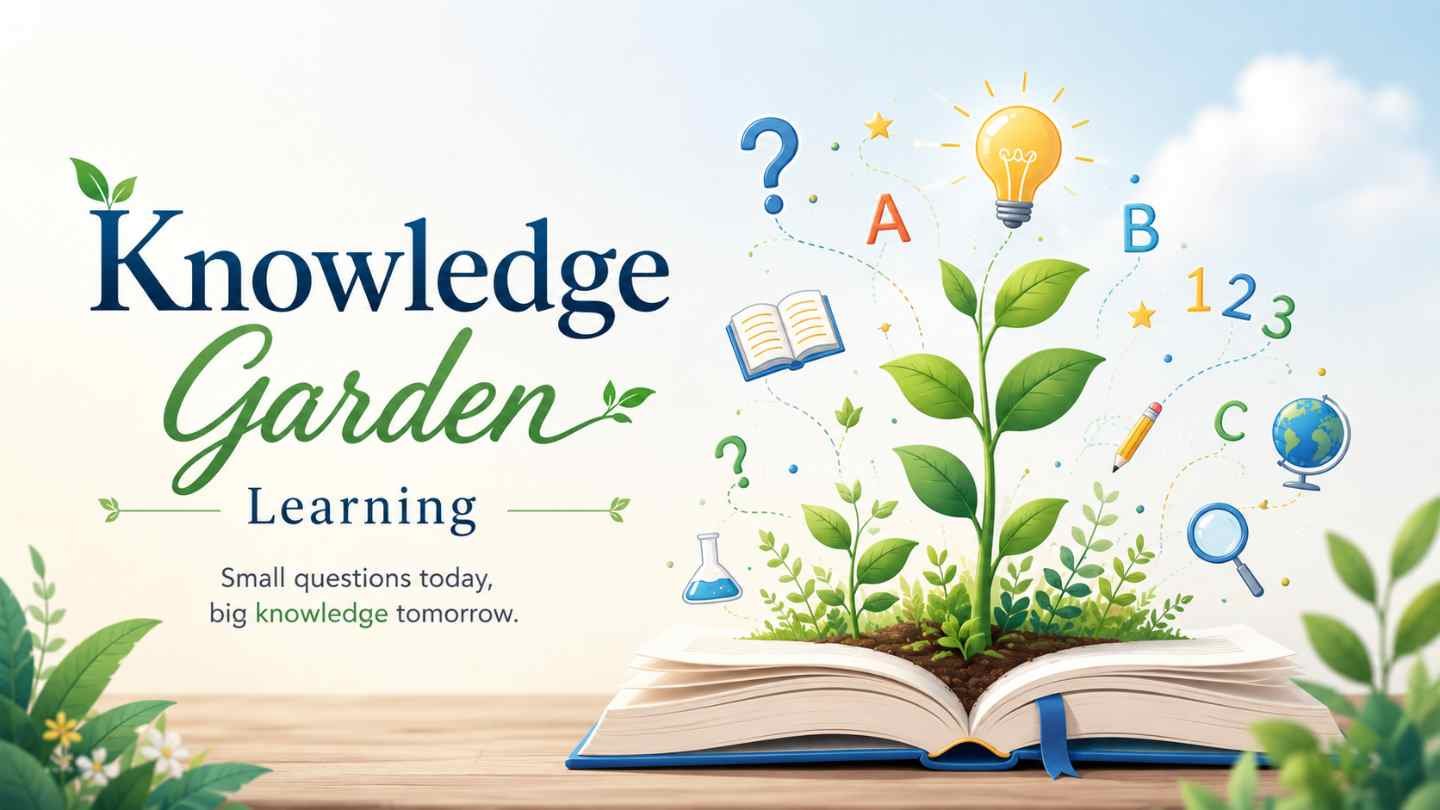
A simple question like “Why did that happen?” or “What does this word mean?” may seem small, but it can open a path toward deeper understanding. One question can lead to another idea, then another connection, then a clearer view of the whole lesson. That is the heart of the Knowledge Garden: treating small questions as seeds that can grow into big learning.
What Is the “Knowledge Garden”?
The Knowledge Garden is a way of learning that starts with curiosity instead of pressure.
Instead of trying to memorize everything at once, you begin with one small question. Then you let that question grow. You explore it, connect it to what you already know, test it with examples, and use it to discover bigger ideas.
A question becomes a seed. Your attention becomes the soil. Practice becomes the water. Reflection becomes the sunlight.
The goal is not to collect random facts. The goal is to grow understanding.
Why Small Questions Can Grow Into Bigger Lessons
Small questions are powerful because they give the mind something clear to follow.
When a lesson feels too large, learners often feel lost. A history chapter, a science topic, a math formula, or a reading passage can feel like a forest with no trail. But one small question creates a starting point.
For example:
“Why do plants need sunlight?” can grow into a lesson about photosynthesis, energy, food chains, and ecosystems.
“Why did a king lose power?” can grow into a lesson about government, economics, war, culture, and human decisions.
“Why is this answer wrong?” can grow into a better understanding of quiz logic, vocabulary, and problem-solving.
A small question gives learning direction. It turns a wide topic into something you can actually enter.
Questions Help Memory Because They Create Meaning
Facts are easier to forget when they feel isolated.
A learner may memorize that water boils at a certain temperature, that a word has a certain definition, or that a historical event happened in a certain year. But if the fact has no meaning, it can slip away quickly.
Questions help facts attach to meaning.
Instead of only remembering “The moon affects tides,” a learner might ask, “How does the moon pull ocean water?” That question adds movement, cause, and explanation. The fact becomes part of a story.
Memory improves when information has hooks. Questions create those hooks because they make the brain search, compare, and connect.
Curiosity Makes Learning Feel Alive
Curiosity changes the mood of learning.
When learners only study to finish a task, learning can feel heavy. But when they ask questions, the lesson becomes more active. They are no longer just receiving information. They are investigating it.
This is why quizzes can be useful when used the right way. A quiz question is not just a test. It can become a seed.
After answering, a learner can ask:
“Why is this the correct answer?”
“What made the other choices wrong?”
“What topic does this connect to?”
“What would be another example?”
That simple habit turns practice into exploration. Even fun formats like educational quizzes can become a way to grow knowledge, not just check scores.
How to Nurture Questions Instead of Rushing Past Them
Many learners have questions while studying, but they move past them too quickly.
They think, “I’ll come back to that later,” but later never comes. Or they ignore the question because it feels too small. But small questions are often the doorway into real understanding.
Write the Question Down
A question that stays only in your head is easy to lose.
Keep a small notebook, notes app, or study document where you collect question seeds. They do not need to be perfect. Even messy questions are useful.
Examples:
“Why does this formula work?”
“What caused this event?”
“How is this word used in real life?”
“Why did I choose the wrong answer?”
Writing the question down tells your brain, “This matters.”
Give the Question a Little Time
You do not need to spend an hour on every question.
Sometimes three minutes is enough to look it up, test an example, or explain it in your own words. The point is to pause long enough for the question to grow.
A rushed learner only sees the answer. A curious learner sees the lesson behind the answer.
Connect the Question to Something You Already Know
Questions grow faster when they connect to existing knowledge.
If you are learning a new science idea, connect it to something you see at home. If you are studying history, connect it to a current event or a human decision. If you are learning a language, connect a new word to a situation where you might actually use it.
Connection is what turns information into understanding.
Practical Examples of Growing Knowledge From Simple Questions
The Knowledge Garden works across many subjects and learning situations.
Quizzes
A quiz asks: “Which planet is known as the Red Planet?”
The answer is Mars.
But the question seed could grow further:
“Why is Mars called red?”
“What is its surface made of?”
“How is Mars different from Earth?”
“What missions have studied Mars?”
Now one quiz answer becomes a doorway into astronomy, chemistry, space exploration, and comparison skills.
School Subjects
In science, a student may ask, “Why do magnets attract some metals but not others?”
That small question can grow into ideas about magnetic fields, atoms, materials, and everyday technology.
In history, “Why did people migrate?” can grow into lessons about food, jobs, climate, war, trade, and survival.
In math, “Why do we need fractions?” can grow into cooking, money, measurement, music, and division.
The subject becomes easier when the question makes it feel useful.
Reading
While reading a story, a learner might ask, “Why did the character make that choice?”
That question can grow into deeper thinking about motivation, conflict, setting, personality, and theme.
Instead of only remembering what happened, the learner begins to understand why it happened.
Online Learning
Online lessons can move quickly. Videos, articles, and apps often present information in small pieces. That can be helpful, but it can also lead to shallow learning if the learner only clicks through.
A question seed slows things down in a good way.
After watching a lesson, ask:
“What was the most important idea?”
“What part still feels unclear?”
“How can I use this?”
“What does this remind me of?”
Those questions help online learning become active instead of passive.
Math
A learner solving an equation might ask, “Why do I do the same thing to both sides?”
That question can grow into a stronger understanding of balance, equality, and logic. Instead of memorizing steps, the learner understands the reason behind the method.
That kind of understanding makes it easier to solve new problems later.
Science
A simple question like “Why does ice float?” can grow into density, states of matter, molecular structure, ocean life, and climate.
That is the beauty of question-based learning. One everyday observation can lead to serious science.
History
A question like “Why did this empire fall?” can grow into government, leadership, economics, geography, military pressure, culture, and public trust.
History becomes more than dates. It becomes a study of causes, choices, and consequences.
Language Learning
A learner may ask, “Why does this phrase sound natural, but that one sounds awkward?”
That question can grow into grammar, culture, tone, word order, and real conversation.
Language learning improves when learners notice patterns, not just vocabulary lists.
Everyday Life
The Knowledge Garden also works outside school.
“Why do I spend too much time on my phone?”
“Why does this recipe fail?”
“Why do I remember songs faster than lessons?”
“Why do I learn better in the morning?”
These questions can grow into better habits, self-awareness, and practical problem-solving.
Even entertainment can become a learning seed. A gaming fun facts quiz, for example, can lead to questions about storytelling, technology, design, history, strategy, and creativity.
The Five-Minute “Question Seed” Exercise
This exercise is simple enough to use after a quiz, class, reading session, or online lesson.
Step 1: Choose One Small Question
Pick one question that came up while learning.
It can be something you got wrong, something you found interesting, or something that feels unclear.
Example: “Why do seasons happen?”
Step 2: Write One Short Answer
Do not aim for a perfect explanation. Write what you currently understand.
Example: “Seasons happen because Earth is tilted as it moves around the sun.”
Step 3: Add One Connection
Connect the answer to another idea.
Example: “This connects to daylight, temperature, farming, and weather patterns.”
Step 4: Add One Example
Use a real or simple example.
Example: “When one part of Earth tilts toward the sun, it gets more direct sunlight and longer days.”
Step 5: Ask the Next Question
Let the seed grow.
Example: “Why are seasons opposite in the Northern and Southern Hemispheres?”
That next question becomes tomorrow’s seed.
Common Mistakes to Avoid When Learning Through Questions
Asking Too Many Questions at Once
Curiosity is good, but too many questions can become overwhelming.
Start with one. Let it grow before jumping to five more. A healthy garden needs attention, not chaos.
Treating Every Question Like a Research Project
Not every question needs a deep investigation.
Some questions need a quick definition. Some need an example. Some need a longer study session. Learn to match the question with the right amount of effort.
Looking for Answers Without Thinking First
It is easy to search online immediately. But before looking up the answer, try to guess, explain, or connect.
That first attempt prepares your mind to understand the answer better.
Ignoring Wrong Answers
Wrong answers are excellent question seeds.
Instead of only marking them as mistakes, ask:
“What confused me?”
“What clue did I miss?”
“What rule or idea do I need to review?”
A wrong answer can teach faster than a lucky guess.
Collecting Facts Without Growing Them
Some learners gather notes, screenshots, definitions, and links but never develop them.
A question needs attention to grow. Ask, explain, connect, and apply. Otherwise, the seed stays in the packet.
How the Knowledge Garden Builds Connected Learning
The best learning does not feel like a pile of separate facts. It feels like a growing network.
One idea connects to another. One answer leads to a better question. One small discovery makes the next lesson easier to understand.
That is connected learning.
A learner who asks questions begins to see patterns:
Math connects to logic.
Science connects to daily life.
History connects to human choices.
Language connects to culture.
Reading connects to emotion and meaning.
Quizzes connect to memory and review.
The Knowledge Garden helps learners stop asking only, “What is the answer?” and start asking, “What can this answer grow into?”
FAQ
What is the Knowledge Garden method?
The Knowledge Garden method is a way of learning where small questions are treated like seeds. A learner starts with one simple question, explores it, connects it to other ideas, and uses it to grow deeper understanding.
Why are small questions important in learning?
Small questions make big topics easier to approach. They give the learner a clear starting point and help turn facts into meaning.
Can this method help with quizzes?
Yes. After answering a quiz question, learners can ask why the answer is correct, why other choices are wrong, and what larger topic the question connects to. This turns quizzes into learning tools instead of simple score checks.
How can I use this method for self-study?
After each study session, write down one question. Answer it briefly, connect it to something you already know, add an example, and ask one follow-up question.
What if my question feels too simple?
Simple questions are often the best starting point. Many deep lessons begin with basic questions like “Why?” “How?” “What changed?” or “What does this connect to?”
Author

Sandy turns complex topics into concise, readable pieces. She built strong research and source-checking habits while helping archive community history projects. She’s exploring future study in the humanities (the University of Oxford is on her shortlist; no current affiliation). Her work is original, clearly cited, and updated when corrections are needed. Offline, she organizes neighborhood book swaps and sketches city scenes.