Quiz time is often treated like a quick break.
You answer a few questions, laugh at the ones you missed, celebrate the ones you guessed right, and move on. That is perfectly fine. Quizzes should be fun. Nobody wants a quiz that feels like a surprise school exam wearing a fake smile.
But here is the better part: quizzes can do more than entertain you.
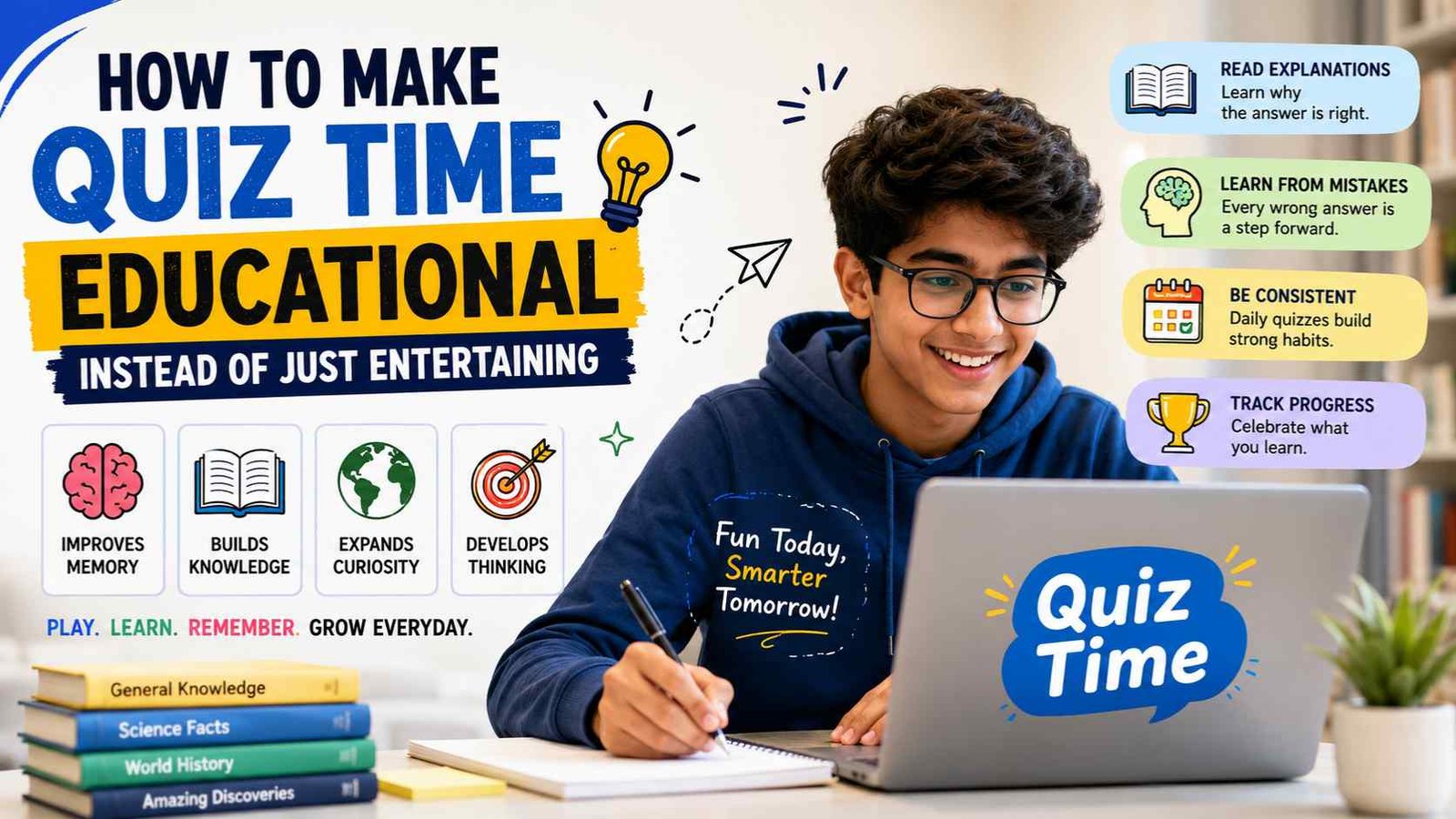
A good quiz can help you remember facts, notice what you do not know, build general knowledge, and make learning feel lighter. The trick is not to make quiz time boring. The trick is to give it a little purpose.
That is where educational quiz time comes in.
It is still fun. It is still quick. But instead of only asking, “How many did I get right?” you also ask, “What did I learn?”
Why Quizzes Are More Than Just a Game
A quiz works because it makes your brain active.
When you read an article or watch a video, you may feel like you understand the topic. But when a question appears, your brain has to search for the answer. That tiny mental effort matters.
It turns passive reading into active thinking.
For example, reading “The Pacific Ocean is the largest ocean on Earth” is useful. But answering this question is even better:
Which ocean is the largest on Earth?
A. Atlantic Ocean
B. Indian Ocean
C. Pacific Ocean
D. Arctic Ocean
Now your brain has to choose, compare, and remember. That makes the fact stick better.
This is why quiz learning can be so powerful. It does not simply show you information. It asks you to use it.
The Difference Between Fun Quizzes and Educational Quizzes
A quiz does not have to be serious to be educational.
The real difference is what happens around the question.
A purely entertaining quiz
You answer quickly, check your score, and forget most of it after a few minutes.
An educational quiz
You answer, notice why the correct answer is right, learn from mistakes, and remember one or two useful facts afterward.
That small shift changes everything.
You are not removing the fun. You are adding value to it.
How Quizzes Help Memory Improvement
Quizzes support memory because they make your brain retrieve information.
Retrieval is the act of pulling something from memory. Every time you try to remember an answer, you strengthen the mental path to that fact.
That is why daily quizzes can be helpful. A short quiz today, another one tomorrow, and another one next week can slowly build knowledge without feeling heavy.
You may not remember every question. That is normal. But repeated exposure helps.
A geography quiz might help you remember capitals. A science quiz might help you understand weather. A history quiz might help you connect dates, people, and events. A Bible quiz might help you remember Scripture references more clearly.
Little by little, your brain builds a wider map of knowledge.
Why Wrong Answers Can Be Useful
Most people dislike getting quiz questions wrong.
But mistakes are often where the learning happens.
When you miss an answer, your brain pays attention. It notices the gap. It becomes more ready to remember the correction.
For example, if you thought the Nile was the longest river but the quiz explains another view or gives context about river measurements, that moment becomes memorable. You are not just memorizing a fact. You are adjusting what you thought you knew.
That is stronger learning.
So instead of treating wrong answers like failure, treat them like signposts. They show you where your knowledge can grow.
How Answer Choices Improve Thinking
Multiple-choice questions are not just about picking A, B, C, or D.
Good answer choices make you compare ideas.
You may know one option is obviously wrong. Another sounds close. One feels familiar but not quite right. The correct answer may require you to slow down and think.
That comparison builds sharper judgment.
For example:
Which planet is known as the Red Planet?
A. Venus
B. Mars
C. Jupiter
D. Saturn
This is simple if you already know the answer. But for a learner, the choices create a memory link. Mars becomes connected to “Red Planet,” while the other planets become less likely next time.
Answer choices help your brain sort information, not just receive it.
Turning Quiz Time Into a Learning Habit
The best educational quizzes are not always long.
In fact, short quizzes can be better because they are easier to repeat. A 5-minute daily quiz is more realistic than a 1-hour study session that you keep avoiding.
Here are practical ways to make quiz time more educational.
1. Choose a topic before you start
Do not always click random quizzes without thinking.
Pick a simple focus for the day:
- World history
- Science facts
- Famous people
- Geography
- Weather and nature
- Bible knowledge
- Current events
- General knowledge
This gives your quiz time direction. You can still enjoy it, but your brain knows what kind of information to collect.
2. Read the explanation after each answer
This is the most important step.
The explanation is where learning becomes clear. It tells you why the correct answer is right and sometimes why the other answers are wrong.
Many people skip explanations because they only care about the score. Big mistake.
The score tells you how you did.
The explanation tells you what you learned.
3. Keep one fact from every quiz
You do not need to memorize everything.
After each quiz, choose one fact worth remembering.
For example:
- “The Amazon Rainforest affects global weather patterns.”
- “Marie Curie won Nobel Prizes in two different scientific fields.”
- “Mount Everest is part of the Himalayas.”
- “The water cycle includes evaporation, condensation, and precipitation.”
One remembered fact is better than ten forgotten questions.
4. Repeat topics you often miss
If you keep missing geography questions, that is not a problem. That is a clue.
Try more geography quizzes for a few days. Repeated practice helps your brain become familiar with names, places, maps, and patterns.
The same works for history, science, entertainment, sports, or any other topic.
Your weak areas can become your strongest areas if you revisit them.
5. Discuss one question with someone else
Learning becomes stronger when you explain it.
After a quiz, share one interesting question with a friend, family member, classmate, or even in a group chat.
You might say:
“I got this wrong today. Did you know the largest ocean is the Pacific?”
That quick conversation helps the fact settle in your memory.
6. Do not rush every question
Fast quizzes are fun, especially when there is a timer. But if your goal is learning, pause on some questions.
Ask yourself:
- What do I already know?
- Which choices can I eliminate?
- Why does this answer make sense?
- Have I seen this fact before?
That small pause turns guessing into thinking.
How Online Quizzes Can Support Daily Learning
Online quizzes are easy to access, which makes them perfect for daily learning.
You can take a quiz during a coffee break, after school, before bed, or while waiting for something. You do not need a notebook, a long lesson, or a formal study plan.
That is the beauty of fun learning.
It fits into normal life.
A daily quiz can become a small habit that keeps your mind curious. Some days you learn a science fact. Another day you remember a historical event. Another day you discover a country, animal, invention, or famous quote you never knew before.
Over time, those small facts add up.
Making General Knowledge Quizzes More Useful
General knowledge quizzes are especially helpful because they mix topics.
One quiz might include a question about space, another about world history, another about animals, and another about literature. That variety keeps your brain flexible.
It also helps you make connections.
For example, a question about oceans can connect to weather. A question about ancient Egypt can connect to geography. A question about inventions can connect to modern technology.
General knowledge grows best when facts do not stay isolated. Quizzes help connect them.
A Simple Educational Quiz Time Routine
Here is an easy routine you can use:
Before the quiz
Pick one topic or decide to play a mixed general knowledge quiz.
During the quiz
Read each question carefully. Eliminate obviously wrong choices. Do not rush unless the timer is part of the challenge.
After each answer
Read the explanation. Notice what surprised you.
After the quiz
Write down or remember one useful fact.
Next day
Try another short quiz. Repeat the habit.
This routine takes only a few minutes, but it changes quiz time from simple entertainment into steady learning.
Best Types of Quizzes for Learning
Not all quizzes teach the same way. Here are some useful types:
Daily quizzes
Great for building a habit and learning small facts often.
Multiple-choice quizzes
Helpful because answer choices train comparison and recall.
Explanation-based quizzes
Best for deeper learning because they explain the answer.
General knowledge quizzes
Good for curiosity and broad learning across many topics.
Topic quizzes
Useful when you want to improve in one area, like science, history, geography, or Bible knowledge.
Common Mistakes That Make Quiz Time Less Educational
Even good quizzes can become less useful if you use them the wrong way.
Avoid these habits:
Only caring about the score
A high score feels good, but learning matters more.
Skipping explanations
This removes the most educational part of the quiz.
Guessing too quickly
Guessing is fine sometimes, but try to think through the choices.
Never repeating missed topics
If you avoid your weak areas, they stay weak.
Taking too many quizzes without remembering anything
More quizzes are not always better. A few remembered facts are more valuable than many forgotten answers.
How Parents and Teachers Can Use Quiz Time
Educational quizzes are useful for kids, adults, and seniors, but they can be especially helpful in family or classroom settings.
Parents can use quizzes to make learning less stressful. Instead of saying, “Study this chapter,” they can ask a few fun questions after reading or watching something educational.
Teachers can use quizzes as warm-ups, reviews, or quick checks for understanding.
The key is to keep the mood encouraging. A quiz should not feel like a trap. It should feel like a chance to think, try, and learn.
How to Keep Quiz Time Fun
Educational does not mean dull.
You can keep quiz time fun by adding variety:
- Try different topics each day.
- Challenge a friend.
- Track your best score.
- Choose quizzes with explanations.
- Mix easy and hard questions.
- Celebrate what you learn, not just what you get right.
A fun quiz makes you want to return. A useful quiz gives you a reason to return.
The best quiz does both.
FAQs About Educational Quiz Time
1. What is educational quiz time?
Educational quiz time is a short quiz session designed for both fun and learning. Instead of only checking your score, you pay attention to explanations, missed answers, and new facts you want to remember.
2. Can online quizzes really help with memory improvement?
Yes, online quizzes can support memory improvement when you use them regularly. They help your brain practice recalling information, which can make facts easier to remember later.
3. How long should a daily quiz session be?
A good daily quiz session can be as short as 5 to 10 minutes. The goal is not to study for hours. The goal is to build a simple habit you can repeat often.
4. Are general knowledge quizzes good for learning?
Yes, general knowledge quizzes are useful because they expose you to many topics. They can improve curiosity, build background knowledge, and help you connect facts across science, history, geography, culture, and more.
Final Thoughts
Quiz time does not have to be only entertainment.
With the right approach, it can become a simple learning habit that improves memory, builds general knowledge, and keeps curiosity alive. You do not need to turn every quiz into a serious lesson. Just slow down a little, read the explanations, notice your mistakes, and remember one useful fact.
That is how educational quiz time becomes powerful.
It stays fun, but it also leaves something behind.
Author

John turns financial data into clear, factual stories. He holds a degree in Accountancy and spent several audit seasons reconciling ledgers and verifying documentation. He studies business cases and is exploring future graduate study in management (MIT is one of the schools he’s considering; no current affiliation). Every piece is concise, well-sourced, and fact-checked, with prompt corrections when needed. Off the clock, he teaches budgeting to local teens and restores vintage bikes.