Most people think quizzes are only for testing what you already know. But the better way to see them is this:
General knowledge quizzes are small “mental bridges.”
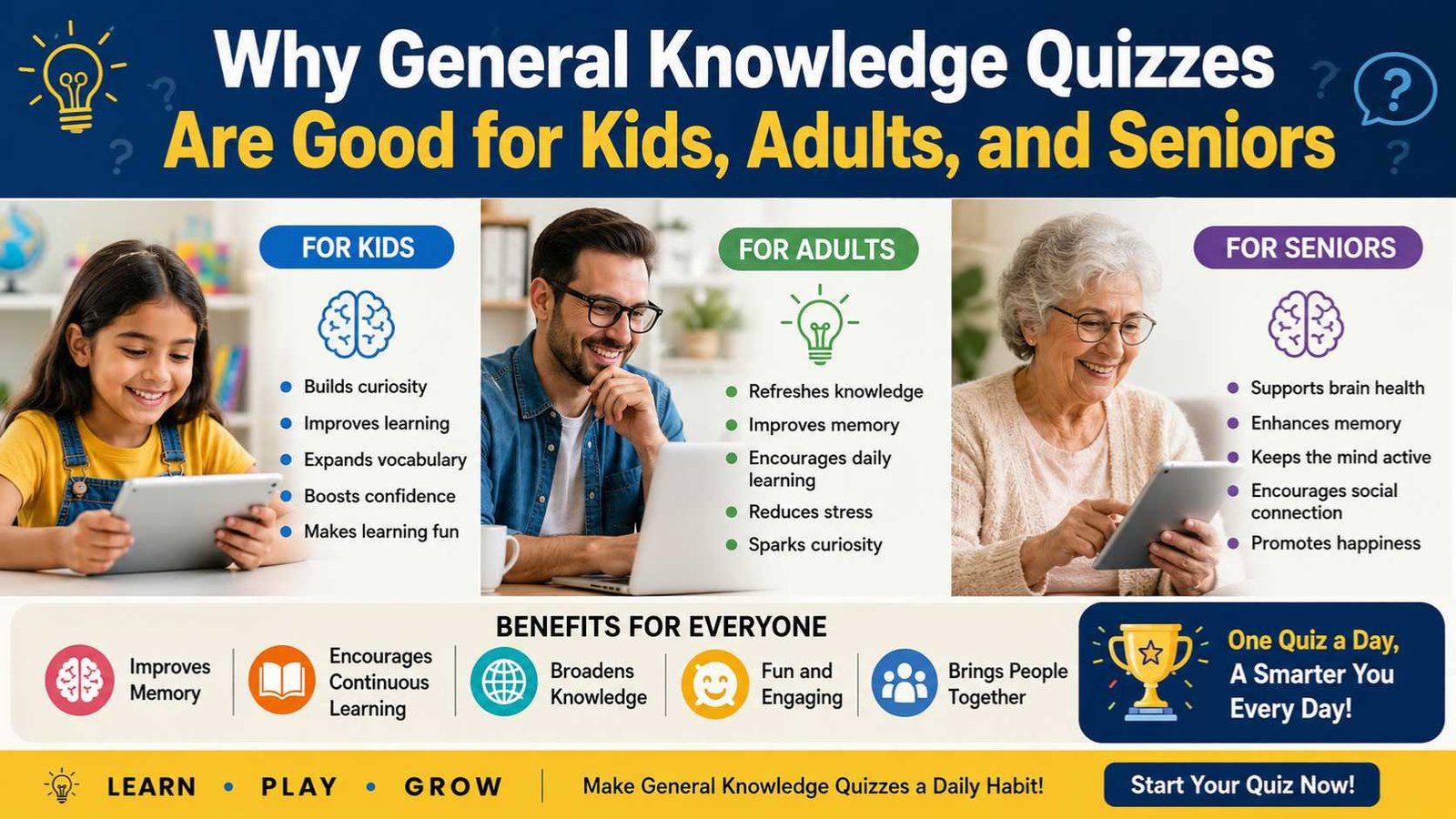
They connect school subjects, real-life facts, memory, curiosity, family conversations, and everyday learning. A child may discover a new country. An adult may remember a history fact they forgot. A senior may enjoy a gentle brain workout without pressure.
That is why general knowledge quizzes work across every age group.
They are simple, flexible, and surprisingly powerful.
What Are General Knowledge Quizzes?
General knowledge quizzes are short question-and-answer activities that cover many topics, such as:
History
Science
Geography
Animals
Sports
Books
Movies
Famous people
Food
Inventions
World facts
Current events
Unlike a school exam, a quiz does not have to feel stressful. It can be quick, fun, and casual.
You answer a question, check the correct answer, read a short explanation, and learn something new. That small process can help your brain connect facts better than just reading a long paragraph.
Why General Knowledge Quizzes Work for All Ages
General knowledge quizzes are useful because they meet people where they are.
Kids enjoy the challenge.
Adults like the quick learning.
Seniors benefit from memory-friendly mental activity.
The same quiz can also bring different generations together. A child may know a space fact. A parent may know a history answer. A grandparent may remember an old movie, a world leader, or a famous event.
That mix makes quiz learning feel alive.
1. Quizzes Help Kids Build Curiosity
Kids are natural question machines.
Why is the sky blue?
Who built the pyramids?
How many bones are in the body?
Where do penguins live?
General knowledge quizzes turn that curiosity into a game.
Instead of saying, “Study this topic,” a quiz asks, “Can you guess this?” That small change matters. It makes learning feel less like work and more like discovery.
How Kids Benefit From General Knowledge Quizzes
Kids quizzes can help children:
Improve reading comprehension
Learn new words
Build confidence
Practice focus
Connect facts across subjects
Develop a habit of asking questions
For example, a geography quiz question about the Nile River may lead to learning about Egypt, ancient civilizations, deserts, maps, animals, and farming. One small question can open a big door.
That is the hidden power of educational quizzes.
They do not just give answers. They start conversations.
2. Quizzes Help Adults Keep Learning in a Busy Life
Adults are busy. Many people do not have time to sit with a textbook for one hour every day.
But a five-minute quiz? That feels possible.
This is where general knowledge quizzes become useful for adults. They offer quick learning without the pressure of formal study.
You can answer a few questions during a coffee break, after lunch, while commuting, or before bed.
Why Adult Quizzes Are Useful
Adult quizzes can help with:
Refreshing forgotten facts
Learning new topics in small pieces
Improving memory through recall
Reducing mindless scrolling
Making daily learning easier
Building confidence in conversations
Adults often say, “I used to know that.”
A quiz brings those facts back to the surface. Sometimes you remember the answer. Sometimes you miss it. Either way, your brain gets a chance to reconnect with the information.
That is more useful than passively reading trivia. A quiz makes you participate.
3. Quizzes Give Seniors Gentle Brain Exercise
For seniors, quizzes can be more than entertainment. They can offer light mental stimulation, memory practice, and social connection.
A good quiz does not need to be difficult. It should be clear, friendly, and enjoyable.
Questions about old songs, classic films, geography, Bible facts, history, food, or famous people can spark memories and conversation.
How Quizzes Support Senior Brain Health
Senior brain health is often connected to staying mentally and socially active. General knowledge quizzes can help seniors:
Practice recall
Stay mentally engaged
Enjoy familiar topics
Learn new facts gently
Share memories with others
Feel included in group activities
The best part is that quizzes can be adjusted.
Some seniors may enjoy easy questions. Others may prefer challenging history or science trivia. The goal is not to embarrass anyone. The goal is to keep the mind active in a pleasant way.
A quiz should feel like a friendly conversation, not a test.
4. Quizzes Improve Memory Through Active Recall
One reason quizzes work so well is active recall.
Active recall means your brain tries to pull an answer from memory instead of simply seeing the answer in front of you.
That effort matters.
When you try to remember the capital of Japan, the inventor of the telephone, or the largest ocean, your brain becomes more involved. Even if you answer incorrectly, the correct answer may stick better afterward because your brain was already searching for it.
Example
Question: What is the largest ocean in the world?
A. Atlantic Ocean
B. Indian Ocean
C. Pacific Ocean
D. Arctic Ocean
Correct answer: Pacific Ocean
If you guessed Atlantic first, the correction helps your brain notice the difference. That small mistake can actually make the fact easier to remember next time.
This is why answer explanations are important. They turn wrong answers into learning moments.
5. Quizzes Make Learning Feel Less Heavy
Not everyone enjoys long lessons. Some people shut down when they see a big wall of text.
Quizzes make learning lighter.
Instead of reading a long article about world geography, you can answer 10 quick questions. Each question gives you a small piece of knowledge. Over time, those pieces add up.
Daily quizzes work especially well because they create a simple routine.
Five questions today.
Ten questions tomorrow.
A new topic next week.
That rhythm helps learning feel normal instead of overwhelming.
6. Quizzes Help Families Learn Together
General knowledge quizzes are perfect for mixed-age groups.
A child, parent, and grandparent can all join the same quiz. They may not know the same answers, but that is part of the fun.
A family quiz night can include:
Easy animal questions for kids
History questions for adults
Classic movie questions for seniors
Food and geography questions for everyone
This turns quiz learning into bonding time.
It also shows kids that learning does not stop after school. Adults and seniors can still be curious, still guess, still laugh, and still learn something new.
That is a beautiful lesson by itself.
7. Quizzes Build Confidence One Question at a Time
Big learning goals can feel intimidating.
But one quiz question feels manageable.
When someone answers correctly, they feel a small boost. When they answer incorrectly but understand the explanation, they still gain something.
That makes quizzes helpful for shy learners, older learners, and people who think they are “not good at studying.”
General knowledge quizzes show that learning can happen in small wins.
You do not need to master everything today. You only need to learn one new fact, then another, then another.
Practical Tips for Using General Knowledge Quizzes
For Kids
Choose colorful and age-friendly quizzes. Start with animals, planets, countries, simple science, and fun history facts.
Keep quiz sessions short. Ten questions are often enough.
After the quiz, ask one follow-up question like, “Which answer surprised you most?”
For Adults
Use daily quizzes as a quick learning habit.
Try different categories during the week:
Monday: History
Tuesday: Science
Wednesday: Geography
Thursday: Entertainment
Friday: Current events
This keeps your brain from getting bored.
For Seniors
Choose clear quizzes with readable text and simple instructions.
Use familiar topics first, such as classic movies, old songs, famous places, food, history, or Bible trivia.
Make it social when possible. Quizzes are often more enjoyable when done with family, friends, or a small group.
For Everyone
Do not focus only on the score.
The best question after a quiz is not always, “How many did I get right?”
A better question is:
“What did I learn today?”
That one question changes the whole purpose of the quiz.
How to Make Daily Quizzes More Useful
Daily quizzes are most helpful when they include explanations.
A correct answer tells you what is right.
A short explanation tells you why it is right.
That “why” is where real learning happens.
For example:
Question: Which planet is known as the Red Planet?
Answer: Mars
Explanation: Mars is called the Red Planet because iron-rich dust on its surface gives it a reddish color.
That explanation makes the fact easier to remember. It gives your brain a picture, not just a word.
Common Mistakes to Avoid
Mistake 1: Making Quizzes Too Hard
A quiz should challenge the learner, not crush their confidence.
Mix easy, medium, and hard questions.
Mistake 2: Ignoring Explanations
If someone only checks the score, they miss the best part of quiz learning.
Always review the answers.
Mistake 3: Using the Same Topic Every Day
Variety keeps curiosity alive.
Mix science, history, geography, entertainment, sports, and everyday facts.
Mistake 4: Treating Quizzes Like Exams
A quiz does not need to feel serious all the time.
It can be playful, surprising, and even funny.
Learning sticks better when people enjoy the process.
FAQs About General Knowledge Quizzes
1. Are general knowledge quizzes good for kids?
Yes. General knowledge quizzes can help kids build curiosity, improve reading skills, learn new facts, and connect different school subjects in a fun way. The best kids quizzes are simple, clear, and age-appropriate.
2. Can adults benefit from daily quizzes?
Yes. Adults can use daily quizzes to refresh old knowledge, learn new facts, improve memory, and take a quick break from passive scrolling. A short quiz can be a simple learning habit for a busy day.
3. Are quizzes helpful for seniors?
Yes. Quizzes can give seniors gentle mental exercise, encourage memory recall, and create social interaction. The key is to choose quizzes with clear questions, readable text, and enjoyable topics.
4. Do quizzes really improve memory?
Quizzes can support memory improvement because they use active recall. When you try to remember an answer, your brain works harder than when you only read information. Reviewing the correct answer and explanation can help the fact stick better.
Final Thoughts
General knowledge quizzes are good for kids, adults, and seniors because they make learning simple, flexible, and enjoyable.
Kids discover new ideas.
Adults keep learning despite busy schedules.
Seniors enjoy gentle brain activity and meaningful conversation.
The real value is not just the score. It is the small spark of curiosity that comes after each question.
A good quiz can make someone say, “I didn’t know that.”
And sometimes, that is where real learning begins.
Author

John turns financial data into clear, factual stories. He holds a degree in Accountancy and spent several audit seasons reconciling ledgers and verifying documentation. He studies business cases and is exploring future graduate study in management (MIT is one of the schools he’s considering; no current affiliation). Every piece is concise, well-sourced, and fact-checked, with prompt corrections when needed. Off the clock, he teaches budgeting to local teens and restores vintage bikes.