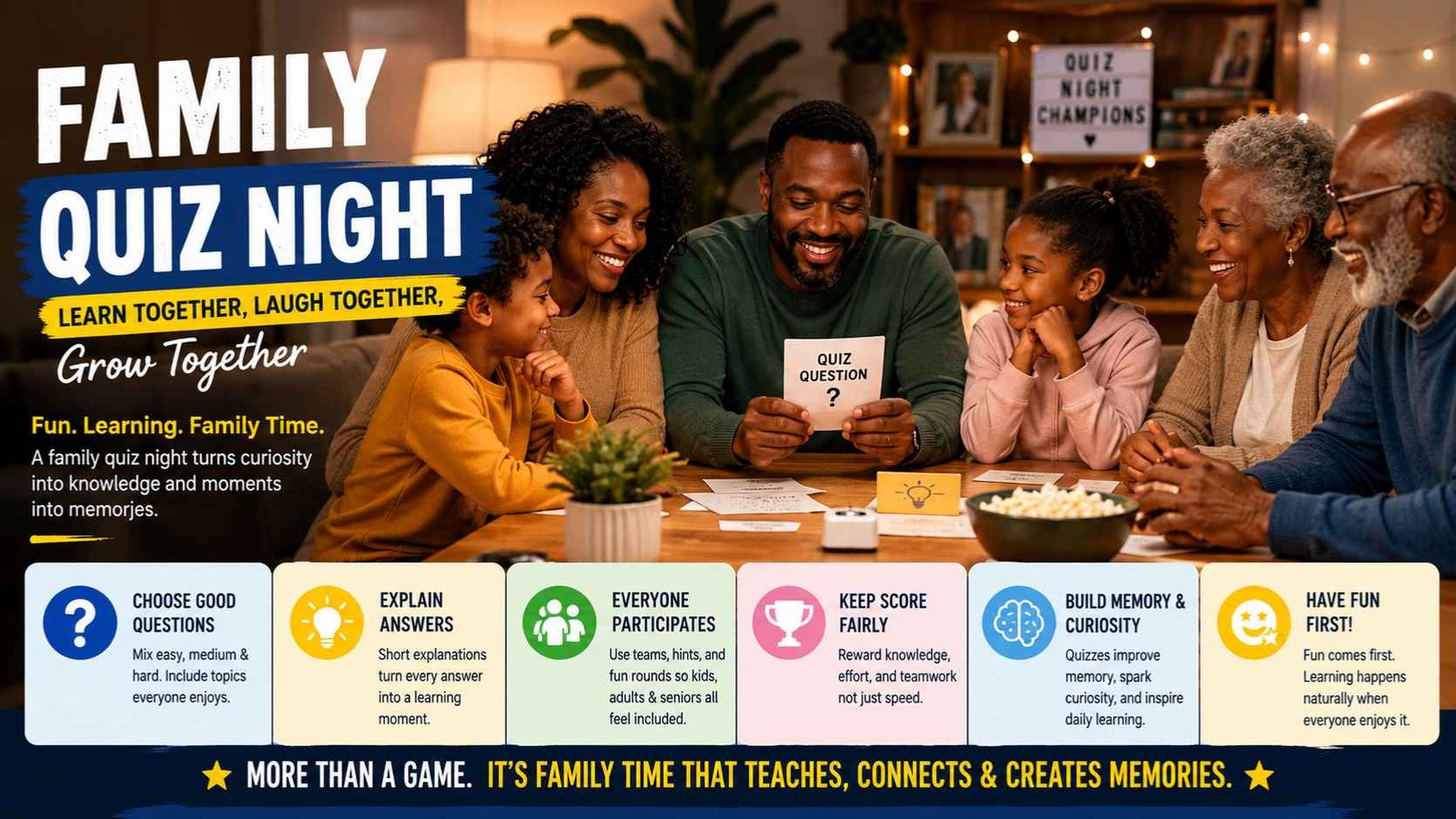
Family quiz night sounds simple.
You gather everyone, ask a few questions, keep score, laugh at the wild guesses, and maybe crown one very proud winner at the end.
But a good family quiz night can do more than fill an evening. It can help kids build confidence, adults refresh forgotten facts, and seniors stay mentally active. It can turn general knowledge into a shared experience instead of something people only learn alone from books, screens, or schoolwork.
The best part? It does not need to feel like a classroom.
When done well, family quiz night feels like a game first. The learning sneaks in quietly through curiosity, conversation, and those little “Oh, I didn’t know that!” moments.
Why Family Quiz Night Works So Well
A quiz is not just about knowing the answer. It makes the brain search, compare, remember, and guess.
That is why quizzes are useful for learning. They encourage active recall, which simply means pulling information out of your memory instead of only reading or hearing it. Even when someone gets an answer wrong, the question can make the correct answer easier to remember later.
For families, this is even better because everyone brings different knowledge.
A child may know animal facts. A parent may know history or food trivia. A grandparent may remember old songs, places, or events that younger players have never heard of.
That mix makes quiz learning feel alive.
How Family Quiz Night Helps Different Ages Learn
Kids Learn Through Play
Children often learn better when they are relaxed. A quiz can help them practice reading, listening, thinking, and speaking without feeling like they are taking a test.
Kids quizzes can include simple topics like animals, colors, planets, Bible stories, cartoons, geography, and everyday science.
For example:
Question: What do bees collect from flowers?
Answer: Nectar.
Quick explanation: Bees use nectar to make honey, and they also help plants by spreading pollen.
That short explanation turns one answer into a mini lesson.
Adults Refresh General Knowledge
Adults are busy. Many do not have time to sit down and study random facts. But a family quiz night gives them a light way to reconnect with general knowledge.
Questions about history, health, money, technology, food, or world facts can spark useful conversations.
An adult may not remember the exact answer right away, but the quiz gives their memory a gentle workout.
Seniors Stay Mentally Engaged
For seniors, quizzes can be a warm and enjoyable way to stay mentally active. Familiar topics like classic movies, old songs, local history, family memories, and simple general knowledge can help them participate with confidence.
The goal is not to pressure them. The goal is to include them.
A good family quiz night gives seniors space to share stories too. Sometimes the story after the answer is more valuable than the score.
Choose Questions Everyone Can Enjoy
The biggest mistake in family quiz night is choosing questions that are too hard for some people and too easy for others.
You need a healthy mix.
Try using these categories:
1. Easy Warm-Up Questions
Start with questions almost everyone can answer. This removes pressure and gets people talking.
Examples:
What color do you get when you mix red and white?
What animal is known as man’s best friend?
How many days are in one week?
Easy questions are not “too simple.” They help younger kids and shy players join early.
2. Medium General Knowledge Questions
These questions make people think, but they should still feel possible.
Examples:
Which planet is known as the Red Planet?
What is the capital of Japan?
Who wrote Romeo and Juliet?
This is where quiz learning becomes fun. People may not know every answer, but they can often make a smart guess.
3. Family-Specific Questions
Add questions about your own family.
Examples:
Who in the family loves spicy food the most?
What was Grandma’s first job?
Which cousin always arrives late?
These questions create laughter and bonding. They also remind everyone that learning is not only about school facts. Family stories matter too.
4. Picture or Sound Questions
Not all quiz questions need to be text-based.
You can show a photo of an animal, play a short song clip, or describe an object and let people guess. This helps visual and auditory learners join in.
For kids and seniors, picture rounds can be especially helpful.
Keep the Rules Simple
A family quiz night should not feel like a legal contract.
Use rules everyone can understand:
Each correct answer gets 1 point.
Teams may discuss before answering.
Younger kids can get hints.
No teasing wrong answers.
The host’s answer is final, but explanations are welcome.
That last part matters. Family quiz night should feel safe. If people are afraid of being laughed at, they stop trying.
A wrong answer should feel like part of the game, not a small public disaster.
Keep Score Fairly
Scoring can make the game exciting, but it can also create tension if handled poorly.
Here are simple ways to keep it fair.
Use Teams Instead of Solo Players
Pair kids with adults. Let seniors join a team with younger players. This balances knowledge and helps everyone contribute.
A child might know the animal question. A grandparent might know the history question. A parent might know the math question.
That is family learning in action.
Give Bonus Points for Explanations
Instead of rewarding only fast answers, give bonus points when someone explains why the answer is correct.
For example:
Question: Why do we need to drink water?
Answer: To keep the body hydrated.
Bonus explanation: Water helps the body control temperature, digest food, and carry nutrients.
This encourages deeper thinking.
Allow Hints for Younger Players
Kids should not feel like they are only watching adults compete. Give them age-friendly hints.
For example:
“Is the answer a planet, an animal, or a country?”
Hints keep them involved and build confidence.
Explain Answers Without Turning It Into a Lecture
This is where many quiz nights either become meaningful or become boring.
Explanations are important, but they should be short.
Think of them as “one extra helpful sentence.”
Example:
Question: Which ocean is the largest?
Answer: The Pacific Ocean.
Explanation: It covers more area than all the land on Earth combined.
That is enough. No need to open a 20-minute geography lesson unless everyone is interested.
A good explanation should answer one of these:
Why is this answer correct?
Why is the fact interesting?
How does this connect to real life?
What common mistake do people make about it?
Short explanations help memory improvement because they give the answer context. People remember facts better when they understand why they matter.
Make Wrong Answers Useful
Wrong answers are not failures. They are learning signals.
When someone answers incorrectly, avoid saying only, “Nope.”
Try this instead:
“Good guess, but the correct answer is…”
“That’s close. The answer is…”
“I can see why you picked that. Here’s the difference…”
This keeps the mood light and helps people learn without embarrassment.
For example:
Question: Which is heavier: a pound of feathers or a pound of bricks?
Wrong answer: Bricks.
Correct answer: They weigh the same.
Explanation: A pound is a pound, no matter what object you are measuring.
That kind of question teaches careful thinking, not just trivia.
Add a Daily Learning Twist
Family quiz night does not have to happen only once a month.
You can make it part of daily learning in small ways.
Ask one question at dinner.
Use one question before bedtime.
Try a weekend 10-question quiz.
Let kids create questions for adults.
Let grandparents ask questions from their childhood.
Small quiz habits can build curiosity over time. They also make learning feel normal, not forced.
Sample Family Quiz Night Format
Here is a simple format you can copy.
Round 1: Easy Warm-Up
5 questions for everyone.
Use animals, colors, food, simple science, and everyday facts.
Round 2: General Knowledge
10 questions with mixed topics.
Use geography, history, nature, technology, sports, and culture.
Round 3: Kids vs. Adults
Kids answer adult-made questions. Adults answer kid-made questions.
This can get hilarious very fast.
Round 4: Family Memories
Ask questions about family stories, birthdays, favorite foods, old trips, or funny moments.
Round 5: Final Challenge
End with 3 slightly harder questions.
Let teams discuss before answering.
Practical Tips for a Better Family Quiz Night
Choose Questions Before the Game
Do not make everything up as you go. Prepare at least 20 to 30 questions so the game flows smoothly.
Mix easy, medium, and funny questions.
Avoid Too Many “Gotcha” Questions
Trick questions can be fun, but too many can annoy people. Use them lightly.
The goal is fun learning, not making everyone feel fooled.
Let Different People Host
One week, a parent can host. Next time, a child can host. Another time, a grandparent can host.
When people create questions, they learn too.
Use Explanations, Not Long Speeches
A good answer explanation should be clear, quick, and interesting.
If someone wants to know more, continue the conversation after the round.
Give Fun Prizes
The prize does not need to be expensive.
Try:
Choosing the next movie
Picking the next snack
Wearing a “quiz champion” paper crown
Getting first choice in the next game
Choosing next week’s quiz topic
Small rewards keep the mood playful.
Family Quiz Night Should Be Fun First
It is worth saying clearly: family quiz night should not feel like homework.
If everyone is tired, keep it short. If younger kids are losing focus, add picture questions. If someone feels shy, let them answer with a teammate.
The fun comes first.
But the night becomes more meaningful when the answers include simple explanations. A score tells people who won. An explanation helps everyone leave knowing something new.
That is the sweet spot.
Fun first. Learning close behind.
Summary
A good family quiz night brings people together through questions, laughter, guessing, and shared learning. It helps kids practice thinking, adults refresh general knowledge, and seniors stay included and mentally active.
To make it work, choose a mix of easy and challenging questions, keep the rules simple, use fair scoring, and explain answers in a short and helpful way. Let everyone participate, avoid embarrassing wrong answers, and remember that bonding matters more than winning.
Family quiz night is not just about points. It is about curiosity, memory, conversation, and creating small learning moments that everyone can enjoy.
Author

Robert creates quizzes grounded in real-life issues and clear sourcing. He has moderated online communities, where he verified facts and kept discussions balanced. He’s preparing to apply for a Social Work degree in the UK (the University of Edinburgh is on his list; no current affiliation). His work uses transparent citations and original writing with proper attribution, and updates or corrections are noted when needed. Off the page, he volunteers at a local food bank and hikes long-distance trails.