Most people do not wake up thinking, “I need to become more curious today.”
Usually, curiosity appears quietly.
You see a strange word.
You hear a country mentioned in the news.
You miss a quiz question about an animal, a president, a movie, or a scientific discovery.
Then something clicks.
“Wait… I want to know more about that.”
That small moment is powerful. And one of the easiest ways to create it every day is through a simple daily quiz.
A daily quiz may look like a quick game, but it can do more than test what you already know. It can wake up your attention. It can expose you to new facts. It can make the world feel bigger, stranger, and more interesting.
That is why even one short quiz a day can improve your curiosity about the world.
What Is a Daily Quiz?
A daily quiz is a short set of questions you answer once a day. It may cover general knowledge, science, history, geography, entertainment, sports, current events, or random fun facts.
Some people take quizzes for fun. Others use them to learn. Some just enjoy the tiny challenge of seeing how many answers they can get right.
A good daily quiz usually has:
✅ Short questions
✅ Multiple-choice answers
✅ A mix of easy and tricky items
✅ Fresh topics
✅ Quick feedback
✅ Simple explanations or learning notes
The best part is that it does not feel like homework. It feels light. Fast. Almost like a mental snack.
But small habits can have surprisingly big effects.
Why Curiosity Matters More Than People Think
Curiosity is the desire to know more.
It is what makes a person ask:
“Why does that happen?”
“Where is that place?”
“Who invented that?”
“How did people live back then?”
“What does this word mean?”
Curiosity matters because it keeps your mind active. It turns ordinary information into something worth exploring. Without curiosity, facts feel dry. With curiosity, even a simple quiz question can become a doorway.
For example, you might see a question like:
Which country is known as the Land of the Rising Sun?
The answer is Japan. Easy for many people.
But curiosity does not stop there. It may lead you to ask why Japan is called that. Then you learn about geography, ancient Chinese references, sunrise direction, and cultural identity.
One small question. Several new connections.
That is how learning starts to grow.
How One Daily Quiz Sparks Curiosity
A daily quiz works because it gives your brain a reason to pay attention.
Most of us move through the day surrounded by information. News headlines. Social media posts. Videos. Ads. Conversations. Notifications. It is too much. The brain starts ignoring things.
A quiz changes that.
It asks you to stop for a moment and choose an answer. That little pause matters.
You are no longer just scrolling. You are thinking.
1. A Quiz Turns Passive Reading Into Active Thinking
Reading a fact is easy. Answering a question is different.
When you answer a quiz question, your brain has to search for clues. It compares choices. It guesses. It remembers. It notices patterns.
That active process makes the information more interesting.
For example:
Which planet has the most prominent ring system?
You may know the answer is Saturn. But the moment you choose, your mind becomes involved. You are not just receiving information. You are participating in it.
That participation can make you more curious about space, planets, moons, and how the solar system works.
2. A Daily Quiz Shows You What You Do Not Know
This is where quizzes become surprisingly useful.
Missing an answer can sting a little. Not a painful sting. More like a tiny mental itch.
You thought you knew it.
You almost knew it.
You chose the wrong country, year, actor, invention, or scientific term.
That gap creates curiosity.
A missed answer often makes you ask, “How did I not know that?”
And that question can lead to real learning.
In many cases, wrong answers are more memorable than correct ones because they surprise you. They interrupt your confidence. They make the fact stand out.
That is not failure. That is fuel.
Daily Quizzes Help You Notice the World Better
The world is full of things we pass over because we have no reason to notice them.
A daily quiz gives you that reason.
You may answer a geography question today, then suddenly notice that country in a news headline tomorrow. You may answer a question about an old movie, then recognize the actor’s name later. You may learn a science term, then hear it again in a documentary.
That is the beauty of curiosity. Once your mind has a hook, it starts catching related information.
A daily quiz gives your brain more hooks.
The Power of Random Topics
One reason daily quizzes are fun is that you never know exactly what will appear.
One question may be about volcanoes.
The next may be about Shakespeare.
Then basketball.
Then world capitals.
Then famous inventions.
Then animals that glow in the dark because nature is apparently showing off.
That randomness is not a weakness. It is part of the magic.
Random topics help you build broad curiosity. You are not trapped in one subject. You get little windows into many areas of knowledge.
This is especially useful for general knowledge quizzes. They help you connect ideas across different subjects.
History connects with geography.
Science connects with technology.
Entertainment connects with culture.
Sports connect with countries, records, and human achievement.
The more connections you build, the more interesting the world becomes.
A Daily Quiz Can Make News and Current Events Easier to Understand
Many people avoid news because it feels overwhelming. Too many names. Too many places. Too many issues happening at once.
But quizzes can make current events easier to approach.
A short news-related question can introduce you to a topic without drowning you in details. It gives you a starting point.
For example, a quiz might ask about a recent election, a major sports event, a scientific discovery, or an international summit. Even if you do not know the answer, you now have a reason to learn more.
This is why daily quizzes can be helpful for people who want to stay informed but do not want to spend hours reading long articles every morning.
For a simple way to start exploring daily trivia and general knowledge, you can try the Bing Homepage Quiz guide and use it as a quick doorway into new topics.
Entertainment Quizzes Can Build Curiosity Too
Some people think curiosity only belongs to serious subjects like science, history, or politics.
Not true.
Entertainment can also open the door to learning.
A movie quiz can lead you to film history.
A music quiz can lead you to culture and language.
A celebrity quiz can lead you to biographies, awards, fashion, business, or media trends.
A TV quiz can show how stories reflect society.
Entertainment is often where curiosity feels easiest because people already enjoy the topic. There is no pressure. No classroom feeling. Just familiar names, surprising facts, and fun discoveries.
That is why an entertainment quiz for pop culture fans can still be educational when it includes context, explanations, and interesting follow-up facts.
Why One Quiz a Day Works Better Than Occasional Cramming
A daily quiz is small enough to repeat.
That matters.
Many people try to learn too much at once. They open a long article, save ten videos, download a course, and then… do nothing. The task feels too big.
A daily quiz avoids that problem.
It is short.
It is easy to start.
It gives instant feedback.
It can fit into a coffee break, commute, lunch hour, or quiet evening.
One quiz will not make you an expert overnight. But one quiz every day can slowly change the way you think.
You begin collecting facts. You begin noticing patterns. You begin asking better questions.
That is how curiosity becomes a habit.
How Daily Quizzes Improve Memory
Curiosity and memory work well together.
When you are curious about something, you are more likely to remember it. And when a quiz challenges you to recall an answer, your brain practices retrieval.
Retrieval means pulling information from memory instead of simply reading it again.
This is important because memory gets stronger when you use it.
A daily quiz may help you remember:
✅ Names
✅ Dates
✅ Places
✅ Definitions
✅ Events
✅ Famous people
✅ Scientific facts
✅ Cultural references
Even better, quizzes often include answer choices. Those choices give your brain clues. Sometimes they help you remember facts you thought you had forgotten.
That “I knew that!” feeling is part of the fun.
The Best Daily Quizzes Explain the Answers
A quiz without explanations can still be fun, but a quiz with explanations is much more useful.
Why?
Because curiosity needs somewhere to go.
If a person misses a question and only sees the correct answer, they may move on too quickly. But if the quiz adds a short explanation, the answer becomes meaningful.
For example:
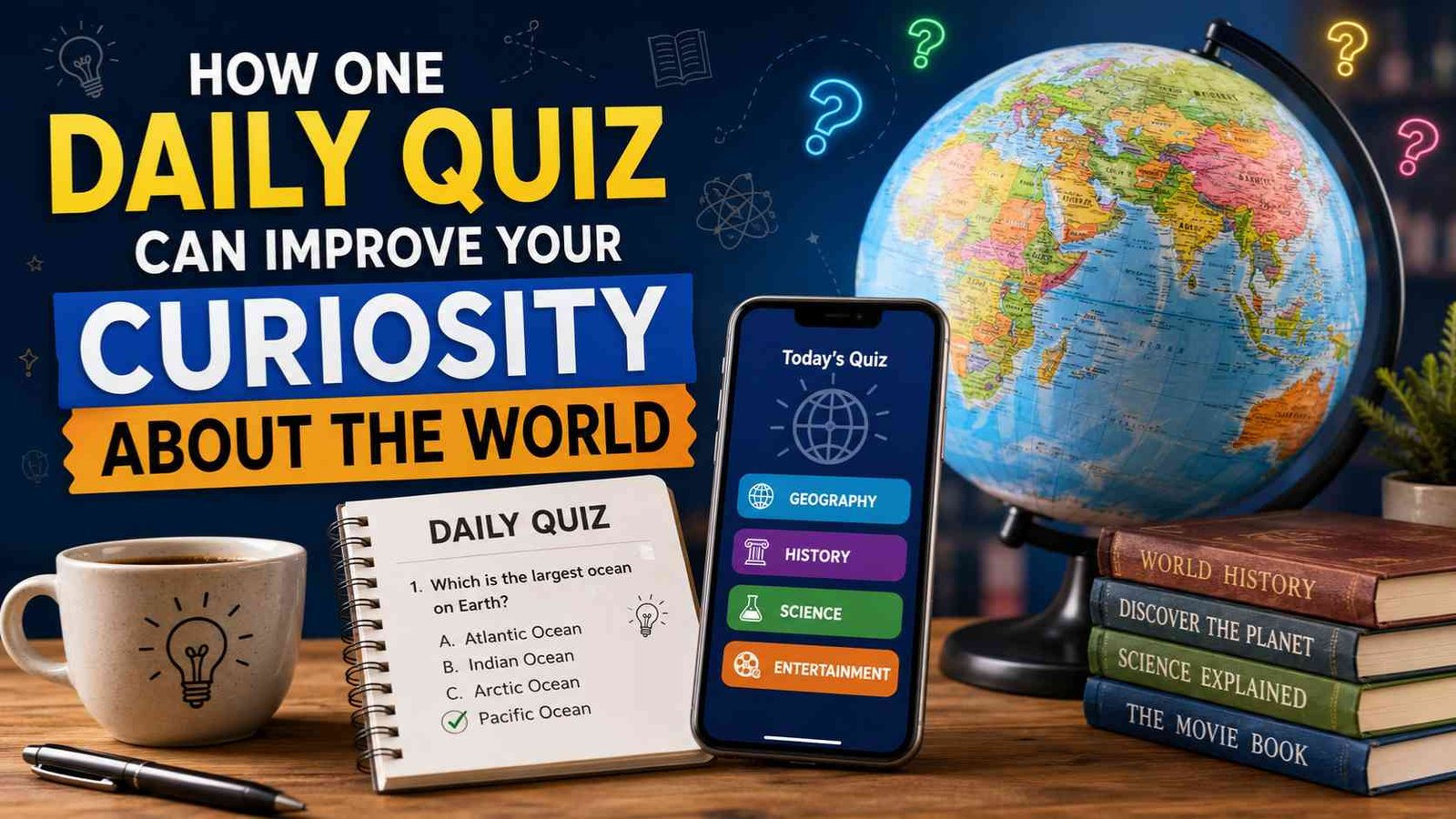
Question: Which ocean is the largest in the world?
Answer: Pacific Ocean.
Explanation: The Pacific Ocean is the largest and deepest ocean, covering more area than all land on Earth combined.
That extra sentence turns a bare answer into a memorable fact.
It gives the brain something to hold.
How to Use One Daily Quiz to Become More Curious
You do not need a complicated system. Keep it simple.
1. Take the Quiz at the Same Time Each Day
Choose a daily rhythm.
Morning coffee. Lunch break. Before dinner. After work. Before bed.
When the quiz becomes part of your routine, you are more likely to continue.
2. Do Not Rush Every Question
It is tempting to click fast. But try pausing for a few seconds.
Read the question carefully. Look at every answer choice. Ask yourself what you already know.
That short pause turns the quiz into a thinking exercise.
3. Pay Attention to Wrong Answers
Wrong answers are not wasted.
They show you where curiosity can begin.
When you miss a question, ask:
“What made me choose the wrong answer?”
“What is the correct fact?”
“What else do I want to know about this?”
This makes the quiz more educational.
4. Save Interesting Facts
Keep a small note on your phone or computer called “Things I Learned.”
Add one fact from your daily quiz.
Not ten. Just one.
After a month, you will have around 30 facts. After a year, hundreds.
That is a quiet but powerful knowledge bank.
5. Follow One Question Further
You do not have to research every answer. That would turn a fun habit into a chore.
Instead, choose one question that catches your attention.
Maybe it is about a country, a movie, a historical figure, an invention, or an animal.
Search it. Read a short article. Watch a quick video. Look at a map.
Let curiosity breathe a little.
Examples of Daily Quiz Questions That Can Spark Curiosity
Here are a few simple examples:
Geography
Which country has the most islands?
This can lead to questions about coastlines, maps, travel, and how countries count islands.
Science
What gas do plants absorb during photosynthesis?
This can lead to curiosity about oxygen, climate, forests, and how plants support life.
History
Who was the first president of the United States?
This can lead to early American history, revolutions, leadership, and how governments form.
Entertainment
Which film won Best Picture at the Academy Awards in a certain year?
This can lead to film history, directors, actors, culture, and storytelling.
Sports
Which country has won the most FIFA World Cup titles?
This can lead to sports history, national pride, famous players, and global competitions.
A quiz question is rarely just a question. It is often a tiny invitation.
Why Curiosity Makes Learning Feel Less Forced
People learn better when they care.
That is the problem with forced learning. The brain resists it. It feels like work, pressure, or obligation.
Curiosity softens that resistance.
When you are curious, learning feels personal. You are not just memorizing because someone told you to. You are following a question that matters to you in that moment.
Daily quizzes are helpful because they create many small chances for that feeling to happen.
Some questions will be boring. That is normal. Not every fact will light up your brain.
But one question might.
And sometimes one question is enough.
Daily Quizzes Can Make You a Better Conversationalist
Here is an underrated benefit: quizzes give you things to talk about.
A curious person is often easier to talk to because they have little facts, questions, and observations ready.
You might say:
“I learned today that…”
“Did you know…”
“I got this quiz question wrong, but the answer surprised me…”
“I never realized that country was so large…”
These small pieces of knowledge can make conversations more lively.
You do not have to sound like a walking encyclopedia. Please do not. Nobody wants to be trapped beside a human documentary with no pause button.
But having interesting facts in your pocket can make everyday conversations richer.
Daily Quizzes Help Kids and Adults Learn Together
A daily quiz can also become a family activity.
Parents can ask kids questions. Kids can challenge adults. Friends can compare scores. Couples can play together. Even grandparents can join in.
This works because quizzes are flexible. They can be serious or silly. Easy or hard. Competitive or relaxed.
More importantly, they create shared curiosity.
When someone asks, “Why is that the answer?” the learning becomes social. People explain, laugh, guess, and remember together.
That kind of learning often sticks.
What Makes a Daily Quiz Worth Returning To?
Not all quizzes are equal.
A good daily quiz should feel fresh, fair, and interesting.
Look for quizzes that offer:
✅ Clear questions
✅ Accurate answers
✅ A mix of subjects
✅ Short explanations
✅ Mobile-friendly design
✅ Updated content
✅ A fun but not confusing layout
Avoid quizzes that rely too much on trick questions, misleading wording, or low-quality facts. A quiz should challenge your mind, not annoy it.
Can One Daily Quiz Really Change How You See the World?
Yes, but not in a dramatic movie-trailer way.
You will not answer ten questions today and suddenly understand every major world issue by breakfast.
But over time, something changes.
You notice more.
You ask more.
You connect more.
You become less intimidated by unfamiliar topics.
You begin to enjoy finding out what you do not know.
That is the real value.
A daily quiz does not just fill your head with facts. At its best, it trains your attention.
And attention is where curiosity begins.
Common Mistakes to Avoid
Treating the Quiz Only as a Score
Scores are fun, but they are not the whole point.
A low score can still teach you a lot. A perfect score can still lead to new questions.
Use the score as feedback, not as your identity.
Skipping the Explanations
The explanation is often where the real learning happens.
Do not just check whether you were right. Read why the answer is correct.
Taking the Same Type of Quiz Every Day
Variety matters.
Try mixing topics: science one day, geography the next, entertainment after that, then history, sports, or general knowledge.
A wider mix builds wider curiosity.
Giving Up After a Hard Quiz
Hard questions are not a sign that you are bad at learning.
They are signs that there is more to discover.
That is the whole point.
FAQs About Daily Quizzes and Curiosity
1. Can a daily quiz really help me learn?
Yes. A daily quiz can help you practice recall, discover new facts, and notice what you do not know yet. It works best when you read the explanations and review the questions you missed.
2. How long should a daily quiz be?
A good daily quiz can be short. Even 5 to 10 questions can be useful if the questions are interesting and the answers include helpful explanations.
3. Are general knowledge quizzes good for curiosity?
Yes. General knowledge quizzes are especially good for curiosity because they cover many topics. They can introduce you to history, science, geography, culture, entertainment, and current events in one quick activity.
4. Should I focus on getting a perfect score?
Not always. A perfect score feels good, but learning often happens when you miss a question and discover something new. The goal is not only to win. The goal is to stay curious.
Final Thoughts
One daily quiz is a small habit, but it can open a surprisingly large window.
It helps you test what you know, notice what you do not know, and explore facts you might have ignored otherwise. It turns learning into a quick daily moment instead of a heavy task.
Some days, you will remember the answers easily. Other days, the quiz will humble you in under two minutes. That is part of the charm.
The real win is not just a higher score.
The real win is this: you start looking at the world with more questions.
And once you begin asking better questions, the world becomes much harder to ignore.
Author

Robert creates quizzes grounded in real-life issues and clear sourcing. He has moderated online communities, where he verified facts and kept discussions balanced. He’s preparing to apply for a Social Work degree in the UK (the University of Edinburgh is on his list; no current affiliation). His work uses transparent citations and original writing with proper attribution, and updates or corrections are noted when needed. Off the page, he volunteers at a local food bank and hikes long-distance trails.