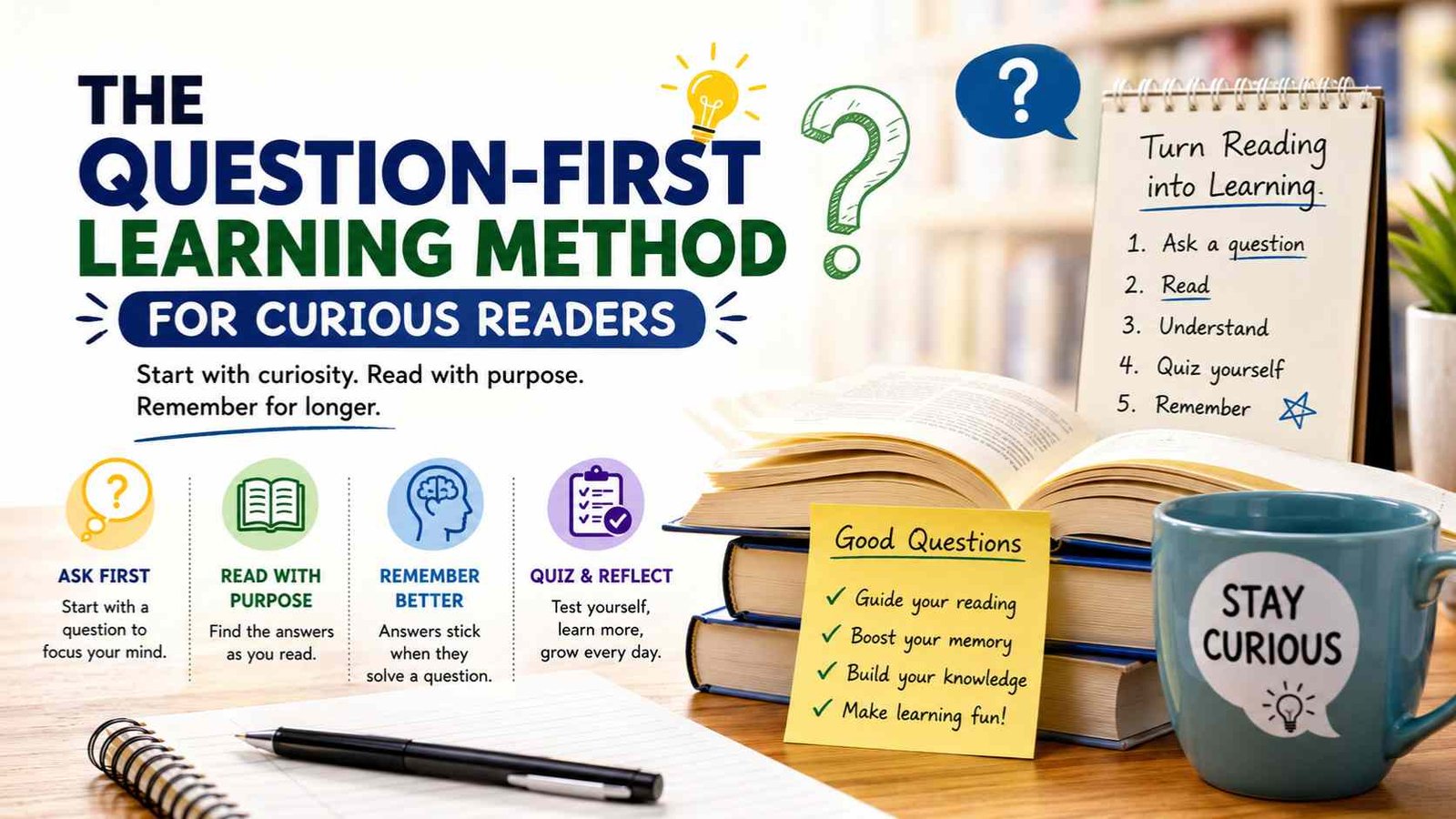
Most people read first and ask questions later. That works sometimes, but it is not always the best way to learn. A curious reader often learns better by flipping the order: ask first, read second.
That is the idea behind question-first learning.
Instead of opening an article, book, or quiz page with a blank mind, you begin with a question. What am I trying to find out? What do I already know? What do I want to remember? That simple shift changes the way your brain pays attention.
It turns reading from passive scrolling into active searching. And for quiz lovers, students, trivia fans, and everyday learners, that can make a big difference.
What Is Question-First Learning?
Question-first learning is a simple method where you begin with questions before reading or studying. The question gives your mind a target.
For example, instead of reading an article about volcanoes with no clear purpose, you might start with:
“What causes a volcano to erupt?”
Now your brain knows what to watch for. You are not just reading words. You are hunting for an answer.
That is why this method works so well for curious readers. Curiosity naturally begins with a question. When you give that question a clear place in your learning routine, reading becomes more focused and memorable.
Why Starting With Questions Helps You Learn Better
Questions wake up attention.
When you start with a question, your brain becomes more alert to useful details. You begin sorting information automatically. Some facts feel important. Others become background. This helps reduce the “I read it, but I forgot everything” problem.
Question-first learning also supports memory improvement because it gives new information something to attach to. A fact is easier to remember when it answers something you were already wondering about.
For example:
Question: “Why is the capital of Australia not Sydney?”
Answer: Canberra was chosen as a compromise between Sydney and Melbourne.
That answer is more memorable because it solves a small mystery. Your brain likes that. It is a tiny “aha” moment, and those moments stick.
How This Method Connects to Quiz Learning
Quizzes are a natural form of question-first learning.
A quiz question appears before the explanation. You think. You guess. You search your memory. Then you see the answer and learn from it. That small cycle is powerful because it combines curiosity, focus, recall, and feedback.
This is why educational quizzes can be more than entertainment. A good quiz does not only ask, “Do you know this?” It also helps you notice what you almost know, what you misunderstood, and what you want to learn next.
You can try this approach with daily quiz practice, such as the Bing Homepage Quiz guide, where general knowledge questions can help turn casual curiosity into a regular learning habit. For lighter topics, pop culture, movies, celebrities, and shows, the Bing Entertainment Quiz practice page can make learning feel more playful while still building recall.
How to Use Questions Before Reading
Before you read anything, pause for a few seconds and ask one or two questions. They do not have to be brilliant. They only need to give your attention a direction.
Ask What You Want to Find Out
Start with a simple “what,” “why,” or “how” question.
Examples:
“What is the main idea of this topic?”
“Why does this matter?”
“How can I explain this to someone else?”
“What fact here would make a good quiz question?”
This works for history, science, geography, entertainment, Bible study, finance, health topics, and almost any kind of reading.
Turn the Title Into a Question
A title can often become your first learning question.
If the title is “Why Daily Quizzes Improve Memory,” you can ask:
“How do daily quizzes improve memory?”
Now you are reading with a purpose. You are not just passing through the article. You are looking for the answer.
Predict Before You Read
Make a quick guess before you begin.
This is not about being right. It is about waking up your mind.
For example, before reading about the deepest part of the ocean, ask yourself, “Where do I think it is?” Then read to confirm or correct your guess. When your prediction is wrong, the correct answer often becomes more memorable.
How to Use Questions During Reading
Question-first learning does not stop once the reading begins. While you read, keep asking small questions that help you stay active.
Ask, “What Is This Paragraph Really Saying?”
Some paragraphs look simple but carry an important point. After reading a section, pause and ask:
“What is the main idea here?”
If you cannot answer, reread the paragraph. Not because you failed, but because your brain is telling you the idea did not land yet.
Ask, “What Surprised Me?”
Surprise is a memory hook.
Maybe you learned that bananas are berries, or that some countries have more than one capital, or that a famous quote is often misattributed. When something surprises you, stop and notice it. That detail may become the easiest part to remember later.
Ask, “Can This Become a Quiz Question?”
This is a useful trick for quiz learners. As you read, look for facts that could become multiple-choice questions.
For example:
Fact: The Nile River is often listed among the longest rivers in the world.
Quiz question: Which river is often listed among the longest in the world?
When you turn information into a question, you process it more deeply.
How to Use Questions After Reading
After reading, many people simply move on. That is where learning often fades.
A few after-reading questions can help move information from short-term attention into stronger memory.
Ask Yourself What You Remember Without Looking
Close the article or look away from the page. Then ask:
“What are three things I remember?”
This is a simple form of recall practice. It feels harder than rereading, but it is usually better for memory.
Ask What You Still Do Not Understand
This is where real learning begins.
A good learner does not only collect answers. A good learner notices the next question.
Maybe you understood what a black hole is, but now you wonder how scientists detect one. Maybe you learned the capital of a country, but now you want to know why that city became the capital. One answer can open the door to another question.
Ask How You Would Explain It Simply
If you can explain something in simple words, you probably understand it better than you think.
Try this:
“How would I explain this to a younger reader?”
“How would I turn this into a short quiz explanation?”
“What example would make this clearer?”
This works especially well for general knowledge topics because they often involve facts that become stronger when connected to stories, places, people, or real-life examples.
Practical Ways to Build a Question-First Learning Habit
You do not need a complicated system. A small routine is enough.
1. Start Every Reading Session With One Question
Before opening an article, quiz, or study page, write or think of one question. This gives your reading a purpose.
Example: “What is the most useful thing I can learn from this page?”
2. Use Daily Quizzes as Warm-Ups
A short quiz can prepare your brain for learning. It brings old knowledge to the surface and shows you what you want to understand better.
That is why daily quizzes can be helpful. They create a repeatable habit. You answer, check, learn, and move on a little smarter than before.
3. Keep a “Question Bank”
Instead of only saving facts, save questions.
For example:
“Why do we have leap years?”
“What makes a planet different from a dwarf planet?”
“Why are some countries landlocked?”
“How do search engines decide what to show first?”
A question bank is useful because it keeps curiosity alive. It also gives you future ideas for reading, quizzes, blog posts, or study sessions.
4. Review Missed Quiz Questions
Wrong answers are not wasted. They are signals.
When you miss a quiz question, ask:
“Why did I choose the wrong answer?”
“What clue did I miss?”
“What fact should I remember next time?”
This turns a mistake into a learning moment.
5. Pair Questions With Short Explanations
Questions are powerful, but they should not stand alone forever. The best learning happens when a question is followed by a clear explanation.
For example, do not only memorize that Ottawa is the capital of Canada. Add a short note about its location, history, or why people often confuse it with Toronto or Vancouver. That extra context makes the answer easier to keep.
Why Curious Readers Benefit Most From This Method
Curious readers do not only want to finish pages. They want to understand things.
Question-first learning fits that mindset because it gives curiosity a structure. It says, “Start with what you wonder about. Then use reading to satisfy that curiosity.”
This also makes learning feel less heavy. You are not forcing your brain to absorb a wall of information. You are following a trail.
One question leads to one answer. One answer leads to a better question. Over time, this builds knowledge in a natural way.
A Balanced Note: Questions Are Only the Beginning
Questions are useful, but they are not magic by themselves.
A question can open the door, but reading, explanation, reflection, and review help the learning stay. If you only ask questions without checking reliable answers, you may remember guesses instead of facts. If you only take quizzes without reading the explanations, you may repeat the same mistakes.
So the best method is not question only. It is question first.
Start with curiosity. Follow it with reading. Strengthen it with explanation. Lock it in with reflection.
That is where real learning happens.
FAQs About Question-First Learning
1. What does question-first learning mean?
Question-first learning means starting with a question before reading, studying, or taking in new information. The question gives your mind a clear purpose and helps you focus on finding the answer.
2. How does question-first learning improve memory?
It improves memory by making learning more active. When your brain is looking for an answer, the information becomes more meaningful. Facts are easier to remember when they connect to a question you cared about first.
3. Can quizzes help with question-first learning?
Yes. Quizzes are one of the easiest ways to practice question-first learning because they begin with a question, ask you to recall or guess, and then show the correct answer. This makes quiz learning useful for focus, memory, and general knowledge.
4. Is question-first learning good for children and adults?
Yes. Children can use it to stay curious and focused, while adults can use it to learn faster, remember better, and make reading more purposeful. The method is simple enough for beginners but still useful for serious learners.
5. Should I ask questions before or after reading?
Both are helpful. Ask questions before reading to guide your attention. Ask questions during reading to stay engaged. Ask questions after reading to test memory, find gaps, and reflect on what you learned.
Final Thoughts
The question-first learning method is simple, but it changes the way reading feels. Instead of waiting for information to become interesting, you begin with curiosity and let that curiosity guide you.
For quiz websites, this method is especially useful. Every question can become a doorway into better focus, stronger memory, and deeper general knowledge. A good quiz does not just measure what you know. It helps you discover what you want to know next.
Start with one question today. Read with that question in mind. Then check what you remember.
That small habit can turn ordinary reading into active learning.
Author

Sayanara focuses on the “why” behind the news and writes clear, well-sourced explainers. She developed careful verification habits while editing cultural essays, tracing claims back to primary sources. She’s exploring future study in philosophy (UC Berkeley is on her shortlist; no current affiliation). Her work is original, transparently cited, and updated with corrections when needed. Off the page, she coaches a local debate team and plays jazz piano..