Sometimes the biggest lessons do not begin with a big lecture, a thick textbook, or a complicated explanation.
They begin with a small question.
Why does this happen?
What does this remind me of?
Where have I seen this before?
What changes if one detail is different?
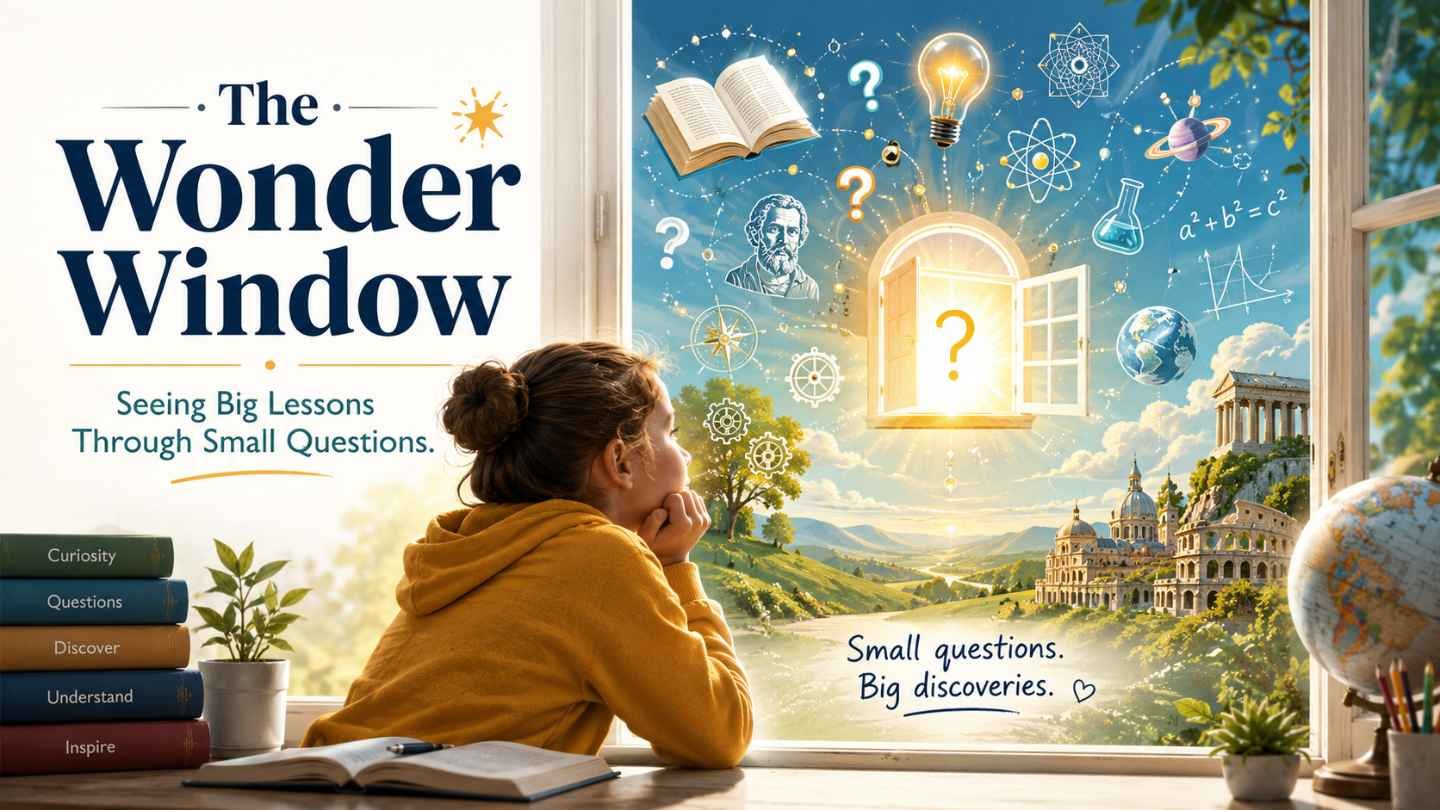
A small question can feel simple at first, but it can open what we might call a Wonder Window—a clear little opening into a much larger idea. Through that window, learners begin to notice patterns, make connections, and understand lessons in a deeper way.
The Wonder Window is the habit of using small questions to see bigger meaning.
It is not about asking random questions just to sound curious. It is about paying attention. It is about noticing one detail and letting that detail lead you somewhere useful.
What Is the Wonder Window?
The Wonder Window is a learning approach built around one simple idea:
Small questions can reveal big lessons.
A learner may begin with something tiny, like a word in a story, a date in history, a mistake in math, a clue in a quiz, or a pattern in science. Instead of rushing past it, the learner pauses and asks a question.
That question becomes the window.
Through it, the learner sees more than the surface fact. They begin to see relationships, reasons, causes, effects, similarities, and hidden meanings.
For example, a student reading about weather might ask, “Why do some places get more rain than others?” That small question can open a larger lesson about climate, geography, mountains, oceans, wind, and seasons.
One small question becomes a doorway into a wider subject.
Why Small Questions Matter in Learning
Small questions matter because they make learning active.
When learners only receive information, they may remember a few facts for a short time. But when they ask questions, they begin to interact with the lesson. They search for meaning instead of just collecting answers.
That shift is powerful.
A small question helps the brain slow down and look more carefully. It encourages learners to compare, test, connect, and explain. These actions make lessons easier to remember because the learner is no longer just hearing information. They are building understanding.
This is why quizzes can be useful when they are used well. A quiz question does more than test memory. It can spark curiosity. A learner who misses an answer may ask, “Why was that wrong?” or “What clue did I miss?” That moment can become a Wonder Window.
For learners who enjoy online quiz practice, resources like the ultimate guide to Bing Homepage Quiz can help turn simple questions into daily opportunities for discovery.
The Power of Curiosity
Curiosity is the engine behind the Wonder Window.
Without curiosity, a question feels like a task. With curiosity, a question becomes an invitation.
A curious learner does not stop at “What is the answer?” They also ask:
What does this mean?
Why does it work this way?
How is this connected to something else?
What can this teach me beyond the question itself?
This type of curiosity makes learning feel less like memorizing and more like exploring.
Think about a child looking at the moon and asking, “Why does it change shape?” That small question can lead to lessons about light, orbit, phases, shadows, calendars, tides, and even history. One simple question opens many paths.
That is the Wonder Window in action.
Observation: The Skill Behind Better Questions
Good questions often begin with good observation.
Before learners ask better questions, they need to notice better details.
In reading, that might mean noticing a repeated word.
In history, it might mean noticing that two events happened close together.
In science, it might mean noticing a pattern in results.
In math, it might mean noticing where an error keeps happening.
In daily life, it might mean noticing how one habit affects another.
Observation gives curiosity something to work with.
A learner who observes carefully might see that a plant near the window grows faster than one in a darker corner. That simple observation can lead to questions about sunlight, photosynthesis, temperature, water, and plant growth.
The lesson becomes more meaningful because it began with something real and visible.
How Small Questions Help Learners Notice Patterns
Patterns are one of the most important parts of deep learning.
A fact by itself can feel isolated. But when learners notice patterns, facts begin to connect.
For example, a learner studying history might ask, “Why do revolutions often happen after economic pressure?” That question can help them compare different countries, time periods, leaders, and public movements.
A learner studying language might ask, “Why do these words sound similar?” That can lead to lessons about root words, prefixes, word families, and language history.
A learner studying current events through a news quiz platform might notice that many headlines connect to larger themes like technology, elections, climate, economy, or culture. A single quiz question can become a window into the bigger story behind the news.
Small questions help learners see that knowledge is rarely random. It usually has structure.
Making Connections Between Lessons
One of the best signs of real understanding is connection.
When a learner can connect a new idea to something they already know, the lesson becomes stronger.
For example:
A science lesson about ecosystems can connect to food supply.
A math lesson about percentages can connect to shopping discounts.
A history lesson about trade routes can connect to modern shipping.
A grammar lesson about sentence structure can connect to better writing.
A quiz question about a landmark can connect to geography, culture, and architecture.
The Wonder Window works because small questions naturally lead to connections.
A learner may begin by asking, “Where is this place?” Then they may ask, “Why is it famous?” Then, “What happened there?” Then, “How did it affect people?” Each question widens the view.
The window gets bigger.
Practical Examples of the Wonder Window
In Reading
A student reads a story and notices that the main character keeps avoiding difficult conversations.
Small question:
Why does the character avoid telling the truth?
Bigger lesson:
This can lead to ideas about fear, conflict, honesty, character development, and consequences.
In Math
A learner gets the wrong answer on a fraction problem.
Small question:
Where exactly did my thinking go off track?
Bigger lesson:
This can reveal a misunderstanding about denominators, equivalent fractions, or simplifying answers.
In Science
A learner sees water droplets on the outside of a cold glass.
Small question:
Where did the water come from?
Bigger lesson:
This opens a lesson about condensation, temperature, humidity, and states of matter.
In History
A student learns about a war, treaty, or revolution.
Small question:
What problem were people trying to solve?
Bigger lesson:
This can lead to discussions about power, resources, leadership, economics, rights, and social change.
In Daily Life
Someone notices they focus better after walking outside.
Small question:
Why does movement help me think more clearly?
Bigger lesson:
This can connect to health, attention, stress, energy, and learning habits.
Simple Follow-Up Questions That Open Bigger Ideas
The first question opens the window. Follow-up questions widen it.
Here are simple follow-up questions learners can use almost anywhere:
Why does this matter?
This helps move from fact to meaning.
What caused this?
This helps learners look for reasons instead of memorizing outcomes.
What changed?
This helps reveal patterns, turning points, and progress.
What is connected to this?
This helps learners link one lesson to another.
What example can I think of?
This makes abstract ideas more concrete.
What would happen if one detail changed?
This builds flexible thinking and deeper understanding.
These questions are small, but they are powerful. They teach learners how to look beyond the obvious.
How to Use the Wonder Window in Five Minutes
You do not need a long study session to use this method. Five minutes is enough.
Step 1: Choose One Small Detail
Pick one fact, word, image, question, mistake, headline, example, or idea.
Step 2: Ask One Honest Question
Ask something simple. Do not worry if it sounds basic. Basic questions often lead to the best learning.
Step 3: Look for One Connection
Connect the detail to another subject, memory, example, or real-life situation.
Step 4: Ask One Follow-Up
Use a question like “Why does this matter?” or “What caused this?”
Step 5: Say the Bigger Lesson in One Sentence
End by summarizing what the small question helped you understand.
For example:
Small detail: A quiz question about volcanoes
Small question: Why do volcanoes form in certain places?
Connection: Earth’s plates move under the surface
Bigger lesson: Volcanoes are connected to plate boundaries, pressure, and Earth’s changing structure.
That is a full Wonder Window moment in only a few minutes.
Common Mistakes to Avoid
Asking Too Many Questions at Once
Curiosity is good, but too many questions can become confusing. Start with one clear question. Let it lead naturally to the next.
Looking Only for Quick Answers
The goal is not just to find an answer fast. The goal is to understand what the answer teaches.
Ignoring Small Details
Many learners skip small details because they seem unimportant. But small details often reveal the pattern behind the lesson.
Treating Mistakes as Failure
A mistake can be one of the best Wonder Windows. It shows where your thinking needs attention.
Forgetting to Connect the Lesson
A question becomes more useful when it connects to something else. Always ask, “What does this remind me of?” or “Where else does this idea appear?”
Why the Wonder Window Builds Deeper Understanding
The Wonder Window works because it changes how learners approach knowledge.
Instead of seeing lessons as separate facts, learners begin to see them as connected ideas. Instead of rushing toward the answer, they pay attention to the path. Instead of feeling overwhelmed by a big subject, they enter through one small question.
This makes learning feel more manageable.
A big topic can be intimidating. But a small question gives the learner a place to begin.
That beginning matters.
One small question can turn confusion into curiosity. Curiosity can turn into investigation. Investigation can turn into understanding. Understanding can turn into confidence.
Final Thoughts
The Wonder Window reminds us that learning does not always begin with something big.
Sometimes it begins with a tiny question that refuses to be ignored.
Why did that happen?
How does this connect?
What does this reveal?
What else can I learn from this?
When learners ask small questions with curiosity and attention, ordinary moments become meaningful. A quiz answer, a sentence, a mistake, a picture, a pattern, or a simple observation can open a larger lesson.
That is the beauty of the Wonder Window.
It teaches us that big understanding often begins with the courage to ask something small.
FAQ
What is the Wonder Window?
The Wonder Window is a learning method that uses small questions to uncover bigger ideas, patterns, and connections.
Why are small questions important?
Small questions make learning active. They help learners slow down, notice details, think more clearly, and understand lessons more deeply.
Can this method help with school subjects?
Yes. It can help with reading, math, science, history, language learning, quizzes, and self-study because it encourages learners to ask thoughtful questions.
How can I start using the Wonder Window?
Choose one small detail from a lesson and ask one simple question about it. Then look for a connection and summarize the bigger lesson you discovered.
Is curiosity more important than memorization?
Both can matter, but curiosity often makes memory stronger. When learners understand why something matters, they are more likely to remember it.
Author

John turns financial data into clear, factual stories. He holds a degree in Accountancy and spent several audit seasons reconciling ledgers and verifying documentation. He studies business cases and is exploring future graduate study in management (MIT is one of the schools he’s considering; no current affiliation). Every piece is concise, well-sourced, and fact-checked, with prompt corrections when needed. Off the clock, he teaches budgeting to local teens and restores vintage bikes.